
Amm Clob Intent Dex Settlement
Concentrated Liquidity AMMs, On-Chain CLOBs, Intent Solvers & MEV Microstructure: 2026 Guide
Modern decentralized exchange settlement splits across concentrated liquidity AMMs, intent-based solver batch auctions, and high-throughput app-chain CLOBs to minimize LVR and MEV.
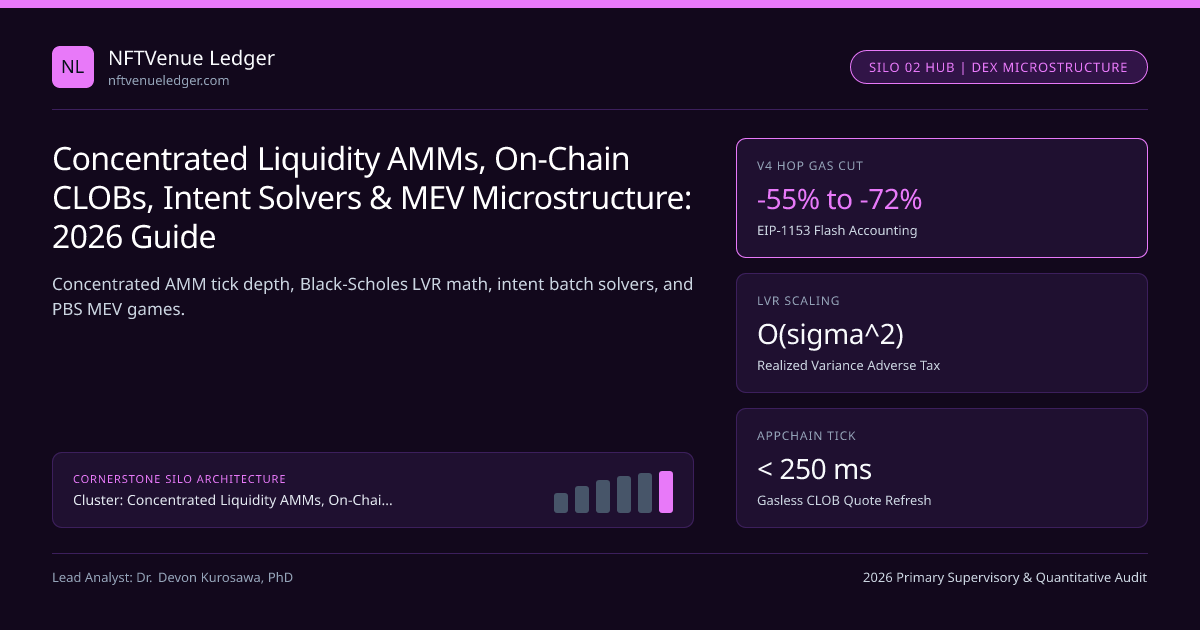
Decentralized exchange (DEX) settlement has fractured into four competing microstructure paradigms: concentrated-liquidity Automated Market Makers governed by the Concentrated Liquidity AMM specification, hook-programmable singletons led by the Uniswap v4 singleton architecture, off-chain signed-order intent auctions such as CoW Protocol batch auctions, and deterministic sub-second App-Chain CLOB protocols. Institutional liquidity providers and execution quants no longer evaluate venues on headline total value locked alone; execution quality is measured in basis points of Loss-Versus-Rebalancing (LVR), toxic CEX-DEX markout decay, and MEV sandwich leakage across the MEV-Boost PBS framework.
Across spot, multi-asset perpetual, and NFT liquidity venues tracked in our global marketplaces directory and AMM, CLOB & Intent DEX hub, matching-engine topology directly determines whether passive LPs earn positive net spread over risk-free rates or subsidize latency arbitrageurs.
Concentrated Liquidity Invariants, Tick Spacing & LVR Adverse Selection#
Constant-product x * y = k pools spread liquidity uniformly from 0 to infinity, leaving over 95% of capital idle on tightly correlated pairs. Concentrated liquidity partitions price space into discrete logarithmic ticks p(i) = 1.0001^i, letting LPs bound capital within [P_a, P_b]—a mechanism we formalize in Uniswap v3 tick spacing & concentrated liquidity depth. Yet higher capital efficiency magnifies gamma exposure: whenever external CEX reference prices jump across ticks, block-top arbitrageurs trade against stale on-chain pool quotes, extracting instantaneous LVR = (sigma^2 / 2) * P * |d^2V / dP^2| dissected in Loss-Versus-Rebalancing Black-Scholes adverse selection.
Next-generation singleton contracts eliminate multi-hop ERC-20 transfer overhead via EIP-1153 transient storage and inject dynamic volatility-scaled fees or auction-managed hooks—analyzed in Uniswap v4 singleton flash accounting & dynamic hooks and auction-managed AMM (am-AMM) hook fee capture.
Intent-Based Batch Auctions & Exclusive Dutch-Decay Fillers#
Routing market orders directly into public EVM mempools exposes swappers to frontrun-backrun sandwich bundles—quantified in sandwich MEV slippage & optimal frontrun sizing—while passive LPs suffer intra-block fee dilution examined in JIT liquidity mint-burn fee dilution. Intent architectures invert this vulnerability by outsourcing pathfinding and gas execution to bonded professional solvers:
- Uniform Clearing Price Batch Auctions: Bonded solvers aggregate coinciding opposing wants ("Coincidence of Wants") and private market-maker inventory into a single batch clearing vector, unpacked in CoW Protocol uniform clearing batch solvers.
- Dutch-Decay RFQ & Cross-Chain Intents: Signed EIP-712 orders parameterize a monotonically decaying limit price from an RFQ quote floor down to an AMM reserve backstop, extended across L2 rollups via standardized escrow contracts—covered in UniswapX Dutch-decay filler auctions and ERC-7683 cross-chain intent escrows.
Microstructure Comparison Matrix Across DEX Execution Venues#
Venues cataloged in our marketplaces directory—including weighted pool DEX Beethoven X, multi-pool router Astroport, concentrated DEX 9mm Pro, and order-book hybrid Alcor—exhibit sharp trade-offs across latency, adverse selection, and gas efficiency:
| Execution Architecture | Representative Venues / Standards | Maker Adverse Selection (LVR) | Taker Sandwich Exposure | Settlement Gas Footprint |
|---|---|---|---|---|
| Concentrated Liquidity AMM | 9mm Pro, Uniswap v3 Spec | High on passive static ticks (sigma^2 / 2 scaling) | High on public RPC; mitigated via private RPC | ~105k–145k gas single hop (L1/L2) |
| Singleton Hook AMM | Uniswap v4 Singleton | Moderated via dynamic volatility & am-AMM hooks | Configurable via async/TWAMM or RFQ hooks | ~58k–78k per hop via EIP-1153 TSTORE |
| Batch / Dutch Intent DEX | CoW Batch Auction, UniswapX | Zero passive pool required for CoW/RFQ fills | Near-zero (gasless signed intents + tight clearing) | Amortized across batch; free on failed fills |
| Enshrined App-Chain CLOB | App-Chain CLOB, Alcor | Zero stale-quote tax (free sub-second cancels) | Validator/sequencer FBA or encrypted mempool | Zero gas on order place/cancel; bps fill fee |
| Multi-Asset / Weighted Pools | Beethoven X, GMX Pool | Oracle-priced zero-impact or multi-token index | Bounded by pull-oracle confidence bands | ~160k–280k gas including keeper callback |
Unified Net LP Profitability vs Taker Execution Cost Equation#
Institutional market makers allocating inventory across an on-chain concentrated AMM range versus quoting via an off-chain RFQ/CLOB book evaluate net annualized spread capture after subtracting instantaneous LVR and gas rebalancing friction:
- GrossFeeYield = (fpool * Volumeinrange) / Capitaldeployed
- DailyLVRDrag = (sigmadaily^2 / 8) * (sqrt(Pupper / Plower) / (sqrt(Pupper / P_lower) - 1))
- NetLPEdge = GrossFeeYield - DailyLVRDrag - (Nrebalances * GasCost / Capital_deployed)
- Worked ETH/USDC 5 bps Pool Stress Test (Capital = USD 1,000,000; Range = +/- 4.0% => sqrt(Pu/Pl) = 1.0408):
- Concentration Multiplier = 1.0408 / 0.0408 = 25.51x vs full-range x*y=k
- Assume Daily VolumeperTVLinrange = 3.2x => GrossFeeYield = 0.0005 * 3.2 = 0.00160 (16.0 bps/day)
- Assume realized daily ETH volatility sigma_daily = 3.8% (0.038):
- => DailyLVRDrag = (0.001444 / 8) * 25.51 = 0.00460 (46.0 bps/day LVR loss!)
- => NetLPEdge = 16.0 - 46.0 - 0.5 = -30.5 bps/day (-$3,050/day without dynamic hooks or hedges!)
Block Building, Sequencer Ordering & Specialized Curve Mechanics#
Execution outcomes ultimately depend on consensus-layer transaction ordering. On Ethereum Layer 1, searchers and builders compete inside the MEV-Boost PBS relay timing games and capture non-atomic CEX-DEX block-time markout arbitrage. On rollups and high-throughput Layer 1s, ordering shifts to L2 sequencer FCFS vs Timeboost auctions, EIP-4844 blob fee spike liquidation latency, Solana Jito bundles & local fee markets, and app-chain CLOB maker rebates.
Finally, specialized asset classes replace constant-product curves with domain-specific invariants: Balancer weighted & LBP token discovery curves (Balancer LBP standard), Curve StableSwap amplification convexity, multi-asset GLP/GM perpetual funding pools, and SudoAMM linear/exponential NFT bonding curves—cross-verifiable via our protocol benchmarks and regulatory frameworks.
Frequently asked questions
Why do passive Uniswap v3 liquidity providers lose money during high-volatility regimes?
Concentrated liquidity positions are short gamma: whenever external CEX prices move, arbitrageurs buy underpriced tokens from the pool at stale block-boundary quotes, generating Loss-Versus-Rebalancing (LVR) proportional to variance sigma^2.
How do intent-based DEXs like CoW Protocol and UniswapX prevent sandwich MEV?
Instead of broadcasting an executable AMM swap transaction with loose slippage to the public mempool, users sign gasless EIP-712 price-floor intents settled by bonded solvers via uniform batch clearing or private market-maker inventory.
What is flash accounting in the Uniswap v4 singleton smart contract?
Uniswap v4 holds all pools inside a single PoolManager contract and tracks net currency deltas in EIP-1153 transient storage (TSTORE/TLOAD), executing ERC-20 transfers only once at the outer lock boundary rather than at every intermediate hop.
When does an on-chain CLOB outperform an Automated Market Maker?
On sub-second app-chains or high-throughput rollups with gasless order cancellations, professional market makers refresh limit quotes faster than CEX-DEX arbitrage decay, delivering tighter top-of-book spreads than passive AMM pools.
Publication record
- Published
- November 14, 2026
- Updated
- November 14, 2026
- Author
- Dr. Devon Kurosawa, PhD
- Review
- Review not recorded
- Automated fact check
- Passed in the stored pipeline record
- Source URLs
- 4 recorded
AI assistance recorded: anthropic/claude-opus-4.6. This field does not establish human review or source verification.
Academic & Institutional Attribution
Cite This Research & Embed Live Data Card
Standard academic & institutional research paper citation format.
Dr. Devon Kurosawa, PhD. (2026, November 14). Concentrated Liquidity AMMs, On-Chain CLOBs, Intent Solvers & MEV Microstructure: 2026 Guide. NFTVenue Ledger. https://nftvenueledger.com/protocols/concentrated-liquidity-amm-clob-intent-dex-mev-guide-2026Regulatory Directory Cross-Reference
Referenced Institutions & Regulatory Registries
Top Regulated Institutions in This Coverage Slice
Referenced Supervisory Authorities
Related Amm Clob Intent Dex Settlement & Institutional Briefings
Explore Amm Clob Intent Dex Settlement Hub (20) →Amm Clob Intent Dex Settlement
Uniswap v3 Tick Spacing, Q64.96 Virtual Reserves & Concentrated Liquidity Depth MathAmm Clob Intent Dex Settlement
Loss-Versus-Rebalancing (LVR): Continuous-Time Black-Scholes AMM Adverse SelectionAmm Clob Intent Dex Settlement
Uniswap v4 Singleton PoolManager: EIP-1153 Flash Accounting & Dynamic Fee HooksAmm Clob Intent Dex Settlement
CoW Protocol Uniform Clearing Price Batch Auctions: Solver NP-Hard Optimization & MEV ShieldAmm Clob Intent Dex Settlement
UniswapX Exclusive Dutch-Decay Orders: RFQ Filler Exclusivity & Priority Gas AuctionsAmm Clob Intent Dex Settlement
MEV-Boost Proposer-Builder Separation (PBS): Relay Timing Games & Builder CentralizationAmm Clob Intent Dex Settlement
Just-In-Time (JIT) AMM Liquidity: Intra-Block Mint-Swap-Burn Fee Dilution & LP DefenseAmm Clob Intent Dex Settlement
Sandwich MEV Attacks: Closed-Form Optimal Frontrun Sizing & Slippage Tolerance ExploitationErc721 Erc1155 Eip712 Permit Security
EIP-712 Typed Signatures, Permit2 Allowances, NFT Royalties & Proxy Timelocks: 2026 Security GuideCross Chain Bridge Validator Exploits
Cross-Chain Bridge Verification, Oracle Manipulation & DeFi Exploit Root-Cause Guide (2026)Onchain Wash Trading Market Abuse
MiCA Title VI Market Abuse Surveillance, Wash-Trade Graph Forensics & STOR Guide (2026)Mica Vara VASP Marketplace Licensing
MiCA Article 67 CASP Prudential Safeguards: EUR 50k, 125k & 150k Own-Funds Mechanics
NFTVenue Ledger Data, Benchmarks & Contributor Records
CC BY 4.0 Open Data
Open Institutional Datasets (CSV / JSON) →
Download desk-compiled quantitative series & schemas.
2026 Reference Matrix
2026 Institutional Benchmarks & Thresholds →
Statutory capital, clearing, margin & rate conventions.
Editorial Records
Authors & Review Records →
View named contributors where those records are available.
Complete Index
Master Research & Dossier Archive →
Browse all published briefings by topic pillar & date.