
Amm Clob Intent Dex Settlement
Just-In-Time (JIT) AMM Liquidity: Intra-Block Mint-Swap-Burn Fee Dilution & LP Defense
Just-In-Time (JIT) searchers bracket large public-mempool swaps inside a single MEV-Boost bundle—minting massive 1-tick concentrated liquidity before the swap and burning immediately after.
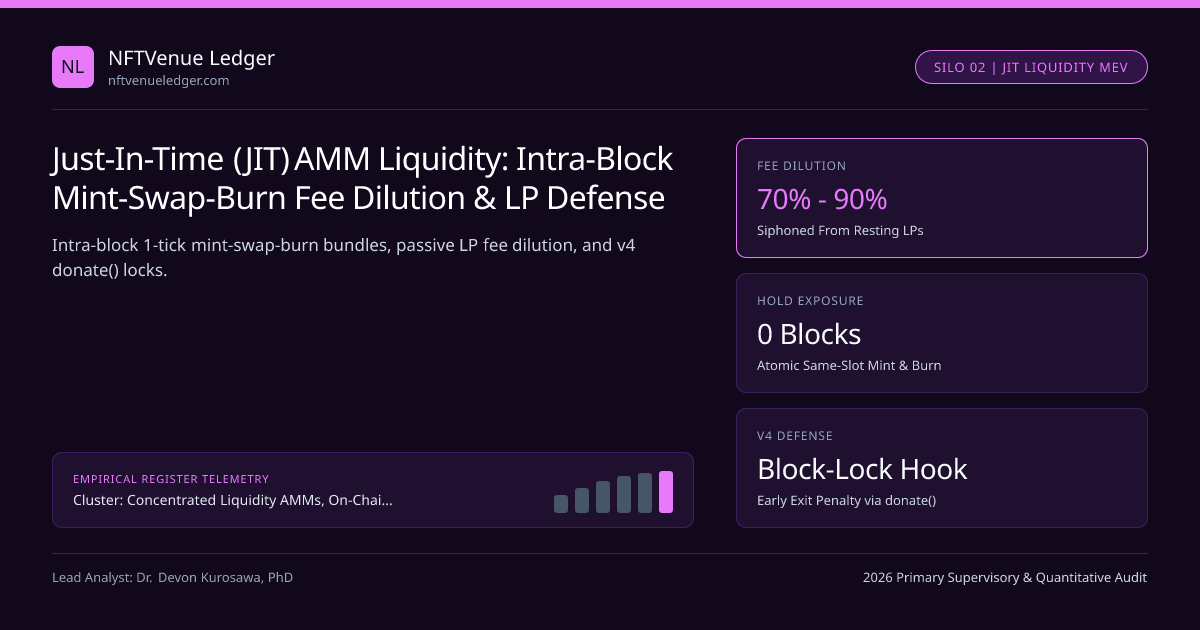
Unlike predatory sandwich attacks that worsen a swapper's fill price, Just-In-Time (JIT) Liquidity improves execution for the incoming taker while parasitically diluting passive Liquidity Providers on Concentrated Liquidity AMMs. When an unprotected whale swap (e.g., 2,500 ETH -> USDC) enters the public mempool or an unguarded router, a JIT searcher constructs an atomic 3-transaction bundle via the MEV-Boost PBS framework: Tx_1 mints $25M+ of liquidity into the single active tickSpacing tick, Tx_2 executes the whale's swap (capturing 70%–90% of the swap fee plus acquiring ETH below CEX bid!), and Tx_3 burns the position in the exact same block while hedging instantly on Binance or Coinbase.
Contextualized within our concentrated AMM, CLOB & intent DEX master guide, JIT liquidity turns an open AMM pool into a permissionless pseudo-RFQ desk—starving passive resting LPs of high-volume noise fee revenue!
Atomic 3-Transaction Bundle Mechanics & Why JIT Is NOT Risk-Free#
A common misconception is that JIT searchers merely farm swap fees f * V_swap. Because Tx_1 supplies USDC and Tx_2 sells ETH into the pool, Tx_3 withdraws much more ETH and much less USDC than deposited! Essentially, a JIT bundle is an on-chain limit order fill:
- Inventory Transformation: If
USDC/ETHpool fee is5 bpsand the JIT searcher capturesalpha = 85%of active tick liquidityL_total = L_passive + L_JIT, the searcher absorbs85%of the whale's soldETHatSpot_Pool * (1 - 0.0005). - Instantaneous CEX Markout Requirement: JIT is profitable only if external CEX bid
P_CEX_bidexceeds the searcher's effective fill price plusTx_1 + Tx_3mint/burn gas and builder priority tips! If the whale swap itself reflects toxic informed flow coinciding with a CEX dump, an unhedged JIT bot loses money—explaining why integrated CEX-DEX builders dominate JIT execution.
Systemic Harm: The Passive LP Adverse-Selection Death Spiral#
If JIT improves taker execution, why do protocol designers on Uniswap v4 singleton pools and concentrated DEXs in our marketplaces directory (such as 9mm Pro and Astroport) build explicit anti-JIT hooks?
Because passive LPs rely on large uninformed ("noise") retail swaps to offset continuous Loss-Versus-Rebalancing on toxic arbitrage blocks! When JIT bots cherry-pick 85% of fees on lucrative $2M+ uninformed swaps while leaving passive LPs 100% exposed on toxic CEX-jump blocks, passive LP net APY turns negative—causing resting LPs to withdraw liquidity and degrading baseline spreads for every small swapper below the JIT gas threshold (<$75,000 on L1).
Welfare & Microstructure Impact Matrix: JIT vs Sandwich vs Resting LP#
| Stakeholder / Metric | Unprotected Sandwich Attack | Atomic JIT Liquidity Bundle | v4 Anti-JIT Time-Weighted Hook |
|---|---|---|---|
| Large Taker ($2M Swap) | Severe loss (pushed to worst slippage limit) | Positive surplus (deepened active tick) | Standard resting-pool depth fill |
| Small Taker ($2k Swap) | Moderately exposed on low-gas L2s | Indirectly harmed as resting LPs exit pool | Tighter resting spreads preserved |
| Passive Resting LPs | Earn extra fee on 2x sandwich volume | Severely diluted (-75%+ fee share on big swaps) | Protected via minimum block-lock / exit tax |
| Required Searcher Capital | Flash-loanable inside single tx! | Often requires real inventory (cannot flash-swap same pool!) | Routed cleanly into formal RFQ / UniswapX |
Optimal JIT Liquidity Sizing (L_JIT*) & Passive Dilution Equation#
Suppose resting passive liquidity in active tick [P_a, P_b] is L_0, incoming whale swap pays gross fee F_gross = f * V_swap, CEX hedge spread edge per filled dollar is e_hedge (can be positive or slightly negative), and capital lock/gas cost is C_fixed + c_cap * L_JIT:
- ShareJIT(LJIT) = LJIT / (L0 + L_JIT)
- PiJIT(LJIT) = ShareJIT(LJIT) * Vswap * (f + ehedge) - ccap * LJIT - Gas_MintBurn
- First-Order Optimal Injection (dPi / dL_JIT = 0):
- LJIT* = max(0, sqrt( (L0 * Vswap * (f + ehedge)) / ccap ) - L0)
- Worked Mainnet 3,000 ETH ($9.0M) Swap on 5 bps ETH/USDC Pool:
- Resting tick depth equivalent = $3.0M (L0 = 3.0); Vswap = $9.0M; f = 5.0 bps; e_hedge = +1.5 bps (CEX bid higher)
- Gross extractable edge Vswap * (f + ehedge) = $9,000,000 * 0.00065 = $5,850; Gas_MintBurn = $140
- With intra-block flash/prop capital cost c_cap = $80 per $1M equivalent:
- => L_JIT* = sqrt((3.0 * 5,850) / 80) - 3.0 = 14.81 - 3.0 = $11.81M equivalent injected!
- => Share_JIT = 11.81 / 14.81 = 79.7% (Passive LPs lose 79.7% of the $4,500 swap fee -> diluted from $4,500 down to $913!)
Uniswap v4 Anti-JIT Hooks: Block-Locks & donate Exit Penalties#
In Uniswap v4 singleton pools, pool creators neutralize 0-block JIT dilution inside beforeRemoveLiquidity: if block.number - lastMintBlock[positionId] < MIN_HOLD_BLOCKS, the hook either reverts or confiscates 100% of accrued fees plus a 10 bps principal haircut via PoolManager.donate straight back to resting in-range LPs! Compare predatory takers' risks next in sandwich MEV optimal frontrun sizing across our AMM, CLOB & Intent DEX hub.
Frequently asked questions
Does Just-In-Time (JIT) liquidity hurt or help the trader whose swap is targeted?
Directly, JIT helps the targeted swapper by temporarily multiplying active-tick liquidity 4x–10x right before execution, reducing price impact; indirectly, chronic JIT drives passive LPs out of pools.
Can a searcher execute JIT liquidity using zero capital via a Uniswap v3 flash swap?
Not from the target pool itself because UniswapV3Pool Slot0.unlocked prevents reentering mint during flash, though searchers borrow inventory free for 1 tx via Aave/Balancer/Maker flash loans and hedge residual delta on CEXs.
Why is JIT liquidity nearly non-existent on Arbitrum and Base compared to Ethereum L1?
JIT requires observing the pending whale swap before block execution; L2 rollups with private single-sequencer mempools do not broadcast pending user calldata publicly prior to sequencing.
How do Uniswap v4 hooks convert JIT attempts into yield for passive LPs?
A JIT-penalty hook tracks the block.number of every modifyLiquidity(+) call and deducts an early-withdrawal fee during same-block modifyLiquidity(-), calling poolManager.donate to credit resting LPs.
Publication record
- Published
- November 14, 2026
- Updated
- November 16, 2026
- Author
- Dr. Devon Kurosawa, PhD
- Review
- Review not recorded
- Automated fact check
- Passed in the stored pipeline record
- Source URLs
- 3 recorded
AI assistance recorded: anthropic/claude-opus-4.6. This field does not establish human review or source verification.
Academic & Institutional Attribution
Cite This Research & Embed Live Data Card
Standard academic & institutional research paper citation format.
Dr. Devon Kurosawa, PhD. (2026, November 16). Just-In-Time (JIT) AMM Liquidity: Intra-Block Mint-Swap-Burn Fee Dilution & LP Defense. NFTVenue Ledger. https://nftvenueledger.com/protocols/jit-just-in-time-liquidity-mint-burn-amm-fee-dilutionRegulatory Directory Cross-Reference
Referenced Institutions & Regulatory Registries
Mentioned Regulated Institutions
Primary Tier-1 Supervisory Registries
Related Amm Clob Intent Dex Settlement & Institutional Briefings
Explore Amm Clob Intent Dex Settlement Hub (20) →Amm Clob Intent Dex Settlement
Concentrated Liquidity AMMs, On-Chain CLOBs, Intent Solvers & MEV Microstructure: 2026 GuideAmm Clob Intent Dex Settlement
Sandwich MEV Attacks: Closed-Form Optimal Frontrun Sizing & Slippage Tolerance ExploitationAmm Clob Intent Dex Settlement
App-Chain On-Chain CLOBs: Enshrined Validator Orderbooks, Cancel Priority & Maker RebatesAmm Clob Intent Dex Settlement
L2 Rollup Sequencer Ordering: Arbitrum Timeboost Express Lanes vs OP-Stack Priority AuctionsAmm Clob Intent Dex Settlement
Solana DEX Microstructure: Sealevel Local Fee Markets, Stake-Weighted QoS & Jito BundlesAmm Clob Intent Dex Settlement
Multi-Asset & Isolated Perpetual Pools (GLP / GM): Skew Funding, Price Impact & OI CapsAmm Clob Intent Dex Settlement
Balancer Weighted Math & Liquidity Bootstrapping Pools (LBPs): Dutch Weight Decay DiscoveryAmm Clob Intent Dex Settlement
Curve StableSwap Amplification Coefficient (A): Newton-Raphson Math & Depeg Convexity CliffsErc721 Erc1155 Eip712 Permit Security
EIP-2535 Diamond Multi-Facet Proxies: Selector Routing, DiamondStorage & Arbitrary DelegatecallErc721 Erc1155 Eip712 Permit Security
TimelockController & Multisig Governance Security: Delay Floors, Signer Ops & Guardian VetoesErc721 Erc1155 Eip712 Permit Security
ERC-1271 Smart-Contract Wallet Signatures: Cross-Safe & Cross-Chain Replay DefenseErc721 Erc1155 Eip712 Permit Security
ERC-4337 Account Abstraction Security: EntryPoint Storage Rules & Paymaster Griefing
NFTVenue Ledger Data, Benchmarks & Contributor Records
CC BY 4.0 Open Data
Open Institutional Datasets (CSV / JSON) →
Download desk-compiled quantitative series & schemas.
2026 Reference Matrix
2026 Institutional Benchmarks & Thresholds →
Statutory capital, clearing, margin & rate conventions.
Editorial Records
Authors & Review Records →
View named contributors where those records are available.
Complete Index
Master Research & Dossier Archive →
Browse all published briefings by topic pillar & date.