
Amm Clob Intent Dex Settlement
Solana DEX Microstructure: Sealevel Local Fee Markets, Stake-Weighted QoS & Jito Bundles
Solana parallel Sealevel runtime requires explicit upfront read/write account locks, isolating hot DEX pool congestion via 12M Compute Unit caps and Jito atomic bundles.
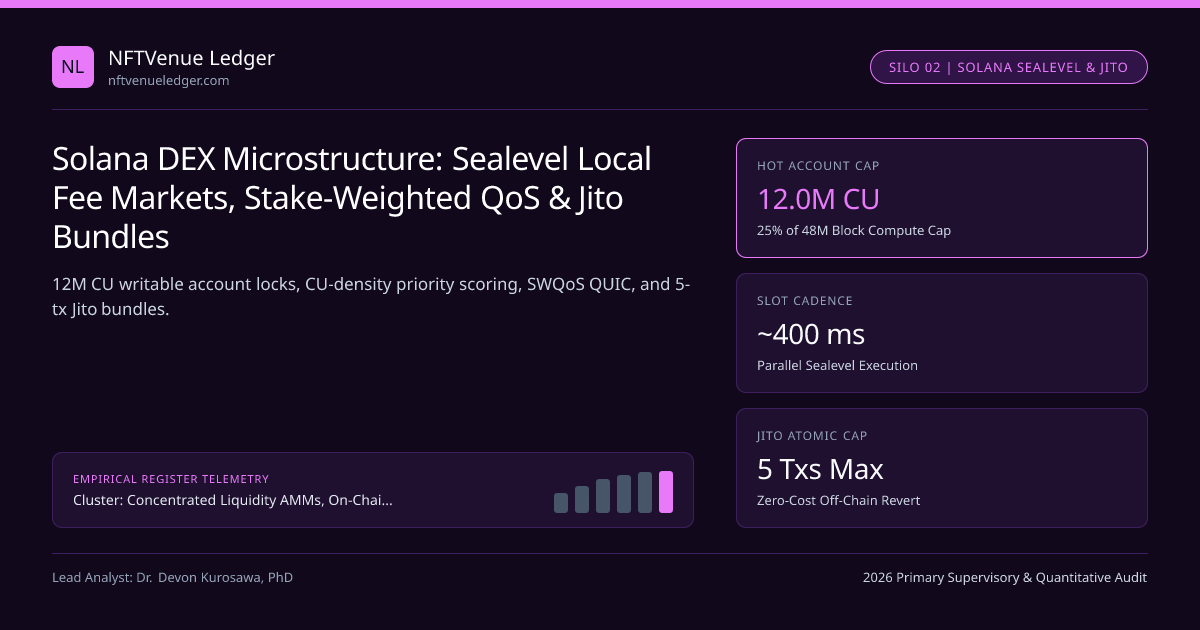
Unlike single-threaded EVM virtual machines where an NFT mint or meme-token frenzy bids up a single global baseFee across the entire chain, Solana's Sealevel parallel runtime requires every transaction header to declare upfront the exact array of AccountMeta public keys it will read vs write. Non-overlapping swaps execute concurrently across multi-core validator threads, while hot accounts—such as a single SOL/USDC Concentrated Liquidity AMM pool or an on-chain Phoenix / OpenBook CLOB state account—are throttled independently by Local Fee Markets capping any single writable account at 12,000,000 Compute Units (25% of the 48,000,000 CU block limit).
Contextualized within our concentrated AMM, CLOB & intent DEX master guide, mastering Solana's scheduler physics (400ms slots, QUIC Stake-Weighted QoS, and Jito Block Engines) is critical for cross-venue arbitrage across ecosystems in our marketplaces directory (comparing Solana parallel DEXs against multi-chain venues like Astroport and Alcor).
Upfront Account Locking, 12M CU Hot-Spot Caps & Scheduler Priority#
Why do transactions targeting a viral new Solana bonding curve pay 50,000x higher priority fees (SetComputeUnitPrice in micro-lamports per CU) while ordinary USDC transfers in the exact same 400ms slot clear for fractions of a cent?
- Per-Account Writable Ceiling (
12M CU / 48M Block CU): Even if 36M CUs of a 48M-CU block sit empty across idle threads, a single pool state account locked aswritablemust execute sequentially on one thread and cannot consume more than 12,000,000 CUs per block (~85 to 120 swaps at ~110k CU per swap!). - Priority Formula Accuracy (
Tight CU Request Wins!): Solana's banking-stage scheduler ranks contending transactions byPriority_Score = (Reward_Lamports) / (Requested_Compute_Units). Leaving the default200,000 CUceiling on a simple65,000 CUswap cuts your effective scheduler priority score by 67.5% for the exact same lamport fee—making accurate pre-flightSetComputeUnitLimitsimulation mandatory!
Jito Block Engine Atomic Bundles vs Continuous Leader Streaming#
Historically, Solana had no mempool at all: Gulf Stream forwarded packets straight to the active leader's Transaction Processing Unit (TPU), causing arbitrage bots to flood leaders with millions of duplicate failed swaps (paying base + priority fees even on reverted execution!). Today, over 92% of Solana stake runs the Jito-Solana client:
- Revert-Protected 5-Transaction Bundles: Searchers submit ordered arrays of up to 5 transactions plus an explicit
Jito Tiptransfer to one of eight tip accounts; the off-chain Jito Block Engine holds packets in a 200ms pseudo-auction tick, simulates state conflicts, and guarantees all-or-nothing atomicity (failed bundles never land on-chain and pay zero SOL!). - Elimination of Jito Public Mempool Stream (
March 2024): After retail sandwich volume exploded on Solana meme pools, Jito permanently shut down its publicMempoolStreamfeed—forcing retail sandwichers to rely on rogue validator RPC leaks or wide-slippage UI routing errors.
Execution Architecture Matrix: Ethereum PBS vs Solana Sealevel + Jito#
| Execution Property | Ethereum L1 (MEV-Boost PBS) | Solana Native TPU + SWQoS | Solana Jito Block Engine Bundles |
|---|---|---|---|
| Slot Cadence & Architecture | 12.0s discrete full-block auction | ~400ms continuous shred streaming | ~200ms Block Engine auction ticks inside 400ms slot |
| State Parallelism | Sequential single-threaded EVM | Parallel Sealevel (<=12M CU per hot account) | Parallel across non-conflicting bundle locks |
| Failed Arbitrage Cost | Reverted bundle dropped free by builder | Lands on-chain & burns CU fee if unpacked | Dropped off-chain for 0 SOL if simulation fails |
| Ingress Bandwidth Access | Open P2P / Builder HTTPS RPC | Stake-Weighted QoS (SWQoS) QUIC staked pipes | Authenticated Block Engine gRPC endpoints |
Quantitative Sealevel Scheduler Priority & CU-Tightening Multiplier#
Execution routers bridging Solana CLMMs (Orca Whirlpools, Raydium CLMM) and on-chain CLOBs (Phoenix) compute exact micro-lamport bids p_cu (1 lamport = 10^6 micro-lamports) so their transaction clears the 12M-CU writable account cutoff:
- TotalFeeLamports = Nsigs * 5000 + ceil( (CUlimit * microLamportsperCU) / 10^6 )
- SchedulerPriorityScore = TotalRewardToLeader / (CUlimit + OverheadCostUnits)
- Worked Hot-Pool Contention Example (Raydium SOL/USDC Pool at 12,000,000 CU Ceiling):
- 12M CU ceiling / 85,000 CU per swap = Max 141 swaps admitted in this 400ms slot!
- TraderNaive pays 50,000 lamports priority fee but leaves default CUlimit = 400,000 CU:
- => Density = 50,000 / 400,000 = 0.125 lamports/CU (misses 141-swap cutoff -> DROPPED!)
- TraderQuant simulates exact usage (74,000 CU), sets CUlimit = 80,000 CU (+8% safety), pays 25,000 lamports:
- => Density = 25,000 / 80,000 = 0.3125 lamports/CU (Pays 50% LESS SOL yet ranks 2.5x HIGHER -> LANDS!)
Liquidity Fragmentation Across CLMMs & Prop-AMMs#
Because Solana's 400ms slots + low fees slash Loss-Versus-Rebalancing, proprietary market-maker Prop-AMMs (Lifinity, Obric, ZeroFi) actively push Pyth/internal oracle updates ahead of Jupiter aggregator swaps—compare oracle-priced liquidity pools next in multi-asset GLP/GM perpetual pools and L2 sequencer Timeboost inside our AMM, CLOB & Intent DEX hub.
Frequently asked questions
Why does a congested meme coin on Solana not raise swap fees on unrelated USDC pools?
Solana enforces a 12M Compute Unit writable ceiling per individual account out of the 48M CU block total; intense bidding on Pool A only bids up priority density for transactions writing to Pool A.
Why should Solana DEX routers always call SetComputeUnitLimit after transaction simulation?
Validators rank competing transactions by fee divided by requested Compute Units—not consumed Compute Units; trimming CU_limit from 200k–400k down to actual usage +10% multiplies priority rank 2x–4x at zero extra cost.
How do Jito bundles differ from regular Solana TPU transactions?
Regular TPU packets stream sequentially without revert guarantees (charging base + priority fees if an on-chain slippage check fails), whereas Jito bundles run 200ms off-chain simulations and land all-or-nothing up to 5 txs.
What is Stake-Weighted Quality of Service (SWQoS) on Solana?
SWQoS allocates 80% of a block leader QUIC ingress connections proportionally to validators staked SOL weight, preventing un-staked botnet IP floods from crowding out legitimate RPC traffic.
Publication record
- Published
- November 14, 2026
- Updated
- November 14, 2026
- Author
- Dr. Devon Kurosawa, PhD
- Review
- Review not recorded
- Automated fact check
- Passed in the stored pipeline record
- Source URLs
- 3 recorded
AI assistance recorded: anthropic/claude-opus-4.6. This field does not establish human review or source verification.
Academic & Institutional Attribution
Cite This Research & Embed Live Data Card
Standard academic & institutional research paper citation format.
Dr. Devon Kurosawa, PhD. (2026, November 14). Solana DEX Microstructure: Sealevel Local Fee Markets, Stake-Weighted QoS & Jito Bundles. NFTVenue Ledger. https://nftvenueledger.com/protocols/solana-jito-bundles-local-fee-markets-clob-amm-arbitrageRegulatory Directory Cross-Reference
Referenced Institutions & Regulatory Registries
Top Regulated Institutions in This Coverage Slice
Primary Tier-1 Supervisory Registries
Related Amm Clob Intent Dex Settlement & Institutional Briefings
Explore Amm Clob Intent Dex Settlement Hub (20) →Amm Clob Intent Dex Settlement
Concentrated Liquidity AMMs, On-Chain CLOBs, Intent Solvers & MEV Microstructure: 2026 GuideAmm Clob Intent Dex Settlement
Multi-Asset & Isolated Perpetual Pools (GLP / GM): Skew Funding, Price Impact & OI CapsAmm Clob Intent Dex Settlement
Balancer Weighted Math & Liquidity Bootstrapping Pools (LBPs): Dutch Weight Decay DiscoveryAmm Clob Intent Dex Settlement
Curve StableSwap Amplification Coefficient (A): Newton-Raphson Math & Depeg Convexity CliffsAmm Clob Intent Dex Settlement
NFT Automated Market Makers (SudoAMM): Discrete Linear vs Exponential Bonding Curve MathAmm Clob Intent Dex Settlement
CEX-DEX Non-Atomic Arbitrage: Inventory Risk, Block-Time Markout Curves & Builder DominanceAmm Clob Intent Dex Settlement
EIP-4844 Blob Base-Fee Spikes: Multi-Dimensional Gas Contention & L2 Liquidation LatencyAmm Clob Intent Dex Settlement
ERC-7683 Cross-Chain Intents: OriginSettler Escrows, Filler Working Capital & Optimistic ProofsErc721 Erc1155 Eip712 Permit Security
EIP-7702 EOA Code Delegation Security: SetCode Tx Type 0x04, Sweeper Phishing & tx.originErc721 Erc1155 Eip712 Permit Security
ERC-5192 Minimal Soulbound NFTs: Non-Transferable KYC Badges, Wrapper Traps & RevocationErc721 Erc1155 Eip712 Permit Security
ERC-6551 Token-Bound Accounts (TBAs): State Nonce Frontrunning & Circular Ownership LocksErc721 Erc1155 Eip712 Permit Security
ERC-721 safeTransferFrom & onERC721Received Reentrancy: Max-Supply Bypass & Escrow Drains
NFTVenue Ledger Data, Benchmarks & Contributor Records
CC BY 4.0 Open Data
Open Institutional Datasets (CSV / JSON) →
Download desk-compiled quantitative series & schemas.
2026 Reference Matrix
2026 Institutional Benchmarks & Thresholds →
Statutory capital, clearing, margin & rate conventions.
Editorial Records
Authors & Review Records →
View named contributors where those records are available.
Complete Index
Master Research & Dossier Archive →
Browse all published briefings by topic pillar & date.