Amm Clob Intent Dex Settlement
EIP-4844 Blob Base-Fee Spikes: Multi-Dimensional Gas Contention & L2 Liquidation Latency
EIP-4844 slashed median Layer-2 swap fees by >90%, yet exponential blob-space contention during market crashes triggers acute L1 data-availability fee spikes and keeper latency.
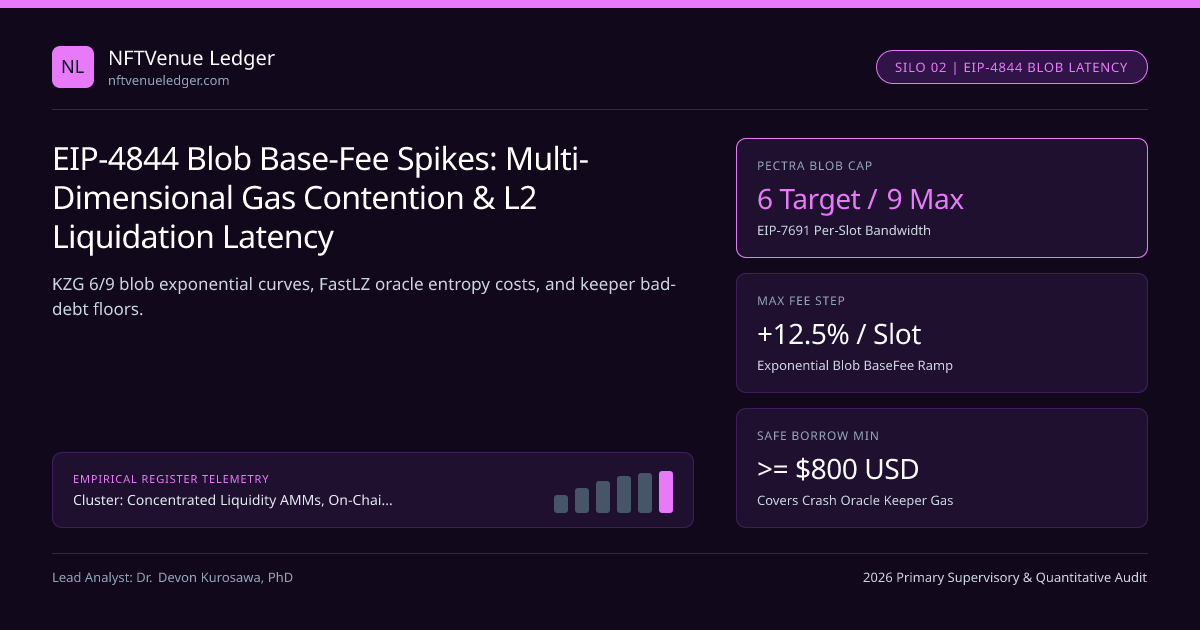
Dencun's EIP-4844 (Proto-Danksharding)—subsequently expanded by Pectra's EIP-7691 raising target/max blobs per Ethereum block from 3 / 6 to 6 / 9—decoupled Layer-2 rollup data-availability (DA) costs from permanent Ethereum CALLDATA execution gas by introducing ephemeral 18-day 128 KB KZG-committed Blobs priced on an independent EIP-1559 exponential curve. During calm markets when aggregate L2 demand sits below target capacity, blobBaseFee hovers at 1 wei, reducing L2 DEX swap fees below $0.005. Yet during synchronized macro liquidations (such as the August 5, 2024 and early 2025/2026 volatility cascades), 25+ rollups simultaneously dump compressed swap and liquidation batches onto L1—driving blobBaseFee up 10^10-fold from 1 wei to 50+ gwei inside minutes!
Anchored in our concentrated AMM, CLOB & intent DEX master guide, modeling multi-dimensional L2 Execution + L1 Blob DA gas spikes is essential for keeper bots liquidating positions on GMX perpetual pools and lending markets.
Dual-Component L2 Gas Pricing: Why Compressed Entropy Breaks Keepers#
Every transaction on an Optimistic or ZK Rollup pays a two-dimensional fee: *`TotalL2Fee = (L2GasUsed L2BasePlusPriorityFee) + (CompressedTxBytes * L1BlobScalar * L1DataFee)`**
When ETH crashes -18% in 20 minutes across DEXs in our marketplaces directory (from Arbitrum/Base Concentrated Liquidity AMMs to multi-chain routers like Astroport), two simultaneous non-linear shocks hit liquidation keepers:
- Exponential
blobBaseFeePrice Discovery Lag: Starting from1 wei = 10^-9 gwei, EIP-4844 increasesblobBaseFeeby at most+12.5%per full L1 block (12 seconds). Climbing23 orders of magnitudein binary steps from1 weito equilibrium20 gweitakes ~195 consecutive full blocks (~39 minutes) of saturated blob queues (resolved partially via EIP-7762 minimum reserve blob base fees), creating batch-poster backlog delays! - High-Entropy Calldata Penalty: Zero bytes compress down ~90% inside Brotli/Zstd rollup batches, whereas cryptographic pull-oracle signatures (
Pyth / Chainlink Data Streams) and multi-hopPermit2calldata have high Shannon entropy (near-zero compression!)—causing complex oracle-backed perp liquidations to surge from$0.01to$18–$45on L2 mid-crash!
Batch-Poster CALLDATA Arbitrage Ceiling & Sequencer Deficit Protection#
Can L2 DA fees rise infinitely above Ethereum L1 execution gas? No, provided the rollup batch poster implements automatic Type-3 Blob vs Type-2 CALLDATA switching! A 128 KB blob consumes 2^17 = 131,072 blob_gas, whereas posting those exact same 128 KB via legacy L1 CALLDATA (16 execution gas per non-zero byte, or 40–68 gas under EIP-7623 calldata floor rules) costs roughly 2.1M to 5.2M L1 execution gas. Whenever blobBaseFee * 131,072 > Calldata_Gas * L1_Execution_BaseFee, rational batch posters temporarily post batches as CALLDATA, capping L2 DA cost at legacy pre-4844 levels!
L2 Fee & Liquidation Resilience Matrix Across Volatility Regimes#
| Network State | L1 blobBaseFee | L2 Execution baseFee | Simple AMM Swap Cost | Pull-Oracle Perp Liquidation Cost |
|---|---|---|---|---|
| Calm Baseline (<6 Blobs/Block) | 1 wei – 0.01 gwei | 0.005 – 0.02 gwei | $0.001 – $0.006 | $0.008 – $0.025 |
| Moderate NFT / Meme Mint (1 L2 Hot) | 0.05 – 0.80 gwei | 0.50 – 4.00 gwei (Local L2!) | $0.08 – $0.65 | $0.25 – $1.40 |
| Systemic Macro Crash (All L2s Full) | 15.0 – 65.0 gwei | 5.0 – 35.0 gwei | $1.80 – $8.50 | $12.00 – $48.00 (High-entropy bytes!) |
| Calldata Fallback Cap (EIP-7623) | Capped by L1 baseFee | 10.0 – 50.0 gwei | $4.50 – $14.00 | $22.00 – $65.00 (Dust positions underwater!) |
Exact EIP-4844 / EIP-7691 Exponential Blob Fee & Keeper Solvency Math#
Risk engineers stress-test lending and perpetual protocols (Aave, Morpho, GMX) by computing exact L2 keeper break-even position size V_min_liq when excess_blob_gas surges during a crash:
- blobbasefee(excess) = MINBLOBBASEFEE * exp( excessblobgas / BLOBBASEFEEUPDATE_FRACTION )
- L2TxTotalUSD = ETHUSD * [ L2Gas * L2Price + FastLZBytes(tx) * (16 * wexec * L1Base + wblob * blobbasefee) / 10^6 ]
- Minimum Profitable Liquidation Collateral (C_min):
- Cmin * LiquidationBonusPct >= L2TxTotalUSD + DEXSwapSlippage_USD
- Worked Flash-Crash Stress Test (ETH = $2,600; L1Base = 45 gwei; blobbasefee = 38 gwei; L2Price = 12 gwei):
- Pull-oracle liquidation + Uniswap v3 collateral swap uses L2_Gas = 620,000 & 1,850 incompressible FastLZ bytes:
- L2ExecutionLeg = 620,000 * 12e-9 * 2,600 = $19.34
- L1BlobDA_Leg = ~0.0054 ETH * 2,600 = $14.04 => Total Keeper Tx Cost = $33.38!
- At 5.0% Liquidation Bonus (0.05) and 0.8% collateral swap impact (net 4.2% keeper margin):
- => C_min = $33.38 / 0.042 = $794.76! (Any micro-account <$795 accrues bad debt unless minimum borrow/escrow >= $1,000!)
Architecting Crash-Safe Keepers & Cross-Chain Settlement#
To prevent micro-account bad debt during blob storms, institutional L2 protocols enforce minimum borrow sizes (>= $500–$1,000) or escrow a dynamic keeper execution deposit upfront when positions open—examine how cross-L2 solvers manage finality delays across rollups next in ERC-7683 cross-chain intent escrows and L2 sequencer Timeboost ordering inside our AMM, CLOB & Intent DEX hub.
Frequently asked questions
Why did L2 transaction fees spike to $10–$40 during market crashes even after EIP-4844?
Once combined batch demand across all Ethereum rollups exceeds the per-block blob target (6 blobs under EIP-7691), excess_blob_gas compounds exponentially by up to 12.5% every 12 seconds alongside local L2 execution priority auctions.
Why do pull-oracle perpetual liquidations cost much more L2 DA gas than simple ERC-20 transfers?
Rollups charge L1 DA fees based on post-compression byte size (FastLZ/Brotli); high-entropy ECDSA/BLS oracle signatures cannot be compressed like zero-padded uint256 ERC-20 calldata.
How does EIP-7691 in Ethereum Pectra upgrade improve L2 DEX settlement?
EIP-7691 doubled target blob throughput from 3 to 6 blobs per block (and raised max from 6 to 9), doubling sustained L2 data-availability bandwidth before exponential blobBaseFee surges trigger.
How do DeFi protocols stop small L2 accounts from causing bad debt when gas spikes?
Protocols either enforce a minimum borrow/position floor (e.g., $500+) so the 5% liquidation bonus always covers peak gas, or collect an upfront ETH execution-fee deposit when opening leveraged orders.
Publication record
- Published
- November 13, 2026
- Updated
- November 14, 2026
- Author
- Dr. Devon Kurosawa, PhD
- Review
- Review not recorded
- Automated fact check
- Passed in the stored pipeline record
- Source URLs
- 3 recorded
AI assistance recorded: anthropic/claude-opus-4.6. This field does not establish human review or source verification.
Academic & Institutional Attribution
Cite This Research & Embed Live Data Card
Standard academic & institutional research paper citation format.
Dr. Devon Kurosawa, PhD. (2026, November 14). EIP-4844 Blob Base-Fee Spikes: Multi-Dimensional Gas Contention & L2 Liquidation Latency. NFTVenue Ledger. https://nftvenueledger.com/protocols/eip-4844-blob-base-fee-spikes-l2-dex-liquidation-latencyRegulatory Directory Cross-Reference
Referenced Institutions & Regulatory Registries
Top Regulated Institutions in This Coverage Slice
Primary Tier-1 Supervisory Registries
Related Amm Clob Intent Dex Settlement & Institutional Briefings
Explore Amm Clob Intent Dex Settlement Hub (20) →Amm Clob Intent Dex Settlement
Concentrated Liquidity AMMs, On-Chain CLOBs, Intent Solvers & MEV Microstructure: 2026 GuideAmm Clob Intent Dex Settlement
ERC-7683 Cross-Chain Intents: OriginSettler Escrows, Filler Working Capital & Optimistic ProofsAmm Clob Intent Dex Settlement
Auction-Managed AMMs (am-AMM) & Bunni/Diamond Hooks: Recapturing LVR On-Chain for LPsAmm Clob Intent Dex Settlement
Uniswap v3 Tick Spacing, Q64.96 Virtual Reserves & Concentrated Liquidity Depth MathAmm Clob Intent Dex Settlement
Loss-Versus-Rebalancing (LVR): Continuous-Time Black-Scholes AMM Adverse SelectionAmm Clob Intent Dex Settlement
Uniswap v4 Singleton PoolManager: EIP-1153 Flash Accounting & Dynamic Fee HooksAmm Clob Intent Dex Settlement
CoW Protocol Uniform Clearing Price Batch Auctions: Solver NP-Hard Optimization & MEV ShieldAmm Clob Intent Dex Settlement
UniswapX Exclusive Dutch-Decay Orders: RFQ Filler Exclusivity & Priority Gas AuctionsErc721 Erc1155 Eip712 Permit Security
CREATE2 Metamorphic Contracts, Cancun EIP-6780 SELFDESTRUCT & Bytecode Provenance AuditsErc721 Erc1155 Eip712 Permit Security
EIP-7201 Namespaced Storage Layouts: Eliminating __gap Fragility in Upgradeable ProxiesCross Chain Bridge Validator Exploits
External Validator Multisig & MPC Bridges: Key-Compromise Anatomy (Ronin, Harmony & Multichain)Cross Chain Bridge Validator Exploits
Optimistic Message Bridges: 1-of-N Watcher Assumptions, Dispute Windows & Nomad Zero-Root RCA
NFTVenue Ledger Data, Benchmarks & Contributor Records
CC BY 4.0 Open Data
Open Institutional Datasets (CSV / JSON) →
Download desk-compiled quantitative series & schemas.
2026 Reference Matrix
2026 Institutional Benchmarks & Thresholds →
Statutory capital, clearing, margin & rate conventions.
Editorial Records
Authors & Review Records →
View named contributors where those records are available.
Complete Index
Master Research & Dossier Archive →
Browse all published briefings by topic pillar & date.