
Amm Clob Intent Dex Settlement
UniswapX Exclusive Dutch-Decay Orders: RFQ Filler Exclusivity & Priority Gas Auctions
UniswapX combines off-chain RFQ quoting with Permit2-backed Dutch-decay on-chain Reactors, granting the winning market maker a brief exclusivity window before open filler competition.
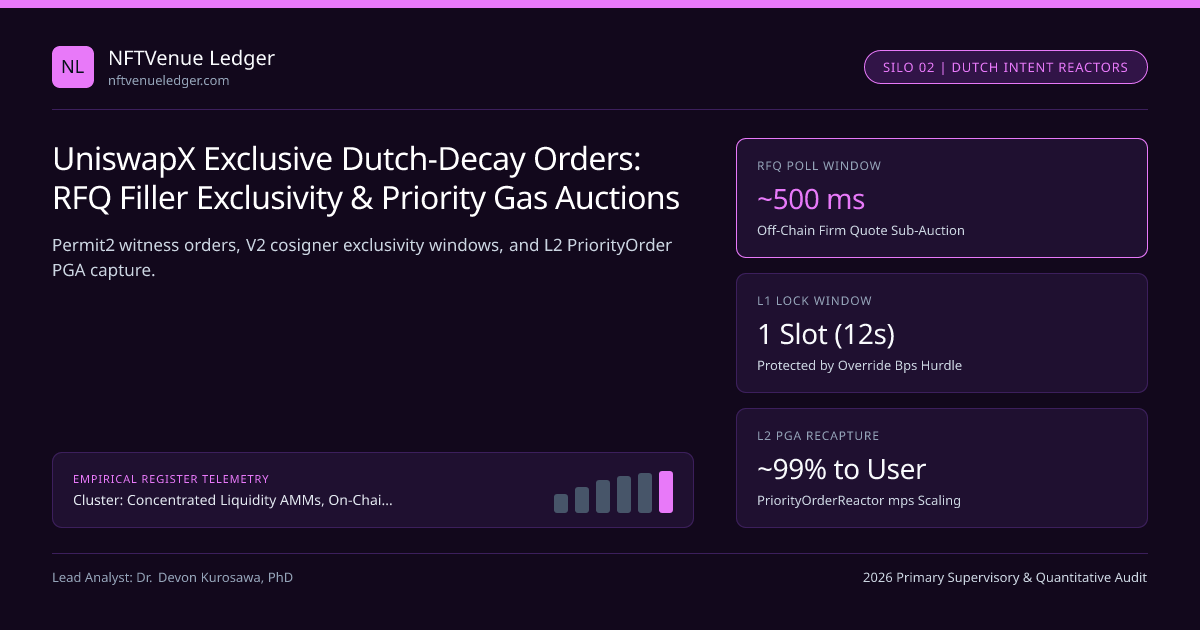
Pure open Dutch auctions on Ethereum Layer 1 suffer from Winner's Curse & Last-Look Latency: if every filler can settle a user's decaying order simultaneously from block 0, off-chain RFQ market makers pad quotes defensively because a searcher can wait until the final millisecond of the 12-second slot to cherry-pick fills only when Binance moves against the user. UniswapX (ExclusiveDutchOrderReactor on Ethereum and PriorityOrderReactor on OP-Stack L2s) solves this game-theoretic deadlock by coupling Permit2 witness signatures (EIP-712 typed standard) with a brief 1-block RFQ Exclusivity Override followed by a non-linear open Dutch decay curve.
Integrated into our concentrated AMM, CLOB & intent DEX master guide, understanding Dutch-decay parameterization is essential for institutional fillers competing alongside CoW Protocol batch solvers and ERC-7683 cross-chain settlers.
Anatomy of an ExclusiveDutchOrder & Permit2 Witness Settlement#
When a swapper requests a quote, the off-chain Parameterization API polls permissioned RFQ market makers over a 500-millisecond sub-auction. Suppose Maker M* bids the highest output Q_RFQ. The user signs a single Permit2.permitWitnessTransferFrom payload encoding:
- Exclusivity Phase (
t <= decayStartTime): OnlyexclusiveFiller = M*may executeReactor.executeat exact priceQ_RFQ(or if another filler somehow executes duringexclusivityOverrideBps, they must improveQ_RFQby e.g.+50 bps, compensating the user for breaking exclusivity!). - Non-Linear Open Decay Phase (
decayStartTime < t <= decayEndTime): IfM*drops offline or refuses to fill, exclusivity expires immediately anddecayOutput(t)interpolates piecewise-linearly fromstartAmount(set slightly aboveQ_RFQto penalize intentional maker fading!) down toendAmount(anchored to best on-chain AMM routing minus worst-case slippage).
L2 PriorityOrderReactor: Replacing Clock Decay with Priority-Fee Scaling#
On 2-second OP-Stack rollups (Base, Optimism, Unichain) where wall-clock Dutch curves are too coarse for 1-block granularity, UniswapX deploys PriorityOrderReactor. Instead of decaying output over block.timestamp, the order fixes a baseline minimum output amount_min and requires competing fillers in the same L2 block to bid extra output tokens directly to the swapper proportional to every wei of priorityFeePerGas paid above auctionStartBlock:
Specifically, if Filler A bids a priorityFee of P_gas wei to win top-of-block inclusion on a priority-ordered rollup sequencer, PriorityOrderReactor enforces Output_Delivered = Baseline_Output * (1 + mpsPerPriorityFeeWei * P_gas)—automatically converting validator/sequencer MEV tips into direct price improvement for the retail swapper!
Execution Comparison Across UniswapX Reactor Variants#
| Reactor Contract Variant | Target Chain Environment | Price Discovery Mechanism | MEV Tax Internalization |
|---|---|---|---|
DutchOrderReactor (v1) | 12s Ethereum L1 | Linear timestamp interpolation [t_start, t_end] | High filler PGA leaks surplus to MEV-Boost builders |
V2DutchOrderReactor (Cosigner) | 12s Ethereum L1 | Off-chain cosigner sets fresh decayStartBlock post-sign | Eliminates stale signature latency & protects MMs |
ExclusiveDutchOrderReactor | 12s L1 & Arbitrum | 1-block RFQ winner lock + exclusivityOverrideBps | Tighter upfront RFQ quotes (-2 to -6 bps spread) |
PriorityOrderReactor | 2s OP-Stack Rollups (Base/Unichain) | Output scales linearly with tx.gasprice - block.basefee | Internalizes 100% of PGA priority tips to swapper! |
Piecewise Dutch Decay & L2 Priority-Fee Scaling Equations#
Execution quants building automated filler bots evaluate instantaneous fill profitability across both L1 timestamp decay and L2 priority-gas scaling (often hedging residual flow on Uniswap v4 singleton pools or multi-chain DEXs in our marketplaces directory like 9mm Pro and Astroport):
- OutDutch(t) = Outk - floor( ((Outk - Out{k+1}) * (t - tk)) / (t{k+1} - t_k) )
- 2) L2 PriorityOrderReactor Output Required at Gas Priority Fee pf_wei = (tx.gasprice - block.basefee):
- SCALE = 10^7 (1 milli-bps = 1e-7)
- OutPriority(pfwei) = AmountBase + ceil( (AmountBase * (pf_wei * mpsPerPriorityFeeWei)) / 10^7 )
- Worked Base L2 PriorityOrder Fill ($200,000 ETH -> USDC Swap):
- Order sets Amount_Base = 199,600 USDC; mpsPerPriorityFeeWei = 2 (i.e., +2e-7 output per wei priority fee)
- Fair CEX value jumps to 200,150 USDC; Filler bids pf_wei = 1,200,000 wei (0.0012 gwei -> <$0.01 L2 gas!) to beat rivals:
- => Improvement_Factor = (1,200,000 * 2) / 10^7 = 0.2400% (+24.0 bps!)
- => Out_Priority = 199,600 * 1.0024 = 200,079.04 USDC delivered to user (vs <$0.01 leaked to sequencer!)
Extending Dutch Intents Across Rollup Bridges#
When input and output tokens sit on separate chains, Dutch-decay Reactors generalize into dual-leg escrow contracts standardized in ERC-7683 cross-chain intent settlers, while L1 filler bundle inclusion depends on MEV-Boost relay timing games inside our AMM, CLOB & Intent DEX hub.
Frequently asked questions
What is the Last-Look problem in exclusive RFQ intent auctions?
If an exclusive market maker holds a multi-block window with zero penalty for abandoning the order, it possesses a free option to fill when prices move against the user and walk away ("fade") when prices move in the user's favor.
How does UniswapX prevent RFQ market makers from abusing Last-Look?
UniswapX bounds exclusivity to a single cosigned slot, sets open Dutch decay starting above the faded RFQ quote, allows rival fillers to override via exclusivityOverrideBps on big jumps, and throttles makers whose fade rate rises.
How does PriorityOrderReactor return MEV to swappers on OP-Stack L2s?
Because OP-Stack sequencers sort transactions within each block strictly by priorityFeePerGas, requiring fillers to scale user output tokens linearly with priorityFeePerGas forces fillers to bid improvement to the user instead of gas to the sequencer.
Why does UniswapX use Permit2 unordered nonces instead of sequential ERC-2612 permits?
Permit2 works across every ERC-20 token (including legacy USDT/WETH lacking EIP-2612) and uses 256-bit word bitmaps so users can sign multiple concurrent open limit/Dutch intents without nonce collisions.
Publication record
- Published
- November 14, 2026
- Updated
- November 14, 2026
- Author
- Dr. Devon Kurosawa, PhD
- Review
- Review not recorded
- Automated fact check
- Passed in the stored pipeline record
- Source URLs
- 3 recorded
AI assistance recorded: anthropic/claude-opus-4.6. This field does not establish human review or source verification.
Academic & Institutional Attribution
Cite This Research & Embed Live Data Card
Standard academic & institutional research paper citation format.
Dr. Devon Kurosawa, PhD. (2026, November 14). UniswapX Exclusive Dutch-Decay Orders: RFQ Filler Exclusivity & Priority Gas Auctions. NFTVenue Ledger. https://nftvenueledger.com/protocols/uniswapx-exclusive-dutch-decay-filler-rfq-auction-curvesRegulatory Directory Cross-Reference
Referenced Institutions & Regulatory Registries
Mentioned Regulated Institutions
Primary Tier-1 Supervisory Registries
Related Amm Clob Intent Dex Settlement & Institutional Briefings
Explore Amm Clob Intent Dex Settlement Hub (20) →Amm Clob Intent Dex Settlement
Concentrated Liquidity AMMs, On-Chain CLOBs, Intent Solvers & MEV Microstructure: 2026 GuideAmm Clob Intent Dex Settlement
MEV-Boost Proposer-Builder Separation (PBS): Relay Timing Games & Builder CentralizationAmm Clob Intent Dex Settlement
Just-In-Time (JIT) AMM Liquidity: Intra-Block Mint-Swap-Burn Fee Dilution & LP DefenseAmm Clob Intent Dex Settlement
Sandwich MEV Attacks: Closed-Form Optimal Frontrun Sizing & Slippage Tolerance ExploitationAmm Clob Intent Dex Settlement
App-Chain On-Chain CLOBs: Enshrined Validator Orderbooks, Cancel Priority & Maker RebatesAmm Clob Intent Dex Settlement
L2 Rollup Sequencer Ordering: Arbitrum Timeboost Express Lanes vs OP-Stack Priority AuctionsAmm Clob Intent Dex Settlement
Solana DEX Microstructure: Sealevel Local Fee Markets, Stake-Weighted QoS & Jito BundlesAmm Clob Intent Dex Settlement
Multi-Asset & Isolated Perpetual Pools (GLP / GM): Skew Funding, Price Impact & OI CapsErc721 Erc1155 Eip712 Permit Security
ERC-2981 NFT Royalty Signaling vs ERC-721C Programmable Transfer-Validator EnforcementErc721 Erc1155 Eip712 Permit Security
ERC-1967 Transparent vs EIP-1822 UUPS Proxies: Storage Slots & Uninitialized Logic ExploitsErc721 Erc1155 Eip712 Permit Security
EIP-2535 Diamond Multi-Facet Proxies: Selector Routing, DiamondStorage & Arbitrary DelegatecallErc721 Erc1155 Eip712 Permit Security
TimelockController & Multisig Governance Security: Delay Floors, Signer Ops & Guardian Vetoes
NFTVenue Ledger Data, Benchmarks & Contributor Records
CC BY 4.0 Open Data
Open Institutional Datasets (CSV / JSON) →
Download desk-compiled quantitative series & schemas.
2026 Reference Matrix
2026 Institutional Benchmarks & Thresholds →
Statutory capital, clearing, margin & rate conventions.
Editorial Records
Authors & Review Records →
View named contributors where those records are available.
Complete Index
Master Research & Dossier Archive →
Browse all published briefings by topic pillar & date.