
Amm Clob Intent Dex Settlement
Uniswap v3 Tick Spacing, Q64.96 Virtual Reserves & Concentrated Liquidity Depth Math
Concentrated liquidity AMMs replace uniform x*y=k reserves with piecewise virtual curves indexed across logarithmic 1-bps ticks and Q64.96 fixed-point square-root prices.
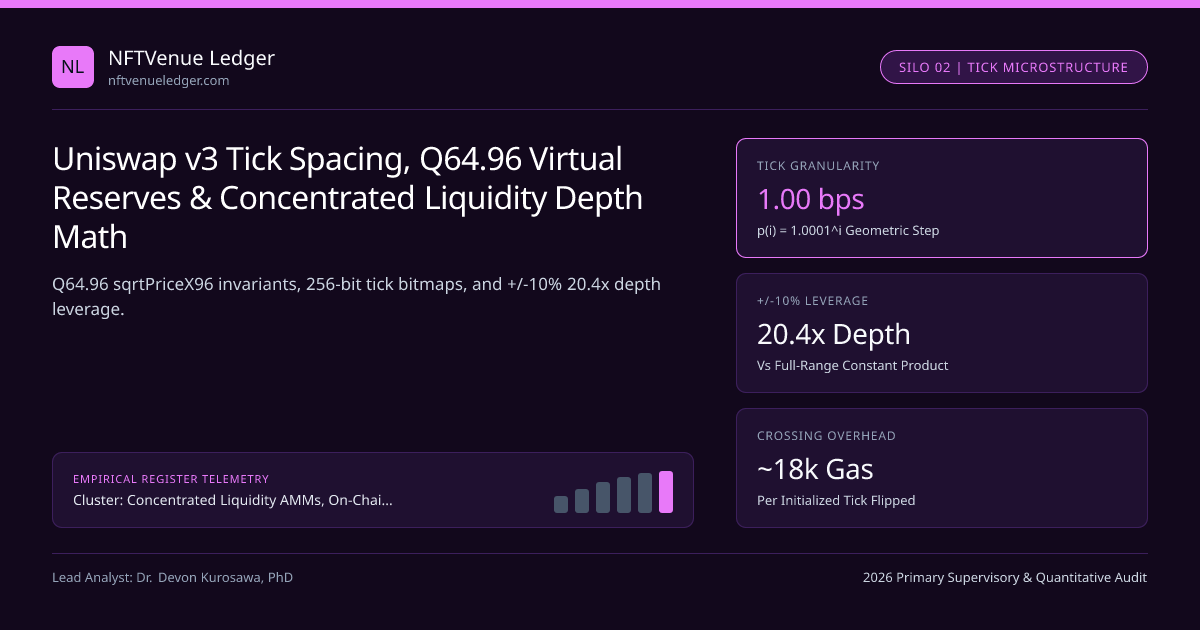
Under the Concentrated Liquidity AMM specification pioneered by Uniswap v3 and deployed across multi-chain forks in our marketplaces directory such as 9mm Pro and Astroport, liquidity providers allocate real reserves (x_real, y_real) exclusively within a bounded price interval [p(i_lower), p(i_upper)]. Rather than storing price P = y / x directly, pool contracts track *`sqrtPriceX96 = floor(sqrt(P) 2^96)** as an unsigned Q64.96 fixed-point integer alongside active tick liquidity L = sqrt(xvirtual * yvirtual)`, converting non-linear price updates into exact linear reciprocal deltas inside a single active tick interval.
Anchored in our concentrated AMM, CLOB & intent DEX master guide, mastering tick-bitmap traversal and concentration leverage is prerequisite to modeling LVR adverse selection and Uniswap v4 singleton hooks.
Logarithmic Tick Indexing & sqrtPriceX96 Fixed-Point Arithmetic#
Discrete price ticks are spaced geometrically by 1 basis point per tick index i in [-887272, +887272] such that p(i) = 1.0001^i and sqrt(p(i)) = 1.0001^(i/2). Why store sqrt(P) in Q64.96 format instead of P? Because within any active segment where no initialized tick boundary is crossed, the constant-product invariant satisfies two pure linear identities in L:
- Token 1 (
y) Reserve Delta:Delta_y = L * (sqrt(P_new) - sqrt(P_old)) - Token 0 (
x) Reserve Delta:Delta_x = L * (1 / sqrt(P_new) - 1 / sqrt(P_old))
Consequently, swapping inside a single tick range requires zero iterative Newton-Raphson root finding—only fixed-point mulDiv operations rounding strictly in favor of the pool (mulDivRoundingUp) to prevent 1-wei dust draining attacks.
Fee Tiers, tickSpacing Quantization & Swap Gas Trade-Offs#
Allowing LPs to initialize every single 1-bps tick on volatile pairs would force medium-sized swaps to cross dozens of storage slots per trade, exploding L1 gas costs. Pool factories therefore couple each swap fee tier f to a mandatory integer tickSpacing modulus (only ticks where i mod tickSpacing == 0 can hold liquidityNet boundaries):
- 1 bps Fee Tier (
tickSpacing = 1): Designed for pegged stablecoin and LST pairs (USDC/USDT,wstETH/ETH), enabling 0.01% range granularity with >2,000x capital efficiency. - 5 bps & 30 bps Fee Tiers (
tickSpacing = 10and60): Standard institutional spot buckets (ETH/USDC,WBTC/ETH), spacing initialized boundaries every 0.10% or 0.60% so typical $100k swaps cross 0 to 2 ticks. - 100 bps Fee Tier (
tickSpacing = 200): Calibrated for exotic governance or newly launched tokens (~2.02% step between initializable ticks), insulating takers from excessive tick-crossing gas during 15% intraday swings.
Fee Tier & Tick-Spacing Engineering Matrix#
| Pool Fee Tier | Mandatory tickSpacing | Minimum Range Width (bps) | Optimal Asset Correlation | Mean L1 Swap Gas (0 vs 3 Crossings) |
|---|---|---|---|---|
| 0.01% (1 bps) | 1 tick | 1.00 bps (0.01%) | Fiat Stablecoins & Pegged LSTs | ~106,000 gas / ~164,000 gas |
| 0.05% (5 bps) | 10 ticks | 10.00 bps (0.10%) | Major L1 Pairs (ETH/USDC, WBTC/USDC) | ~108,000 gas / ~168,000 gas |
| 0.30% (30 bps) | 60 ticks | 60.18 bps (0.60%) | Mid-Cap DeFi & Ecosystem Pairs | ~109,000 gas / ~171,000 gas |
| 1.00% (100 bps) | 200 ticks | 202.00 bps (2.02%) | Long-Tail Volatile / Launch Tokens | ~110,000 gas / ~173,000 gas |
Exact Real-to-Virtual Reserve & Capital Efficiency Derivation#
Given current spot price P in [P_a, P_b], liquidity L relates real deposited amounts (x_real, y_real) to equivalent full-range virtual reserves via:
- xreal = L * (sqrt(Pb) - sqrt(P)) / (sqrt(P) * sqrt(P_b))
- yreal = L * (sqrt(P) - sqrt(Pa))
- EfficiencyMultiplier(Pa, Pb) = 1 / (1 - (Pa / Pb)^(1/4)) [evaluated at symmetric geometric midpoint P = sqrt(Pa * P_b)]
- Worked Institutional Position Sizing (ETH Spot P = 3,000 USDC; Range = [2,700, 3,300]):
- sqrt(P) = 54.772256; sqrt(Pa) = 51.961524; sqrt(Pb) = 57.445626
- Target Virtual Depth equivalent to a USD 20,000,000 full-range v2 pool (xv = 3,333.33 ETH, yv = 10,000,000 USDC):
- => Required L = sqrt(3,333.33 * 10,000,000) = 182,574.19
- Real Capital Required in [2,700, 3,300]:
- x_real = 182,574.19 * (57.445626 - 54.772256) / (54.772256 * 57.445626) = 155.14 ETH ($465,420)
- y_real = 182,574.19 * (54.772256 - 51.961524) = 513,167 USDC
- Total Real Deposit = $978,587 (Efficiency = $20,000,000 / $978,587 = 20.44x!)
Managing Out-of-Range Inventory & Singleton Evolution#
When spot price exits [P_a, P_b], active liquidity drops out of the range (feeGrowthInside halts accruing) and 100% of the LP's principal sits in the depreciating asset—magnifying the convexity cost modeled next in Loss-Versus-Rebalancing Black-Scholes adverse selection and addressed via custom rebalancing hooks in Uniswap v4 singleton flash accounting inside our AMM, CLOB & Intent DEX hub.
Frequently asked questions
Why does Uniswap v3 store sqrtPriceX96 instead of a standard 18-decimal token price?
Within a constant-liquidity tick segment, changes in sqrt(P) relate linearly to token1 reserves (Delta_y = L * Delta_sqrtP) and changes in 1/sqrt(P) relate linearly to token0 reserves, eliminating expensive on-chain square-root calls during simple swaps.
How much extra gas does crossing an initialized tick add to a Uniswap v3 swap?
Crossing each initialized tick boundary adds roughly 14,000 to 22,000 gas on EVM chains due to reading the tick struct from storage, flipping feeGrowthOutside accumulators via SSTORE, and updating active liquidity L.
What is the role of the tickBitmap mapping in concentrated liquidity AMMs?
tickBitmap packs 256 boolean initialized-tick flags into each uint256 storage word, letting the swap loop locate the next active boundary across up to 256 * tickSpacing ticks using bit-shift intrinsics in a single SLOAD.
Does tighter concentration reduce impermanent loss or increase it?
Tighter concentration multiplies both fee capture and divergence loss (impermanent loss / LVR) by the exact same concentration factor; if swap fee revenue fails to exceed amplified convexity decay, tight ranges underperform.
Publication record
- Published
- November 14, 2026
- Updated
- November 14, 2026
- Author
- Dr. Devon Kurosawa, PhD
- Review
- Review not recorded
- Automated fact check
- Passed in the stored pipeline record
- Source URLs
- 3 recorded
AI assistance recorded: anthropic/claude-opus-4.6. This field does not establish human review or source verification.
Academic & Institutional Attribution
Cite This Research & Embed Live Data Card
Standard academic & institutional research paper citation format.
Dr. Devon Kurosawa, PhD. (2026, November 14). Uniswap v3 Tick Spacing, Q64.96 Virtual Reserves & Concentrated Liquidity Depth Math. NFTVenue Ledger. https://nftvenueledger.com/protocols/uniswap-v3-tick-spacing-concentrated-liquidity-depthRegulatory Directory Cross-Reference
Referenced Institutions & Regulatory Registries
Top Regulated Institutions in This Coverage Slice
Primary Tier-1 Supervisory Registries
Related Amm Clob Intent Dex Settlement & Institutional Briefings
Explore Amm Clob Intent Dex Settlement Hub (20) →Amm Clob Intent Dex Settlement
Concentrated Liquidity AMMs, On-Chain CLOBs, Intent Solvers & MEV Microstructure: 2026 GuideAmm Clob Intent Dex Settlement
Loss-Versus-Rebalancing (LVR): Continuous-Time Black-Scholes AMM Adverse SelectionAmm Clob Intent Dex Settlement
Uniswap v4 Singleton PoolManager: EIP-1153 Flash Accounting & Dynamic Fee HooksAmm Clob Intent Dex Settlement
CoW Protocol Uniform Clearing Price Batch Auctions: Solver NP-Hard Optimization & MEV ShieldAmm Clob Intent Dex Settlement
UniswapX Exclusive Dutch-Decay Orders: RFQ Filler Exclusivity & Priority Gas AuctionsAmm Clob Intent Dex Settlement
MEV-Boost Proposer-Builder Separation (PBS): Relay Timing Games & Builder CentralizationAmm Clob Intent Dex Settlement
Just-In-Time (JIT) AMM Liquidity: Intra-Block Mint-Swap-Burn Fee Dilution & LP DefenseAmm Clob Intent Dex Settlement
Sandwich MEV Attacks: Closed-Form Optimal Frontrun Sizing & Slippage Tolerance ExploitationErc721 Erc1155 Eip712 Permit Security
Uniswap Permit2 Security Audit: AllowanceTransfer vs SignatureTransfer & Witness PhishingErc721 Erc1155 Eip712 Permit Security
EIP-2612 ERC-20 Permit Audits: ecrecover Zero-Address, s-Malleability & Griefing FrontrunsErc721 Erc1155 Eip712 Permit Security
ERC-721 & ERC-1155 setApprovalForAll Security: Operator Blast Radius & Conduit IsolationErc721 Erc1155 Eip712 Permit Security
Seaport v1.6 Protocol Architecture: Conduits, Hook Zones & Bulk Order Merkle Trees
NFTVenue Ledger Data, Benchmarks & Contributor Records
CC BY 4.0 Open Data
Open Institutional Datasets (CSV / JSON) →
Download desk-compiled quantitative series & schemas.
2026 Reference Matrix
2026 Institutional Benchmarks & Thresholds →
Statutory capital, clearing, margin & rate conventions.
Editorial Records
Authors & Review Records →
View named contributors where those records are available.
Complete Index
Master Research & Dossier Archive →
Browse all published briefings by topic pillar & date.