Cross Chain Bridge Validator Exploits
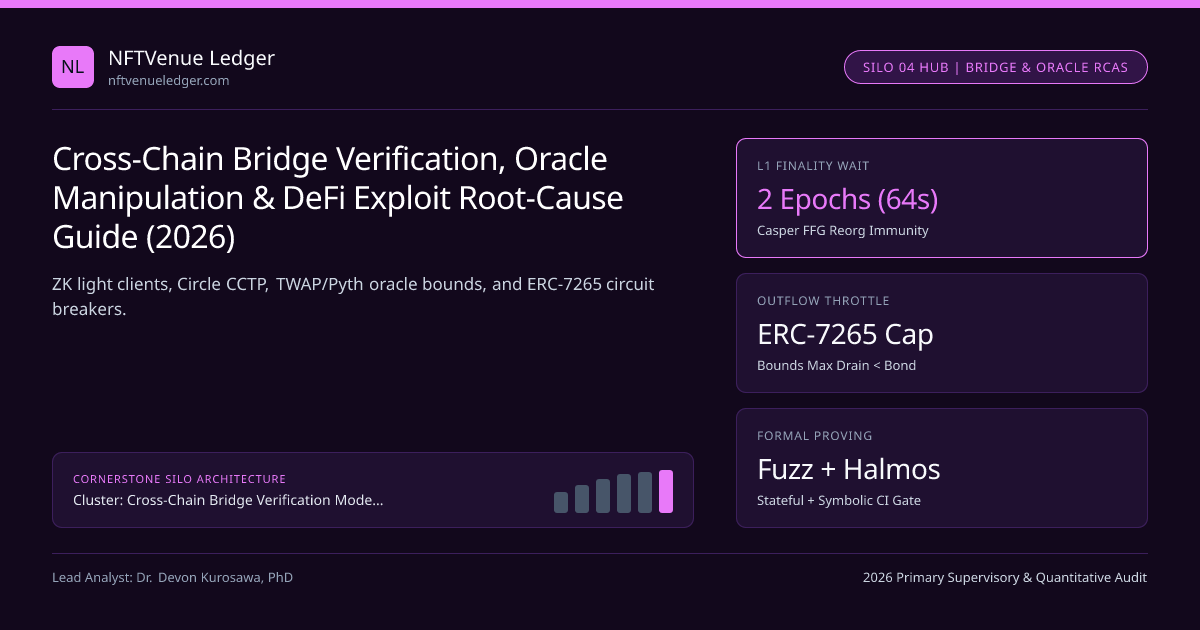
Cross-Chain Bridge Verification, Oracle Manipulation & DeFi Exploit Root-Cause Guide (2026)
Cross-chain bridges and price-oracle adapters account for over 68% of historical DeFi exploit losses—demanding ZK light clients, burn-and-mint settlement, and ERC-7265 circuit breakers.
Between 2021 and 2026, more than USD 4.8 billion in institutional and retail liquidity evaporated across cross-chain messaging bridges, spot-reserve oracle adapters, and vault share-accounting edge cases. Unlike isolated single-contract bugs, cross-chain and oracle exploits compound systemic contagion: a compromised lock-and-mint bridge pool de-pegs wrapped collateral across dozens of downstream DEXs and lending markets simultaneously.
Published inside our Cross-Chain Bridge & Oracle Security hub and mapped across venues in our global marketplaces directory and exploits archive, this 2026 institutional reference establishes rigorous verification architectures spanning ZK-SNARK light clients, Circle CCTP burn-and-mint standards, manipulation-resistant oracle feeds, and CEI invariant engineering.
Cross-Chain Bridge Trust Spectrum: External Multisigs vs Optimistic vs ZK Light Clients#
Every cross-chain message protocol answers one fundamental question: how does Destination Chain B verify that Event E genuinely finalized on Source Chain A? Four distinct verification architectures trade off latency, gas cost, and corruptible-honest-majority assumptions:
- External Validator Multisigs & MPC Committees: Trusted off-chain signers attest to source events—catastrophically vulnerable when honeypot TVL exceeds signer operational security as dissected in external validator multisig bridge key-compromise anatomy, or when crypto-economic bond value lags TVL in EigenLayer restaked bridge AVS slashing bounds.
- Optimistic Fraud-Proof Bridges & Canonical Rollup Messengers: Relayers post state roots subject to a challenge window analyzed in optimistic message bridges & fraud-proof dispute windows, while execution engines guard against premature source-chain forks in bridge relayer message replay & reorg finality depth and leaf-encoding bugs in Merkle tree leaf preimage collision & proof forgery.
- ZK Validity-Proof Light Clients & Native Issuer Burn-and-Mint: Succinct proofs verify Ethereum Altair Sync Committee BLS signatures directly on-chain in ZK-SNARK light-client header verification, while stablecoin issuers eliminate honey-pot lockboxes entirely via Circle CCTP burn-and-mint vs lock-and-mint TVL.
Price Oracle Manipulation, Read-Only Reentrancy & Precision Exploits#
Even when cross-chain collateral is 100% authentic, lending markets and perpetual DEXs across our marketplaces directory—such as Acala Swap, Astroport, Beethoven X, and Apeswap—face acute Price & Accounting Manipulation Vectors:
- Spot Flash-Swaps, TWAP Cost Bounds & Pull-Oracle Latency: Reading instantaneous AMM reserves allows zero-cost drainage in cross-contract flash-swap collateral drains. Protocols therefore evaluate multi-block cost curves in Uniswap v3 geometric-mean TWAP manipulation cost, sub-second uncertainty bands in Pyth pull-oracle confidence intervals, and rollup halt safety in L2 sequencer downtime & Chainlink grace periods.
- View-Function Reentrancy, Rounding & Governance Flashes: Attackers skew Balancer/Curve LP
getRatemid-callback in read-only reentrancy LP virtual-price skew, defeated by CEI & transient reentrancy guards. Meanwhile, vault and token math audits target ERC-4626 first-depositor share inflation, WAD/RAY directional rounding truncation, and flash-loan governance quorum hijacks.
Bridge & Oracle Verification Model Security Matrix#
| Verification / Oracle Architecture | Trust / Cryptographic Assumption | Historical Exploit Vector | Institutional Mitigation Standard |
|---|---|---|---|
| External Multisig Bridge (5-of-9) | Honest signer key custody | Ronin ($624M) / Harmony ($100M) key theft | Migrate to ZK light clients + ERC-7265 rate limits |
| Optimistic Message Bridge | >= 1 honest watcher in window | Nomad ($190M) zero-root init bug | Foundry invariant fuzzing + Halmos + 30m–7d window |
| ZK-SNARK Light Client | Soundness of circuit + L1 consensus | Under-constrained circuit witness bug | Multi-prover diversity (ZK + TEE/Optimistic 2-of-2) |
| Circle CCTP Burn-and-Mint | Native Circle issuer attestation | Zero wrapped bridge TVL honeypot! | Canonical USDC settlement across EVM & Solana |
| Pull + Push Hybrid Oracles | Publisher quorum + L2 uptime feed | Stale price liquidation post-L2 halt | Enforce confidence / price <= maxBps + 3,600s grace period |
Fundamental Economic Security & Outflow Containment Inequality#
Risk committees supervised by ESMA, FINMA, and MAS underwrite cross-chain exposure only when Cryptoeconomic Corruption Cost (C_corrupt) strictly exceeds Maximum Single-Window Extractable Value (EV_max):
- Without Circuit Breaker: EVmax = TVLlockedbridge => Unsafe whenever TVLlocked > SlashableValidatorBond!
- With ERC-7265 Rate Cap Rwindow (USD/hour) & Watcher Freeze Latency Tfreeze (hours):
- EVmaxbounded = Rwindow * Tfreeze << SlashableValidatorBond (C_corrupt)
- Worked $500M Bridge Security Sizing:
- Unthrottled 5-of-9 Multisig ($0 slashable bond, $500M TVL): Profit = +$500M -> CATASTROPHIC HONEYPOT!
- Restaked + ZK Dual-Verifier ($180M slashable bond) + ERC-7265 Rate Limit ($2.5M/hour cap, 0.5h freeze SLA):
- => Max extractable before freeze = $1.25M << $180M slashable loss -> Net Attacker PnL = -$178.75M (Economically Irrational!)
Continuous Formal Verification & Post-Incident Recovery#
Preventing bugs before mainnet deployment combines stateful property campaigns and SMT bytecode proofs in Foundry stateful invariant fuzzing & Halmos symbolic proving, backed by legally binding on-chain recovery escrows in Immunefi whitehat bounties & SEAL Safe Harbor SLAs.
Frequently asked questions
Why have cross-chain bridges suffered larger hacks than standalone DEXs?
Lock-and-mint bridges pool hundreds of millions of dollars of native L1 assets into a single escrow contract while relying on complex off-chain or cross-chain verification logic—where a single proof or key bug drains the entire backing pool.
How does Circle CCTP eliminate wrapped-token de-peg risk?
Instead of locking USDC on Ethereum and minting synthetic bridged-USDC on Arbitrum or Solana, CCTP cryptographically burns native USDC on the source chain and mints canonical native USDC on the destination chain.
What is read-only reentrancy in DeFi price oracles?
During a mid-withdrawal ETH callback from a Balancer or Curve pool, token balances have already decreased before LP totalSupply updates, temporarily inflating the read-only get_virtual_price view function read by external lending markets.
How does an ERC-7265 circuit breaker protect TVL during a zero-day exploit?
ERC-7265 tracks rolling net token outflows per time window inside an isolated CircuitBreaker contract; if withdrawals exceed a configured threshold (e.g., 10% in 1 hour), outflows automatically lock into delayed escrow.
Publication record
- Published
- November 14, 2026
- Updated
- November 14, 2026
- Author
- Dr. Devon Kurosawa, PhD
- Review
- Review not recorded
- Automated fact check
- Passed in the stored pipeline record
- Source URLs
- 4 recorded
AI assistance recorded: anthropic/claude-opus-4.6. This field does not establish human review or source verification.
Academic & Institutional Attribution
Cite This Research & Embed Live Data Card
Standard academic & institutional research paper citation format.
Dr. Devon Kurosawa, PhD. (2026, November 14). Cross-Chain Bridge Verification, Oracle Manipulation & DeFi Exploit Root-Cause Guide (2026). NFTVenue Ledger. https://nftvenueledger.com/protocols/cross-chain-bridge-verification-oracle-exploit-rca-guide-2026Related Cross Chain Bridge Validator Exploits & Institutional Briefings
Explore Cross Chain Bridge Validator Exploits Hub (20) →Cross Chain Bridge Validator Exploits
External Validator Multisig & MPC Bridges: Key-Compromise Anatomy (Ronin, Harmony & Multichain)Cross Chain Bridge Validator Exploits
Optimistic Message Bridges: 1-of-N Watcher Assumptions, Dispute Windows & Nomad Zero-Root RCACross Chain Bridge Validator Exploits
ZK-SNARK Light-Client Bridges: Ethereum Sync Committee Proofs, Circuit Bugs & Multi-Prover DefenseCross Chain Bridge Validator Exploits
Circle CCTP Burn-and-Mint Architecture vs Lock-and-Mint Wrapped Bridge ContagionCross Chain Bridge Validator Exploits
Uniswap v3 Geometric-Mean TWAP Oracles: Tick-Accumulator Math & PoS Multi-Block Manipulation CostCross Chain Bridge Validator Exploits
Pull-Based Low-Latency Oracles (Pyth & Chainlink Data Streams): Confidence Intervals & Staleness GuardsCross Chain Bridge Validator Exploits
Read-Only Reentrancy Exploits: Curve get_virtual_price & Balancer getRate View SkewsCross Chain Bridge Validator Exploits
Checks-Effects-Interactions (CEI), Cross-Contract Locks & Cancun EIP-1153 Transient GuardsOnchain Wash Trading Market Abuse
MiCA Title VI Market Abuse Surveillance, Wash-Trade Graph Forensics & STOR Guide (2026)Mica Vara VASP Marketplace Licensing
MiCA Article 67 CASP Prudential Safeguards: EUR 50k, 125k & 150k Own-Funds MechanicsRegulatory and Market Glossary
MSCI Index Overhaul Threatens $2.8 Billion In Forced Outflows For Strategy (NASDAQ: MSTR) As Bitcoin Slides - Foreign Policy JournalMarket Insights
[Analysis] Bitcoin Derivatives Selling Hits One-Year Extreme, Potentially Signaling Rebound - bloomingbit
NFTVenue Ledger Data, Benchmarks & Contributor Records
CC BY 4.0 Open Data
Open Institutional Datasets (CSV / JSON) →
Download desk-compiled quantitative series & schemas.
2026 Reference Matrix
2026 Institutional Benchmarks & Thresholds →
Statutory capital, clearing, margin & rate conventions.
Editorial Records
Authors & Review Records →
View named contributors where those records are available.
Complete Index
Master Research & Dossier Archive →
Browse all published briefings by topic pillar & date.