Onchain Wash Trading Market Abuse
MiCA Title VI Market Abuse Surveillance, Wash-Trade Graph Forensics & STOR Guide (2026)
With EU MiCA Title VI extending insider dealing, unlawful disclosure, and market manipulation prohibitions to on-chain venues and CASPs, compliance teams require graph forensics and automated STOR engines.
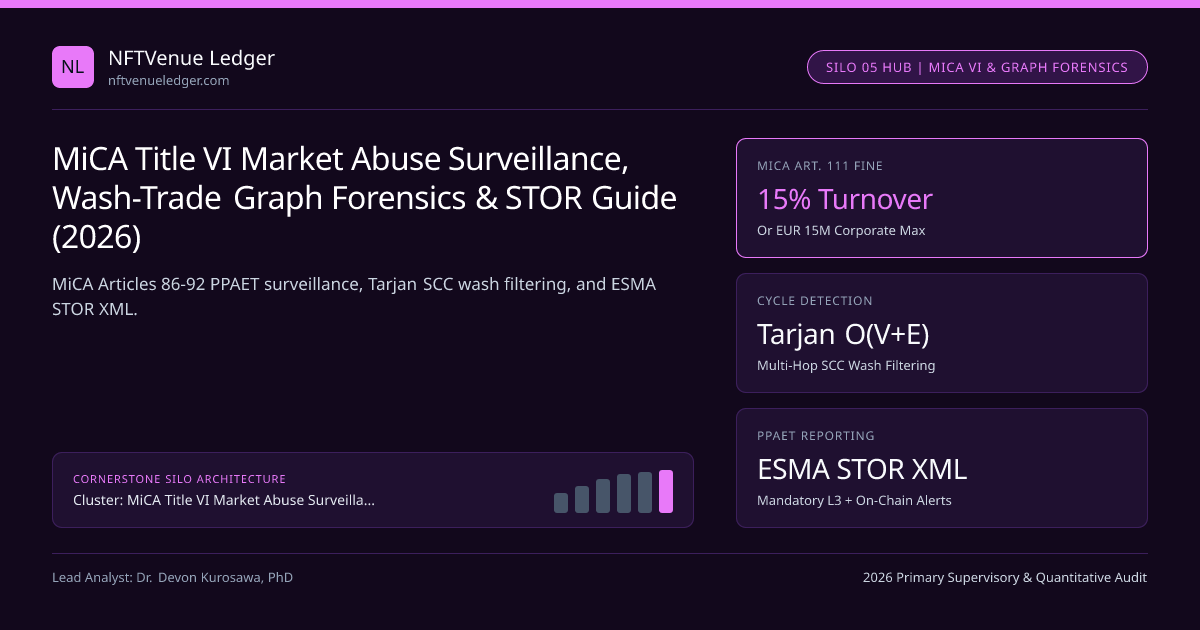
Market manipulation and synthetic volume fabrication distorted the first decade of digital-asset price discovery: peer-reviewed academic studies and institutional chain-forensics audits documented that over 70% of raw 2022–2023 zero-fee NFT marketplace volume and 50%+ of unregulated offshore exchange prints originated from cyclic self-trades, token-emission rebate farming, and off-chain orderbook spoofing. Under Title VI (Articles 86–92) of Regulation (EU) 2023/1114 (MiCA) and parallel Dubai VARA Market Conduct Rulebooks, operating a trading venue or routing client orders without automated market-abuse surveillance now carries administrative fines of up to 15% of total annual turnover (or EUR 15,000,000 for legal persons under MiCA Article 111).
Published inside our MiCA Title VI Market Abuse & Graph Forensics hub and benchmarked across venues in our global marketplaces directory and regulatory frameworks index, this 2026 institutional architecture reference connects statutory market-integrity obligations enforced by ESMA, BaFin, AMF, VARA, and FinCEN directly to production graph algorithms, orderbook telemetry, and wash-adjusted index calculation.
Statutory Pillars of MiCA Title VI (Articles 86–92) & Global Market Integrity#
Unlike traditional MiFID II / MAR (Regulation (EU) No 596/2014), which only policed regulated securities venues, MiCA Article 86 extends market-abuse prohibitions to any crypto-asset admitted to trading on a CASP trading platform—covering both on-venue orderbook trades AND off-venue on-chain transactions (AMMs, NFT marketplaces, OTC swaps, perpetual DEXs) whose price or volume impacts a regulated venue:
- Inside Information & Token Unlocks (
Articles 87, 88, 89): Issuers, offerors, and persons seeking admission to trading must publicly disclose inside information as soon as possible and maintain timestamped insider lists, as modeled in MiCA Article 88 inside information disclosure & token unlocks and monitored on-chain via pre-listing insider fresh-wallet clustering around CEX announcements. - Market Manipulation & Finfluencer Touting (
Article 91): Prohibits false/misleading volume signals (wash trades, rebate loops), price positioning (floor sweeping to trigger liquidations, closing-window oracle gaming), layering/spoofing, and taking positions then disseminating biased social-media recommendations without disclosing conflicts, analyzed in social-media finfluencer pump-and-dump rules under MiCA Article 91. - PPAET Automated Surveillance & Cross-Border STORs (
Article 92): Persons Professionally Arranging or Executing Transactions (PPAETs) must operate effective automated detection systems (RTS under Regulation 2025/885) detailed in MiCA Article 92 PPAET automated STOR surveillance systems and file standardized machine-readable reports via ESMA STOR XML schemas & cross-border supervisory data sharing.
Directed Graph Forensics: Wash Cycles, Sybil Farms & Statistical Anomalies#
Because pseudonymous actors split capital across hundreds of disposable wallets, naive buyer == seller checks miss 98% of real wash trading across Seaport NFT marketplaces and appchain CLOBs. Institutional surveillance stacks combine six graph-theoretic and econometric engines:
- Cyclic NFT & Token Wash Detection: Decomposing directed asset-and-funding transfer graphs via Tarjan Strongly Connected Components (SCC) wash-cycle graphs and stripping zero-fee token-rebate mining distortions.
- Wallet Clustering & Airdrop Sybil Forensics: Linking multi-wallet actors through entity resolution, common-input & CEX deposit-address reuse heuristics alongside industrial airdrop Sybil farm Louvain modularity clustering.
- Statistical Print Verification & Benchmark Construction: Auditing unverified exchange feeds with Benford's Law & power-law trade-size anomaly tests to publish compliant institutional reference rates under wash-adjusted TWAP/VWAP NFT & token index IOSCO Principles.
Cross-Venue Manipulation, DeFi Predatory Mechanics & Sanctions Screening#
Across centralized exchanges like Binance and Bakkt Market, NFT ecosystems like Azuki and Art Blocks x Bright Moments, and DEXs like 9mm Pro, Astroport, and Beethoven X, modern market-abuse teams also police microstructure, oracle, bytecode, and illicit-finance vectors:
- Orderbook & Oracle Price Gaming: Detecting high-frequency hybrid DEX off-chain orderbook layering & spoofing cancel ratios, NFT floor-price oracle manipulation & NFTfi/BendDAO liquidation cascades, and derivative oracle settlement banging-the-close & perpetual funding gaming.
- Token Launch Traps & Governance Bribes: Flagging block-0 meme-token bonding-curve sniper bundles & rug-pull telemetry, simulating ERC-20 honeypot & hidden transfer-tax bytecode via `eth_call`, and quantifying DAO governance bribe markets & vote-buying convexity manipulation.
- Cross-Chain AML & Sanctions Taint: Tracing cross-chain laundering peel chains & bridge-hop taint scoring and enforcing OFAC SDN & Tornado pool exposure on-chain screening aligned with FATF Virtual Asset Guidance.
MiCA Title VI & Global Crypto Market-Abuse Surveillance Matrix#
| Manipulation / Abuse Typology | Statutory Prohibition | Primary Forensic Detection Signal | Automated Venue / PPAET Control |
|---|---|---|---|
| Cyclic NFT / Token Wash Trading | MiCA Art. 91(2)(a); VARA Market Conduct | Tarjan SCC cycle len >= 2 + shared gas funder | Strip from volume/indices; claw back rebates; file STOR |
| Layering & Orderbook Spoofing | MiCA Art. 91(2)(c); MAR Annex I | Order-to-Trade Ratio (OTR > 25:1) + <500ms cancel post-opposite fill | Minimum resting-time speedbumps + OTR fee surcharges |
| Pre-Listing Insider Dealing | MiCA Art. 89 (Insider Dealing) | Fresh EOA funded via mixer/CEX accumulating <72h pre-announcement | Freeze suspicious accounts; submit urgent NCA STOR XML |
| Floor / Settlement Banging-the-Close | MiCA Art. 91(2)(b); IOSCO Principle 7 | Concentrated market orders inside final 60s of TWAP/funding window | Volume-weighted median windows +wash-filtered inputs |
| Honeypot / Bundled Sniper Rug | MiCA Art. 91 + Consumer Fraud | Block-0 MEV-Boost bundle >40% supply + eth_call sell revert | Wallet/DEX router simulation warning + auto-delisting |
Economic Wash-Trade Breakeven & Clean Volume Filtration Equation#
Why did zero-royalty, zero-platform-fee NFT and token venues experience 10x higher wash volume than 30-bps fee venues? Because rational wash trading explodes the instant Expected Token/Points Rebate Value exceeds Round-Trip Transaction Friction:
- NetWashProfit = Vwash * ( Rtokenrebaterate - fvenuefee - fcreatorroyalty ) - Ntx * GasCost_USD
- Whenever Rtokenrebaterate > (fvenuefee + fcreatorroyalty + Gasper_dollar),
- => Profit-maximizing bots scale Vwash -> infinity until marginal token emission dilutes Rtokenrebaterate ==Total_Fee!
- 2) Institutional Clean-Volume Adjustment Ratio (Entity-Clustered Directed Graph G = (Vclusters, Etrades)):
- Vorganic(T) = Sum{e=(u,v) in Etrades(T)} Vol(e) * I( Cluster(u) != Cluster(v) ) * I( !InTimedSCCCycle(e, Deltat) )
- WashSharePct = (1 - Vorganic(T) / Vreported_raw(T)) * 100%
Navigating All 19 Market-Abuse & Blockchain Forensics Deep Dives#
Use the topical links throughout this master blueprint—starting with Tarjan SCC NFT wash-cycle graph algorithms and MiCA Article 92 PPAET surveillance systems—to engineer regulator-ready surveillance across every venue in our MiCA Title VI Market Abuse hub.
Frequently asked questions
Does EU MiCA Title VI apply to decentralized AMM or NFT marketplace trades?
Yes! Under MiCA Article 86(2), market abuse prohibitions apply to ANY transaction, order, or behavior concerning a crypto-asset admitted to trading on a CASP platform, explicitly irrespective of whether the manipulative trade executes on a regulated platform or on-chain via a DEX/NFT protocol.
What is a PPAET under MiCA Article 92?
A Person Professionally Arranging or Executing Transactions (PPAET) includes any crypto exchange, broker, order-routing aggregator, or portfolio manager executing crypto orders professionally—all of whom must operate automated surveillance and file Suspicious Transaction and Order Reports (STORs).
What are the maximum financial penalties for market manipulation under MiCA?
Under MiCA Article 111, national competent authorities (like ESMA-coordinated BaFin or AMF) must be empowered to levy administrative fines up to EUR 5,000,000 for natural persons and up to EUR 15,000,000 or 15% of total annual turnover for legal persons.
How do institutional NFT and crypto benchmarks filter wash trading?
Wash-adjusted indices cluster related wallets via shared gas funders and CEX deposit addresses, discard trades inside time-bounded Strongly Connected Components (SCCs), and weight remaining prints via outlier-trimmed VWAP/TWAP windows.
Publication record
- Published
- November 14, 2026
- Updated
- November 14, 2026
- Author
- Dr. Devon Kurosawa, PhD
- Review
- Review not recorded
- Automated fact check
- Passed in the stored pipeline record
- Source URLs
- 4 recorded
AI assistance recorded: anthropic/claude-opus-4.6. This field does not establish human review or source verification.
Academic & Institutional Attribution
Cite This Research & Embed Live Data Card
Standard academic & institutional research paper citation format.
Dr. Devon Kurosawa, PhD. (2026, November 14). MiCA Title VI Market Abuse Surveillance, Wash-Trade Graph Forensics & STOR Guide (2026). NFTVenue Ledger. https://nftvenueledger.com/protocols/mica-title-vi-market-abuse-wash-trading-graph-forensics-2026Regulatory Directory Cross-Reference
Referenced Institutions & Regulatory Registries
Mentioned Regulated Institutions
Referenced Supervisory Authorities
Related Onchain Wash Trading Market Abuse & Institutional Briefings
Explore Onchain Wash Trading Market Abuse Hub (20) →Onchain Wash Trading Market Abuse
Tarjan Strongly Connected Components (SCC) & Johnson Cycle Graphs for NFT Wash-Trade FilteringOnchain Wash Trading Market Abuse
Zero-Fee Token-Rebate Mining & Points Farming: NFT Marketplace Volume Distortion MechanicsOnchain Wash Trading Market Abuse
MiCA Article 92 PPAET Compliance: Automated Market-Abuse Surveillance & RTS 2025/885 ArchitectureOnchain Wash Trading Market Abuse
MiCA Articles 87–90 Inside Information: Token Unlocks, Exploit Disclosures & Insider ListsOnchain Wash Trading Market Abuse
Pre-Listing Insider Wallet Forensics: Fresh-EOA Clustering Around CEX Listing AnnouncementsOnchain Wash Trading Market Abuse
Hybrid DEX & Appchain CLOB Surveillance: Layering, Spoofing & Order-to-Trade Ratios (OTR)Onchain Wash Trading Market Abuse
NFT Floor-Price Oracle Manipulation: Peer-to-Pool Lending Drains & Liquidation CascadesOnchain Wash Trading Market Abuse
Industrial Airdrop Sybil Detection: Louvain/Leiden Modularity, Gas Trees & Action Sequence CosineMica Vara VASP Marketplace Licensing
MiCA Article 67 CASP Prudential Safeguards: EUR 50k, 125k & 150k Own-Funds MechanicsMica Vara VASP Marketplace Licensing
ESMA MiCA Guidelines on NFT Fractionalization: Large-Series Fungibility vs Article 2(3)Mica Vara VASP Marketplace Licensing
Dubai VARA Exchange & Broker-Dealer Rulebooks: Paid-Up AED Capital & Net Liquid AssetsMica Vara VASP Marketplace Licensing
EU Transfer of Funds Regulation (TFR) Article 14: Self-Hosted Wallet >EUR 1,000 Verification
NFTVenue Ledger Data, Benchmarks & Contributor Records
CC BY 4.0 Open Data
Open Institutional Datasets (CSV / JSON) →
Download desk-compiled quantitative series & schemas.
2026 Reference Matrix
2026 Institutional Benchmarks & Thresholds →
Statutory capital, clearing, margin & rate conventions.
Editorial Records
Authors & Review Records →
View named contributors where those records are available.
Complete Index
Master Research & Dossier Archive →
Browse all published briefings by topic pillar & date.