Amm Clob Intent Dex Settlement
Multi-Asset & Isolated Perpetual Pools (GLP / GM): Skew Funding, Price Impact & OI Caps
Oracle-priced perpetual pools cast LP vaults directly as the counterparty to leveraged traders, requiring asymmetric open-interest skew fees and pull-oracle latency bounds.
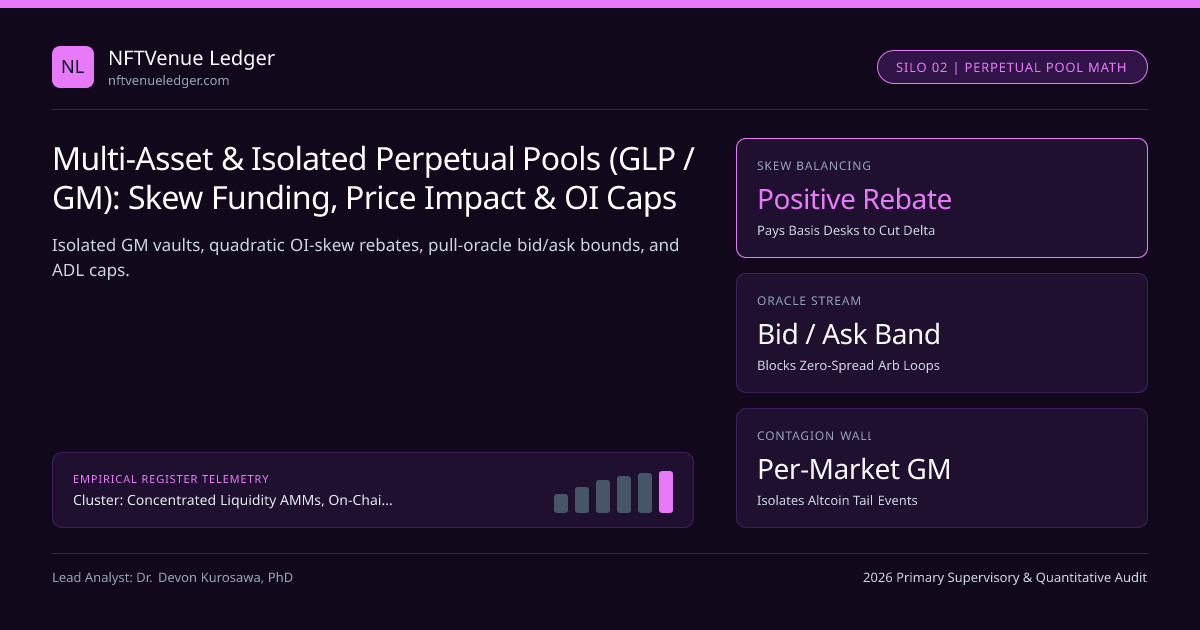
First-generation oracle perpetual vaults—pioneered by GMX v1 GLP under the Multi-Asset Liquidity Pool standard—promised a seductive breakthrough: zero-price-impact leveraged swaps and perpetuals executed directly against external median oracle prices across an index basket (~50% USDC/USDT + BTC + ETH + LINK/UNI). Yet zero price impact created an existential structural vulnerability exploited during the September 2022 AVAX manipulation incident: if an attacker could push thin external spot books upward with $10M, they could open and close a $50M long on GLP with zero slippage, draining passive LPs! Consequently, GMX v2 Isolated GM Markets and modern peer-to-pool perpetual engines replaced naive zero-impact execution with Asymmetric Skew Price Impact, Adaptive Funding Rates, and Auto-Deleveraging (ADL) Open Interest Caps.
Anchored in our concentrated AMM, CLOB & intent DEX master guide, understanding LP counterparty delta is vital before allocating vault capital across perpetual venues vs app-chain CLOBs.
From Shared GLP Contagion to Isolated GM Token Pairs#
Why did institutional LPs demand migrating from monolithic multi-asset GLP to isolated two-token GM pools (e.g., GM: ETH/USDC backed strictly by WETH for longs and USDC for shorts)?
- Eliminating Long-Tail Contagion: In a shared 8-asset
GLPbasket, a single oracle glitch or one-sided 10x rally on an illiquid altcoin drainedUSDCandBTCbelonging to conservative LPs who wanted zero exposure to that altcoin! IsolatedGMpools ring-fence counterparty PnL per market—paralleling isolated-pool risk compartments seen on DEXs in our marketplaces directory like Astroport and Beethoven X. - Two-Step Asynchronous Keeper Execution + Pull Oracles: Traders submit
createOrderin BlockN, and decentralized keepers bundle fresh sub-second Chainlink Data Streams / Pyth signed pull-oracle prices in BlockN+1, eliminating frontrunning of known on-chain oracle heartbeats!
Synthetic Skew Price Impact & Adaptive Funding vs Borrow Fees#
In a peer-to-pool perpetual venue, LPs are net short Trader Net Open Interest (OI_Long - OI_Short): if $80M of longs face $30M of shorts, the GM pool carries an unwanted -$50M net short delta! Modern pools neutralize this directional exposure through dual economic feedbacks:
- Asymmetric Execution Price Impact: Any trade that increases
|OI_Long - OI_Short|pays a convex quadratic price-impact penalty credited to a Price Impact Pool; any trade that reduces|OI_Long - OI_Short|receives a positive price-impact rebate from that pool—turning arbitrageurs into automated delta-neutralizers for passive LPs! - Dual Borrow + Skew Funding: Both longs and shorts pay a utilization Borrowing Fee directly to
GMLPs (compensating capital lockup), while the dominant side (LongswhenOI_Long > OI_Short) pays continuous Adaptive Funding directly to the minority side (Shorts), attracting CEX-hedged cash-and-carry basis desks untilOI_Long approx OI_Short.
Architecture Matrix: Shared GLP vs Isolated GM vs App-Chain CLOB#
| Risk & Pricing Dimension | Legacy Multi-Asset Pool (GMX v1 GLP) | Isolated Skew-Impact Pool (GMX v2 GM) | Enshrined CLOB (App-Chain CLOB) | ||
|---|---|---|---|---|---|
| Slippage / Price Impact | 0.00 bps up to hard OI cap (Exploitable!) | Quadratic in ` | OILong - OIShort | ` delta | Endogenous limit-book depth sweep |
| Tail-Asset Risk Contagion | Shared across entire multi-token vault | Strictly isolated per GM market | Isolated to margin + backstop vault | ||
| LP Directional Counterparty Risk | Unhedged against net trader PnL skew | Actively driven toward 0 net skew via funding | Zero passive pool required (MMs hedge) | ||
| Funding Rate Structure | One-way hourly borrow fee to LPs only | Long-to-Short adaptive funding + LP borrow | Peer-to-peer 1h/8h funding between traders |
Quadratic OI-Skew Price Impact & Funding Velocity Equations#
Protocol risk engineers calibrate price-impact exponent p (typically p in [1.3, 2.0]) and impact factor c_impact so manipulating an external spot book costs strictly more than any extractable GM profit:
- Let Skew0 = |OILong0 - OIShort0|, Skew1 = |OILong1 - OIShort1|
- ImpactPoolUSD(Skew) = c_impact * (Skew)^p
- If Skew1 > Skew0 (Trade worsens pool imbalance):
- TraderPenaltyUSD = cpositiveorneg * ( (Skew1)^p - (Skew_0)^p ) [Paid INTO Impact Pool]
- If Skew1 < Skew0 (Trade reduces pool imbalance):
- TraderRebateUSD = min(ImpactPoolBalance, crebate * ( (Skew0)^p - (Skew_1)^p )) [Paid TO Trader!]
- Worked $5,000,000 ETH Long vs Short Execution (Current OILong = $42M, OIShort = $22M => Skew_0 = +$20M; p = 2.0, c = 2.5e-11):
- Case A — Trader opens $5M MORE Long (Skew_1 = $25M, worsens imbalance):
- Penalty = 2.5e-11 * (6.25e14 - 4.00e14) = $5,625 (-11.25 bps negative price impact + 7 bps fee = -18.25 bps!)
- Case B — Basis Desk opens $5M Short (Skew_1 = $15M, restores pool balance!):
- Rebate = 2.5e-11 * (4.00e14 - 2.25e14) = +$4,375 (+8.75 bps positive rebate - 5 bps fee = NET +3.75 bps PAID TO OPEN!)
Comparing Multi-Asset Index Weights Against Balancer & Curve Pools#
While GM pools price derivatives via pull-oracles to escape Loss-Versus-Rebalancing, spot index vaults price multi-token baskets endogenously—examine generalized spot invariant curves next in Balancer weighted pools & LBP token discovery and Curve StableSwap amplification convexity inside our AMM, CLOB & Intent DEX hub.
Frequently asked questions
Why was zero-slippage trading dangerous for liquidity providers in GMX v1 GLP?
If a perpetual pool fills $40M positions at 0% price impact off an external spot oracle where moving the CEX book by 5% only costs $8M, an attacker profits net +$1M+ directly out of passive LP reserves.
How can a trader earn a positive price-impact rebate when opening a perpetual on GMX v2?
Whenever a market is skewed (e.g., more longs than shorts), penalties paid by skew-increasing longs accumulate in an on-chain Impact Pool and are rebated directly as price improvement to shorts who restore balance.
How do GM perpetual pools avoid traditional AMM Loss-Versus-Rebalancing (LVR)?
Unlike x*y=k spot AMMs that leave stale deterministic quotes sitting on-chain waiting to be arbitraged, GM pools price swaps and positions dynamically using real-time signed pull-oracle bid/ask intervals.
What triggers Auto-Deleveraging (ADL) in an isolated perpetual pool?
If one-sided unrealized trader profits grow past a market configured Max PnL-to-Pool Factor (e.g., 70%–85% of backing reserve tokens), keepers partially close winning positions pro-rata to preserve pool solvency.
Publication record
- Published
- November 13, 2026
- Updated
- November 14, 2026
- Author
- Dr. Devon Kurosawa, PhD
- Review
- Review not recorded
- Automated fact check
- Passed in the stored pipeline record
- Source URLs
- 3 recorded
AI assistance recorded: anthropic/claude-opus-4.6. This field does not establish human review or source verification.
Academic & Institutional Attribution
Cite This Research & Embed Live Data Card
Standard academic & institutional research paper citation format.
Dr. Devon Kurosawa, PhD. (2026, November 14). Multi-Asset & Isolated Perpetual Pools (GLP / GM): Skew Funding, Price Impact & OI Caps. NFTVenue Ledger. https://nftvenueledger.com/protocols/multi-asset-perp-pools-glp-gm-funding-open-interest-capsRegulatory Directory Cross-Reference
Referenced Institutions & Regulatory Registries
Top Regulated Institutions in This Coverage Slice
Primary Tier-1 Supervisory Registries
Related Amm Clob Intent Dex Settlement & Institutional Briefings
Explore Amm Clob Intent Dex Settlement Hub (20) →Amm Clob Intent Dex Settlement
Concentrated Liquidity AMMs, On-Chain CLOBs, Intent Solvers & MEV Microstructure: 2026 GuideAmm Clob Intent Dex Settlement
Balancer Weighted Math & Liquidity Bootstrapping Pools (LBPs): Dutch Weight Decay DiscoveryAmm Clob Intent Dex Settlement
Curve StableSwap Amplification Coefficient (A): Newton-Raphson Math & Depeg Convexity CliffsAmm Clob Intent Dex Settlement
NFT Automated Market Makers (SudoAMM): Discrete Linear vs Exponential Bonding Curve MathAmm Clob Intent Dex Settlement
CEX-DEX Non-Atomic Arbitrage: Inventory Risk, Block-Time Markout Curves & Builder DominanceAmm Clob Intent Dex Settlement
EIP-4844 Blob Base-Fee Spikes: Multi-Dimensional Gas Contention & L2 Liquidation LatencyAmm Clob Intent Dex Settlement
ERC-7683 Cross-Chain Intents: OriginSettler Escrows, Filler Working Capital & Optimistic ProofsAmm Clob Intent Dex Settlement
Auction-Managed AMMs (am-AMM) & Bunni/Diamond Hooks: Recapturing LVR On-Chain for LPsErc721 Erc1155 Eip712 Permit Security
ERC-5192 Minimal Soulbound NFTs: Non-Transferable KYC Badges, Wrapper Traps & RevocationErc721 Erc1155 Eip712 Permit Security
ERC-6551 Token-Bound Accounts (TBAs): State Nonce Frontrunning & Circular Ownership LocksErc721 Erc1155 Eip712 Permit Security
ERC-721 safeTransferFrom & onERC721Received Reentrancy: Max-Supply Bypass & Escrow DrainsErc721 Erc1155 Eip712 Permit Security
Blind-Signing Deprecation (eth_sign), Pre-Sign Transaction Simulation & EIP-7730 Clear Signing
NFTVenue Ledger Data, Benchmarks & Contributor Records
CC BY 4.0 Open Data
Open Institutional Datasets (CSV / JSON) →
Download desk-compiled quantitative series & schemas.
2026 Reference Matrix
2026 Institutional Benchmarks & Thresholds →
Statutory capital, clearing, margin & rate conventions.
Editorial Records
Authors & Review Records →
View named contributors where those records are available.
Complete Index
Master Research & Dossier Archive →
Browse all published briefings by topic pillar & date.