
Amm Clob Intent Dex Settlement
Auction-Managed AMMs (am-AMM) & Bunni/Diamond Hooks: Recapturing LVR On-Chain for LPs
Auction-Managed AMMs (am-AMMs) embed an on-chain Harberger slot auction inside Uniswap v4 hooks, forcing HFT arbitrageurs to pay continuous rent directly to passive LPs.
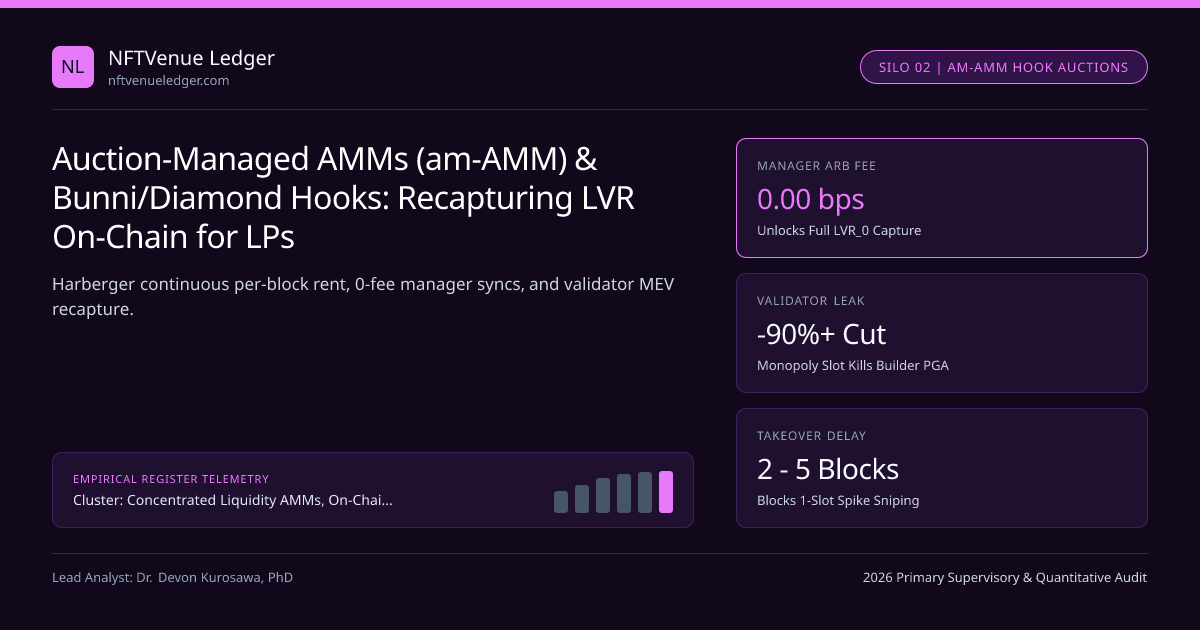
Under standard MEV-Boost PBS, CEX-DEX arbitrageurs extract billions in Loss-Versus-Rebalancing (LVR) from passive AMM liquidity providers and hand 85%–92% of those profits to PoS validators rather than the LPs whose capital made the trade possible! Co-designed by Adams, Millionis, Moallemi, Reynolds, and Robinson (2024, am-AMM: An Auction-Managed Automated Market Maker) and deployed on mainnet via Uniswap v4 singleton hooks (such as Bunni v2 and Sorella Angstrom app-specific auctions), Auction-Managed AMMs (am-AMMs) hijack the arbitrageur competition inside the pool smart contract itself—converting validator MEV bribes into continuous per-block rent streamed directly to passive LPs!
Situated at the frontier of our concentrated AMM, CLOB & intent DEX master guide, am-AMMs resolve the core economic flaw of passive on-chain market making across DEX venues in our marketplaces directory (from 9mm Pro to Beethoven X).
How Harberger Continuous Slot Rent Works Inside a v4 Hook#
Instead of running an expensive gas-heavy sealed auction on every single 12-second block, an am-AMM hook (implementing beforeSwap and afterSwap) runs a censorship-resistant continuous Harberger self-assessed rent auction for the role of *Pool Manager (`M`)**:
- Exclusive First-Swap & Zero-Fee Arbitrage Right: The active Pool Manager
M*holds two superpowers inside every block: (a) exclusive right to execute the very first swap in the block (paying 0 bps pool swap fee!) to align pool price with Binance/Coinbase, and (b) dynamic authority to set the retail swap feef_retail(up to a protocol ceiling) on all subsequent swaps in that block and pocket those retail swap fees! - Continuous Per-Block Rent Paid to Passive LPs: In exchange,
M*deposits prepaid rent collateral and commits to paying passive LPs a self-selected per-block rentR_block(denominated in pool LP shares or numeraire token) on every single block (whether volatility is high or zero!). Any rival HFT desk can *outbid `Mat any time** by postingRnew >= Rcurrent * (1 + minBidIncrement)(taking effect after a briefK = 2..5` block anti-frontrunning delay!).
The Counterintuitive Result: Why am-AMM Pays LPs More Than Standard LVR!#
Here is the mathematical masterstroke proven in Adams et al. (2024): On a standard 30 bps AMM pool, arbitrageurs only rebalance the pool when CEX prices move > 30 bps (leaving the pool slightly stale inside [-30 bps, +30 bps] and forfeiting small-move LVR). Because the am-AMM Pool Manager pays 0.00 bps swap fee on its top-of-block sync trade, the Manager arbitrages every tiny 0.5-bps CEX tick, extracting full zero-fee continuous-time LVR_0 > LVR_f—and under competitive HFT bidding, bids 100% of (LVR_0 + Expected_Retail_Fees - CEX_Hedge_Cost) directly to passive LPs as R_block! Furthermore, because pool price is synced to exact CEX mid at the top of every block, retail aggregators enjoy tighter, fairer mid-prices and route more volume to the pool!
LVR Recapture Architecture Matrix: McAMM vs Diamond vs am-AMM vs Angstrom#
| LVR Mitigation Design | Core Mechanism | Validator Censorship Resistance | Who Sets Retail Swap Fees? | Net LP Surplus vs Standard v3 |
|---|---|---|---|---|
| Standard Uniswap v3 Pool | Passive fixed fee; PBS builders auction top-of-block | High (Permissionless) | Fixed at deploy (1/5/30/100 bps) | Baseline (Loses ~85%+ of LVR to validators) |
Per-Block First-Swap Auction (McAMM) | Separate sealed bid every block for tx_0 | Vulnerable if proposer censors rival bids | Protocol static or formulaic | Recaptures LVR_f, but misses sub-fee sync |
Harberger am-AMM (Bunni v2) | Multi-block continuous rent + 0-fee manager sync | High (K-block delay + deposit burn) | Incentive-aligned Pool Manager! | Highest (LVR_0 + Optimal Retail Fees) |
App-Specific Batch + Top Auction (Angstrom) | Off-chain Restaked AVS runs top-of-block + batch | Secured by EigenLayer slashing | Protocol + uniform batch clearing | Zero LVR leak + CoW batch surplus |
Equilibrium am-AMM Harberger Rent & LP Profit Uplift Equation#
Suppose N >= 2 integrated HFT desks compete to become Pool Manager over expected horizon M blocks (e.g., M = 50 blocks = 10 minutes), facing CEX hedge fee f_CEX and retail volume demand curve V_noise(f) = V_0 * exp(-eta * f):
- 1) Revenue Maximizing Retail Swap Fee Chosen by Manager:
- Maximizef [ f * V0 * exp(-eta * f) ] => f_retail* = 1 / eta
- 2) Manager Expected Per-Block Gross Revenue (0-Fee Arb Sync + Retail Fees):
- E[RevManager] = E[LVRzerofeeperblock(sigma, fCEX)] + (1 / eta) * V0 * exp(-1) - GasSync
- 3) Competitive Harberger Equilibrium Rent Paid to Passive LPs:
- Rblock* = E[RevManager] - DeskRiskSpread
- Worked $25M Concentrated ETH/USDC Pool Comparison (sigmadaily = 3.6%, V0 = $40M/day, eta = 2,000 => f* = 5.0 bps):
- Standard 5-bps v3 Pool (7,200 blocks/day):
- Retail Fees = $14.7M * 5 bps = +$7,350/day; Realized LVR_5bps = -$11,200/day => Net LP PnL = -$3,850/day (LOSS!)
- am-AMM v4 Pool (Manager syncs at 0 DEX fee, paying only 1.1 bps CEX VIP fee => extracts $16,400/day LVR_0!):
- Manager Gross = $16,400 (Arb) + $7,350 (Retail Fees) - $1,150 (Sync Gas & Risk) = $22,600/day ($3.14/block rent!)
- Passive LPs Receive +$22,600/day Rent - $16,400/day LVR_0 Bleed = +$6,200/day POSITIVE NET PROFIT (+$10,050/day swing!)
Synthesizing Next-Generation On-Chain Venue Microstructure#
By embedding continuous Harberger auctions inside Uniswap v4 singleton hooks, am-AMMs transform Loss-Versus-Rebalancing from an uncompensated validator subsidy into positive LP yield—return to our concentrated AMM, CLOB & intent DEX master guide or explore all twenty deep-dives in the AMM, CLOB & Intent DEX hub.
Frequently asked questions
How does an Auction-Managed AMM (am-AMM) stop validators from stealing LVR via MEV-Boost?
Only the registered Pool Manager address is permitted by the v4 beforeSwap hook to execute the top-of-block 0-fee swap; rival searchers cannot outbid the Manager via validator tips in that block, collapsing builder PGA bids.
Why won't the am-AMM Pool Manager set a predatory 50% swap fee on retail traders?
DEX aggregators (1inch, CowSwap,odos, Jupiter) route volume away instantaneously if a pool fee exceeds competing venues; to maximize f * Volume(f) over its rent epoch, the Manager sets the revenue-optimal competitive fee.
Why is there a K-block delay before a higher rent bid takes over as Pool Manager?
Without a K-block (e.g., 3-block) transition buffer, a searcher seeing a sudden +3% Binance candle right now would outbid the incumbent for 1 block, extract the spike, and immediately forfeit its deposit.
Can passive LPs earn more in an am-AMM than they lose to arbitrageurs?
Yes. While passive LPs lose LVR_0 on pool inventory changes, competitive managers bid R_block equal to LVR_0 plus expected retail fee revenue (minus small CEX/gas costs), leaving passive LPs net positive.
Publication record
- Published
- November 13, 2026
- Updated
- November 14, 2026
- Author
- Dr. Devon Kurosawa, PhD
- Review
- Review not recorded
- Automated fact check
- Passed in the stored pipeline record
- Source URLs
- 3 recorded
AI assistance recorded: anthropic/claude-opus-4.6. This field does not establish human review or source verification.
Academic & Institutional Attribution
Cite This Research & Embed Live Data Card
Standard academic & institutional research paper citation format.
Dr. Devon Kurosawa, PhD. (2026, November 14). Auction-Managed AMMs (am-AMM) & Bunni/Diamond Hooks: Recapturing LVR On-Chain for LPs. NFTVenue Ledger. https://nftvenueledger.com/protocols/diamond-hook-vrda-am-amm-auction-managed-pool-fee-captureRegulatory Directory Cross-Reference
Referenced Institutions & Regulatory Registries
Mentioned Regulated Institutions
Primary Tier-1 Supervisory Registries
Related Amm Clob Intent Dex Settlement & Institutional Briefings
Explore Amm Clob Intent Dex Settlement Hub (20) →Amm Clob Intent Dex Settlement
Concentrated Liquidity AMMs, On-Chain CLOBs, Intent Solvers & MEV Microstructure: 2026 GuideAmm Clob Intent Dex Settlement
Uniswap v3 Tick Spacing, Q64.96 Virtual Reserves & Concentrated Liquidity Depth MathAmm Clob Intent Dex Settlement
Loss-Versus-Rebalancing (LVR): Continuous-Time Black-Scholes AMM Adverse SelectionAmm Clob Intent Dex Settlement
Uniswap v4 Singleton PoolManager: EIP-1153 Flash Accounting & Dynamic Fee HooksAmm Clob Intent Dex Settlement
CoW Protocol Uniform Clearing Price Batch Auctions: Solver NP-Hard Optimization & MEV ShieldAmm Clob Intent Dex Settlement
UniswapX Exclusive Dutch-Decay Orders: RFQ Filler Exclusivity & Priority Gas AuctionsAmm Clob Intent Dex Settlement
MEV-Boost Proposer-Builder Separation (PBS): Relay Timing Games & Builder CentralizationAmm Clob Intent Dex Settlement
Just-In-Time (JIT) AMM Liquidity: Intra-Block Mint-Swap-Burn Fee Dilution & LP DefenseCross Chain Bridge Validator Exploits
External Validator Multisig & MPC Bridges: Key-Compromise Anatomy (Ronin, Harmony & Multichain)Cross Chain Bridge Validator Exploits
Optimistic Message Bridges: 1-of-N Watcher Assumptions, Dispute Windows & Nomad Zero-Root RCACross Chain Bridge Validator Exploits
ZK-SNARK Light-Client Bridges: Ethereum Sync Committee Proofs, Circuit Bugs & Multi-Prover DefenseCross Chain Bridge Validator Exploits
Circle CCTP Burn-and-Mint Architecture vs Lock-and-Mint Wrapped Bridge Contagion
NFTVenue Ledger Data, Benchmarks & Contributor Records
CC BY 4.0 Open Data
Open Institutional Datasets (CSV / JSON) →
Download desk-compiled quantitative series & schemas.
2026 Reference Matrix
2026 Institutional Benchmarks & Thresholds →
Statutory capital, clearing, margin & rate conventions.
Editorial Records
Authors & Review Records →
View named contributors where those records are available.
Complete Index
Master Research & Dossier Archive →
Browse all published briefings by topic pillar & date.