
Amm Clob Intent Dex Settlement
Balancer Weighted Math & Liquidity Bootstrapping Pools (LBPs): Dutch Weight Decay Discovery
Balancer generalizes constant-product AMMs into N-asset Cobb-Douglas value functions and time-decaying Liquidity Bootstrapping Pools that neutralize sniper bots.
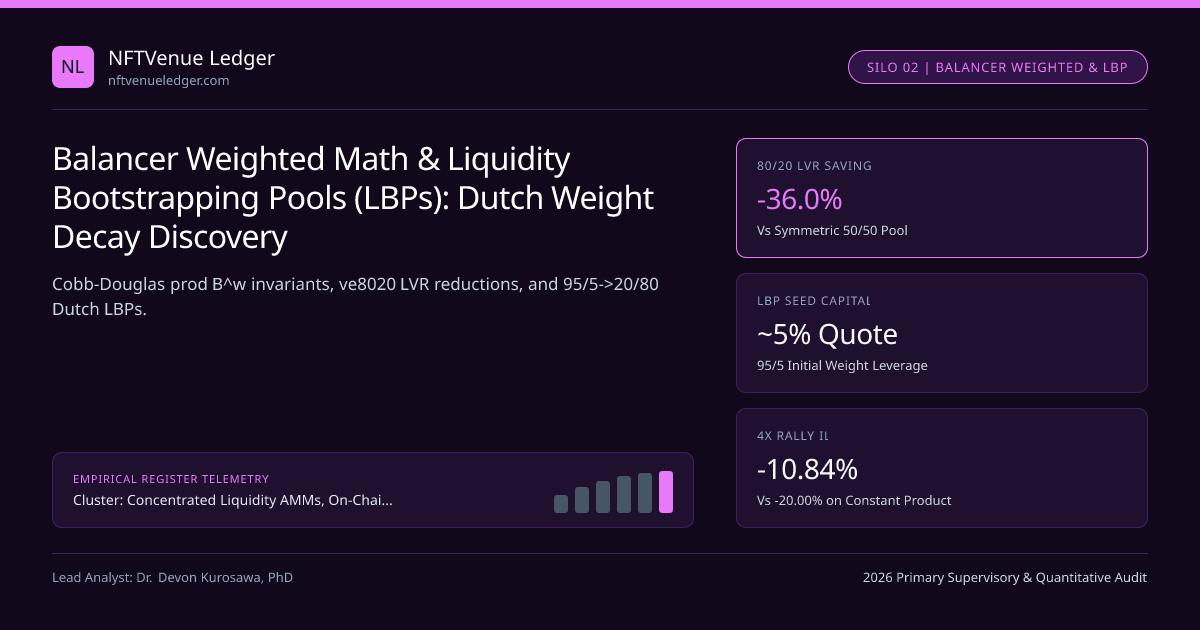
Launching a new protocol token inside a standard 50/50 constant-product AMM requires locking massive upfront USDC or ETH treasury capital and hands 60%–80% of undervalued initial supply to block-0 MEV sniper bundles. Formalized by the Balancer LBP standard and deployed across weighted-math venues in our marketplaces directory led by Beethoven X alongside Balancer Vault ecosystems, Weighted Math (prod B_k^{w_k} = V) decouples reserve value weights w_k from fixed 50/50 symmetry—powering both low-impermanent-loss 80/20 governance liquidity pools and Liquidity Bootstrapping Pools (LBPs) that sweep weights dynamically from 96/4 down to 20/80 over 48 to 72 hours.
Contextualized within our concentrated AMM, CLOB & intent DEX master guide, Cobb-Douglas weighted invariants reshape both primary token price discovery and long-term DAO treasury liquidity management.
Cobb-Douglas Value Function V = prod B_k^(w_k) & 80/20 Pool Economics#
For N tokens (up to N = 8) with normalized weights sum w_k = 1 and token balances B_k, Balancer's invariant maintains constant value index V = prod_{k=1}^N B_k^{w_k}, implying marginal spot price between asset i and numeraire o equals P_{i/o} = (B_o / w_o) / (B_i / w_i). Why have dozens of major DAOs (Aave, Radiant, Pendle, Gnosis) migrated staking and governance liquidity into 80% Token / 20% WETH weighted pools instead of 50/50 pools?
- 80% Upside Retention & -36% Lower LVR: When the governance token rallies
5xagainstETH, a50/50LP suffers-25.5%divergence loss (selling half the rally early), whereas an80/20LP suffers only-12.0%divergence loss—and pays 36% less running Loss-Versus-Rebalancing (w * (1 - w) * sigma^2 / 2 = 0.16 * sigma^2 / 2vs0.25 * sigma^2 / 2)! - 4x Treasury
USDC/ETHCapital Efficiency: Pairing$8.0Mof native treasury tokens requires only$2.0Mof scarceETHorUSDCrather than$8.0M.
How Time-Decaying LBP Weights Punish Block-0 Snipers#
In an LBP, an authorized launch controller invokes updateWeightsGradually(startTime, endTime, endWeights), interpolating w_TKN(t) linearly from w_start = 0.95 (w_USDC = 0.05) at t = 0 down to w_end = 0.20 (w_USDC = 0.80) at t = 72h. Even if zero trades occur (B_TKN and B_USDC constant), spot price P(t) = (B_USDC / B_TKN) * (w_TKN(t) / (1 - w_TKN(t))) decays 76x purely from weight shifting (0.95/0.05 = 19.0 down to 0.20/0.80 = 0.25)!
Consequently, frontrunning block 0 is financial suicide: sniper bots face an intentionally inflated ceiling price, forcing participants to wait until the descending curve intersects fundamental market demand, after which steady buy inflows push B_USDC up and B_TKN down to hold spot price flat across the remaining auction window!
Token Launch & Treasury Pool Architecture Comparison Matrix#
| Pool / Launch Mechanism | Upfront Quote (USDC/ETH) Needed | Block-0 Sniper Vulnerability | Divergence Loss at 3x Token Rally | Post-Launch Liquidity Utility |
|---|---|---|---|---|
Standard 50/50 Constant Product | 100% 1:1 Match ($5M for $5M) | Extreme (Block-0 MEV bundles sweep cheap floor) | -13.40% | High symmetric depth; high LVR |
| Concentrated v3 Single-Sided Range | $0 upfront if minted above spot | High if starting tick mispriced | Variable (100% sold once crossed) | Requires active range management |
Balancer 95/5 -> 20/80 LBP | Only ~5.3% quote seed ($526k for $10M) | Near-Zero (Downward weight decay crushes bots) | N/A (Temporary 72h price-discovery vault) | Proceeds seed permanent 80/20 pool |
Balancer 80/20 Governance Pool | 25% Match ($2.5M for $10M) | Low (Steady-state secondary pool) | -6.05% (55% less IL than 50/50!) | Ideal ve8020 staking + liquid market |
Exact Weighted Swap Output, Divergence Loss & LBP Price Trajectory Math#
Quantitative treasury managers model exact outGivenIn slippage alongside generalized weighted divergence loss DL(k, w_1) for price ratio k = P_final / P_initial:
- 1) AmountOut Given AmountIn (Token i -> Token o, net of fee gamma = 1 - f):
- AmountOut = Bo * [ 1 - ( Bi / (Bi + gamma * AmountIn) )^(wi / w_o) ]
- 2) Generalized Weighted Divergence Loss for Price Ratio k = P1 / P0 (with w1 + w2 = 1):
- DL(k, w1) = ( k^(w1) ) / ( w1 * k + w2 ) - 1
- 3) LBP No-Trade Spot Price Decay Schedule at Hour t in [0, T]:
- w1(t) = wstart - (wstart - wend) * (t / T)
- Pnotrade(t) = (BUSDC / BTKN) * ( w1(t) / (1 - w1(t)) )
- Worked Governance Treasury Audit (k = 4.0x token rally; comparing 50/50 vs 80/20):
- 50/50 Pool (w_1 = 0.50): DL = (4.0^0.50) / (0.50 * 4.0 + 0.50) - 1 = 2.0 / 2.5 - 1 = -20.00%
- 80/20 Pool (w_1 = 0.80): DL = (4.0^0.80) / (0.80 * 4.0 + 0.20) - 1 = 3.0314 / 3.40 - 1 = -10.84% (Nearly cuts IL in half!)
Contrasting Low-Curvature Weighted Pools Against High-Curvature Peg Curves#
While 80/20 weighted pools flatten portfolio rebalance speed for volatile governance tokens, pegged assets (USDC/USDT, ezETH/ETH) require the exact opposite—ultra-low-slippage near-zero-curvature invariants around 1:1 parity! Examine hybrid constant-sum/constant-product invariants next in Curve StableSwap amplification convexity and NFT bonding curves in SudoAMM linear/exponential spreads inside our AMM, CLOB & Intent DEX hub.
Frequently asked questions
Why do sniper bots lose money if they buy in Block 0 of a Balancer LBP?
LBPs initialize at an intentionally high weight ratio (such as 95% project token / 5% USDC); unless massive immediate buying overwhelms the scheduled downward weight shift, spot price falls automatically block after block.
How much more slippage does an 80/20 weighted pool have compared to a 50/50 pool of equal TVL?
Near spot equilibrium, local price impact per dollar swapped scales as 1 / (4 * w * (1 - w)); for w = 0.80, 1 / (4 * 0.16) = 1.5625x—only 56% higher slippage in exchange for 4x less quote-asset capital and 36% less LVR.
Can a Balancer Liquidity Bootstrapping Pool price go up if weights are constantly decaying?
Yes. Whenever organic buyer inflows increase B_USDC and deplete B_TKN faster than w_TKN/(1 - w_TKN) decays, spot price rises or stabilizes along a horizontal equilibrium discovery plateau.
What is the ve8020 tokenomics model adopted by DeFi DAOs?
Instead of locking pure governance tokens in a non-productive staking contract, users lock LP shares of an 80% Governance Token / 20% WETH Balancer pool—preserving 80% token upside while guaranteeing deep spot liquidity.
Publication record
- Published
- November 13, 2026
- Updated
- November 14, 2026
- Author
- Dr. Devon Kurosawa, PhD
- Review
- Review not recorded
- Automated fact check
- Passed in the stored pipeline record
- Source URLs
- 3 recorded
AI assistance recorded: anthropic/claude-opus-4.6. This field does not establish human review or source verification.
Academic & Institutional Attribution
Cite This Research & Embed Live Data Card
Standard academic & institutional research paper citation format.
Dr. Devon Kurosawa, PhD. (2026, November 14). Balancer Weighted Math & Liquidity Bootstrapping Pools (LBPs): Dutch Weight Decay Discovery. NFTVenue Ledger. https://nftvenueledger.com/protocols/balancer-weighted-pools-lbp-decay-token-price-discoveryRegulatory Directory Cross-Reference
Referenced Institutions & Regulatory Registries
Top Regulated Institutions in This Coverage Slice
Primary Tier-1 Supervisory Registries
Related Amm Clob Intent Dex Settlement & Institutional Briefings
Explore Amm Clob Intent Dex Settlement Hub (20) →Amm Clob Intent Dex Settlement
Concentrated Liquidity AMMs, On-Chain CLOBs, Intent Solvers & MEV Microstructure: 2026 GuideAmm Clob Intent Dex Settlement
Curve StableSwap Amplification Coefficient (A): Newton-Raphson Math & Depeg Convexity CliffsAmm Clob Intent Dex Settlement
NFT Automated Market Makers (SudoAMM): Discrete Linear vs Exponential Bonding Curve MathAmm Clob Intent Dex Settlement
CEX-DEX Non-Atomic Arbitrage: Inventory Risk, Block-Time Markout Curves & Builder DominanceAmm Clob Intent Dex Settlement
EIP-4844 Blob Base-Fee Spikes: Multi-Dimensional Gas Contention & L2 Liquidation LatencyAmm Clob Intent Dex Settlement
ERC-7683 Cross-Chain Intents: OriginSettler Escrows, Filler Working Capital & Optimistic ProofsAmm Clob Intent Dex Settlement
Auction-Managed AMMs (am-AMM) & Bunni/Diamond Hooks: Recapturing LVR On-Chain for LPsAmm Clob Intent Dex Settlement
Uniswap v3 Tick Spacing, Q64.96 Virtual Reserves & Concentrated Liquidity Depth MathErc721 Erc1155 Eip712 Permit Security
ERC-6551 Token-Bound Accounts (TBAs): State Nonce Frontrunning & Circular Ownership LocksErc721 Erc1155 Eip712 Permit Security
ERC-721 safeTransferFrom & onERC721Received Reentrancy: Max-Supply Bypass & Escrow DrainsErc721 Erc1155 Eip712 Permit Security
Blind-Signing Deprecation (eth_sign), Pre-Sign Transaction Simulation & EIP-7730 Clear SigningErc721 Erc1155 Eip712 Permit Security
ERC-1155 Batch Transfer Security: Mandatory Receiver Hooks, Array Mismatches & Gas-Bomb DoS
NFTVenue Ledger Data, Benchmarks & Contributor Records
CC BY 4.0 Open Data
Open Institutional Datasets (CSV / JSON) →
Download desk-compiled quantitative series & schemas.
2026 Reference Matrix
2026 Institutional Benchmarks & Thresholds →
Statutory capital, clearing, margin & rate conventions.
Editorial Records
Authors & Review Records →
View named contributors where those records are available.
Complete Index
Master Research & Dossier Archive →
Browse all published briefings by topic pillar & date.