
Amm Clob Intent Dex Settlement
Loss-Versus-Rebalancing (LVR): Continuous-Time Black-Scholes AMM Adverse Selection
Formalized by Milionis, Moallemi, and Roughgarden, Loss-Versus-Rebalancing isolates the irreversible stale-quote arbitrage tax paid by passive AMM liquidity providers.
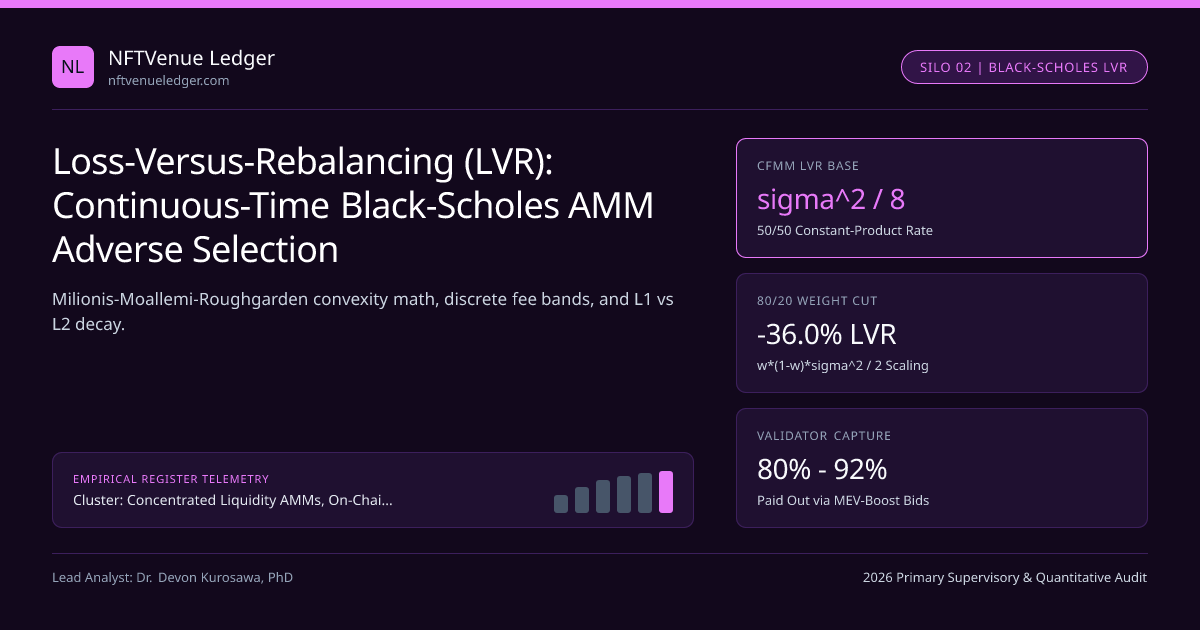
Path-dependent Impermanent Loss (IL) conflates two fundamentally distinct economic forces: market directional risk (which vanishes if price returns to entry) and irreversible informational adverse selection paid to CEX-DEX arbitrageurs along the price path. Formalized by Milionis, Moallemi, Roughgarden, and Zhang (2022–2024), Loss-Versus-Rebalancing (LVR) benchmarks a passive Automated Market Maker pool against a dynamic rebalancing portfolio that executes the exact same trades as the AMM at contemporaneous external CEX mid-prices rather than stale on-chain marginal curves.
Contextualized within our concentrated AMM, CLOB & intent DEX master guide, LVR proves mathematically that delta-hedging an LP position on a perpetual exchange eliminates directional variance while crystallizing LVR as a non-negative running cash bleed equal to Black-Scholes option theta!
Ito's Lemma & Instantaneous LVR Rate ell(P) = (sigma^2 / 2) * P^2 * |x'(P)|#
Let V(P) denote the mark-to-market value of an AMM pool holding reserves (x(P), y(P)) when external geometric Brownian motion price follows dP_t / P_t = mu * dt + sigma * dW_t. By the envelope theorem for cost-minimizing CFMMs, V'(P) = x(P) and V''(P) = x'(P) <= 0 (since risky reserve x(P) decreases as P rises). Applying Ito's Lemma comparing the self-financing CEX rebalancing strategy R_t against pool value V(P_t) yields:
- Non-Negative Running Process:
LVR_T = R_T - V(P_T) = integral_0^T ell(P_t) dt >= 0, strictly increasing with time wheneversigma > 0and liquidityL > 0. - Exact Local Convexity Scaling: Instantaneous loss rate
ell(P) = (sigma^2 / 2) * P^2 * |x'(P)|. For a standardx * y = kpool (V(P) = 2 * sqrt(k * P)),ell(P) / V(P) = sigma^2 / 8!
Discrete Block Times & Swap Fees (LVR_fee) Across L1 vs Fast L2s#
In zero-fee continuous time, LVR is completely invariant to block time! However, real pools on venues in our marketplaces directory (such as Beethoven X, Astroport, and 9mm Pro) charge proportional swap fee f and settle at discrete slot interval Delta_t. Milionis et al. (2023, Automated Market Making and Arbitrage Profits in the Presence of Fees) prove that an arbitrageur trades at the end of slot Delta_t only when the accumulated log-price deviation exceeds the fee no-trade band [-f, +f]:
- *Regime 1: Slow Block Time (`sigma sqrt(Delta_t) >> f
)**: Nearly every block experiences a jump larger thanf; arbitrage probability approaches1, and LPs suffer nearly full continuous-timesigma^2 / 8` LVR. - *Regime 2: Sub-Second Block Time (`sigma sqrt(Deltat) << f
)**: Frequent micro-blocks allow noisy mean-reverting CEX oscillations inside[-f, +f]to cancel out without triggering toxic arbitrage, **reducing fee-adjusted LVR asymptotically byO(1 / (f / (sigma * sqrt(Deltat))))`**!
LVR Exposure Across Pool Invariants & Block Cadences#
| Pool Curve & Chain Cadence | Instantaneous Convexity ` | P^2 x'(P) | / V` | Annualized Zero-Fee LVR (sigma = 70%) | Effect of 30 bps Fee + Block Time |
|---|---|---|---|---|---|
Full-Range x * y = k (12s Ethereum L1) | 0.25 (sigma^2 / 8) | 6.13% of TVL / yr | Moderate filter (~28% LVR reduction) | ||
Uniswap v3 +/- 5% Range (12s L1 + MEV-Boost) | ~10.12 (40.5x leverage) | 248.1% of active TVL / yr (while in range) | High toxic top-of-block CEX-DEX sniping | ||
Uniswap v3 +/- 5% Range (250ms Fast L2) | ~10.12 (40.5x leverage) | 248.1% zero-fee baseline | Significant LVR compression via sub-fee noise | ||
Balancer 80/20 Weighted Pool | 0.16 (w * (1-w) * sigma^2 / 2) | 3.92% of TVL / yr | 36% lower LVR than 50/50 constant product |
Worked Fee-Adjusted LVR & Break-Even Retail Volume Model#
Quantitative vaults running delta-neutral liquidity on Concentrated Liquidity AMMs solve for the minimum daily non-toxic ("noise") turnover multiplier tau_min required to break even against discrete-slot LVR:
- LVR0daily = (sigmadaily^2 / 8) * Mconcentration
- ProbArbPerSlot(f, Deltat) approx 1 / (1 + (f / (sigma_slot * sqrt(pi / 2))))
- LVRnetdaily = LVR0daily * ProbArbPer_Slot
- BreakEvenNoiseVolumeRatio (Vnoise / TVL) = LVRnet_daily / f
- Worked Comparison (ETH/USDC, f = 5 bps = 0.0005, sigmaann = 65% => sigmadaily = 3.40%, M_conc = 20x):
- LVR0daily = (0.001156 / 8) * 20 = 0.00289 (28.9 bps/day)
- Case A — Ethereum L1 (Deltat = 12s => 7,200 slots/day, sigmaslot = 4.01 bps):
- ProbArb approx 1 / (1 + 5.0 / 5.02) = 0.499 => LVRnet_L1 = 14.4 bps/day -> Needs 2.88x daily noise TVL turnover!
- Case B — 250ms Rollup (Deltat = 0.25s => 345,600 slots/day, sigmaslot = 0.58 bps):
- ProbArbasymptotic drops ~0.18 => LVRnetL2 = 5.2 bps/day -> Needs only 1.04x daily noise TVL turnover!
Mitigating LVR via Dynamic Hooks & Auction-Managed Pools#
Protocols recapture or avoid LVR through three structural mechanisms: widening fees dynamically during volatility spikes in Uniswap v4 singleton dynamic hooks, auctioning the first-in-block swap slot to a rent-paying manager in am-AMM auction-managed pools, or measuring empirical post-trade decay via CEX-DEX non-atomic arbitrage markouts across our AMM, CLOB & Intent DEX hub.
Frequently asked questions
How does Loss-Versus-Rebalancing (LVR) differ from Impermanent Loss (IL)?
Impermanent Loss compares holding tokens passively from t=0 to t=T against the AMM pool (vanishing if P_T returns to P_0), whereas LVR compares the AMM against continuously executing the exact same rebalances at CEX mid-prices—accumulating irreversibly along every price oscillation.
Why does faster block time reduce LVR only when pool swap fees are greater than zero?
In a theoretical zero-fee pool, arbitrageurs extract sigma^2/8 regardless of block frequency; with a positive fee f, smaller per-slot price steps stay trapped inside the [-f, +f] no-arbitrage band and mean-revert harmlessly.
Who captures the dollar value lost by LPs to LVR on Ethereum Mainnet?
Arbitrage searchers capture gross LVR between Binance/Coinbase and Ethereum DEX pools, but bid away 80% to 92% of that profit to block builders and PoS validators via MEV-Boost priority tips.
Can dynamic AMM fees completely eliminate LVR on slow 12-second blockchains?
Dynamic directional or volatility fees reduce net LP bleed by taxing arbitrageurs more heavily during high-sigma bursts, though only oracle-assisted hooks or block-top slot auctions (am-AMMs) directly neutralize stale-quote asymmetry.
Publication record
- Published
- November 14, 2026
- Updated
- November 14, 2026
- Author
- Dr. Devon Kurosawa, PhD
- Review
- Review not recorded
- Automated fact check
- Passed in the stored pipeline record
- Source URLs
- 3 recorded
AI assistance recorded: anthropic/claude-opus-4.6. This field does not establish human review or source verification.
Academic & Institutional Attribution
Cite This Research & Embed Live Data Card
Standard academic & institutional research paper citation format.
Dr. Devon Kurosawa, PhD. (2026, November 14). Loss-Versus-Rebalancing (LVR): Continuous-Time Black-Scholes AMM Adverse Selection. NFTVenue Ledger. https://nftvenueledger.com/protocols/loss-versus-rebalancing-lvr-black-scholes-amm-adverseRegulatory Directory Cross-Reference
Referenced Institutions & Regulatory Registries
Top Regulated Institutions in This Coverage Slice
Primary Tier-1 Supervisory Registries
Related Amm Clob Intent Dex Settlement & Institutional Briefings
Explore Amm Clob Intent Dex Settlement Hub (20) →Amm Clob Intent Dex Settlement
Concentrated Liquidity AMMs, On-Chain CLOBs, Intent Solvers & MEV Microstructure: 2026 GuideAmm Clob Intent Dex Settlement
Uniswap v4 Singleton PoolManager: EIP-1153 Flash Accounting & Dynamic Fee HooksAmm Clob Intent Dex Settlement
CoW Protocol Uniform Clearing Price Batch Auctions: Solver NP-Hard Optimization & MEV ShieldAmm Clob Intent Dex Settlement
UniswapX Exclusive Dutch-Decay Orders: RFQ Filler Exclusivity & Priority Gas AuctionsAmm Clob Intent Dex Settlement
MEV-Boost Proposer-Builder Separation (PBS): Relay Timing Games & Builder CentralizationAmm Clob Intent Dex Settlement
Just-In-Time (JIT) AMM Liquidity: Intra-Block Mint-Swap-Burn Fee Dilution & LP DefenseAmm Clob Intent Dex Settlement
Sandwich MEV Attacks: Closed-Form Optimal Frontrun Sizing & Slippage Tolerance ExploitationAmm Clob Intent Dex Settlement
App-Chain On-Chain CLOBs: Enshrined Validator Orderbooks, Cancel Priority & Maker RebatesErc721 Erc1155 Eip712 Permit Security
EIP-2612 ERC-20 Permit Audits: ecrecover Zero-Address, s-Malleability & Griefing FrontrunsErc721 Erc1155 Eip712 Permit Security
ERC-721 & ERC-1155 setApprovalForAll Security: Operator Blast Radius & Conduit IsolationErc721 Erc1155 Eip712 Permit Security
Seaport v1.6 Protocol Architecture: Conduits, Hook Zones & Bulk Order Merkle TreesErc721 Erc1155 Eip712 Permit Security
ERC-2981 NFT Royalty Signaling vs ERC-721C Programmable Transfer-Validator Enforcement
NFTVenue Ledger Data, Benchmarks & Contributor Records
CC BY 4.0 Open Data
Open Institutional Datasets (CSV / JSON) →
Download desk-compiled quantitative series & schemas.
2026 Reference Matrix
2026 Institutional Benchmarks & Thresholds →
Statutory capital, clearing, margin & rate conventions.
Editorial Records
Authors & Review Records →
View named contributors where those records are available.
Complete Index
Master Research & Dossier Archive →
Browse all published briefings by topic pillar & date.