
Mica Vara VASP Marketplace Licensing
EU MiCA Title V CASP Authorization, Dubai VARA & IVMS101 Travel Rule: 2026 Venue Licensing Guide
Under Regulation (EU) 2023/1114 Title V, every crypto exchange and digital asset venue operating in the EEA must hold Class 1, 2, or 3 MiCA CASP own-funds capital alongside IVMS101 Travel Rule telemetry.
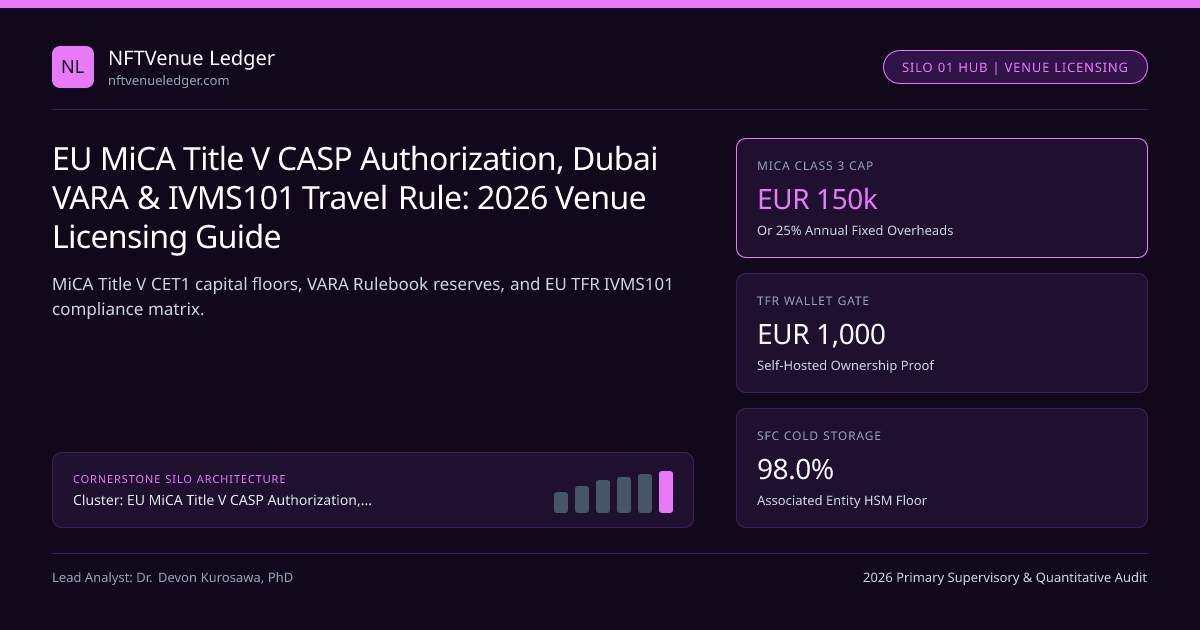
Regulation (EU) 2023/1114 (MiCA) Title V and Regulation (EU) 2023/1113 (TFR) enforce binding prudential capital floors of EUR 50,000, EUR 125,000, and EUR 150,000 across European Economic Area crypto-asset service providers, operating alongside Dubai Virtual Assets Regulatory Authority (VARA) paid-up capital mandates ranging from AED 100,000 to AED 1,500,000. Following the expiry of final transitional grandfathering windows across key member states in mid-2026, institutional liquidity venues, tokenized order books, and hybrid NFT aggregators must map smart-contract execution flows directly against statutory licensing perimeters.
Venue operators tracked inside the regulatory frameworks index and the global marketplaces directory face a three-dimensional supervisory matrix: prudential balance-sheet buffers tied to fixed overheads, wallet-level segregation liabilities for custodied keys, and cryptographic beneficiary messaging under InterVASP Messaging Standard FATF Recommendation 15 VASP standards. This cornerstone reference synthesizes the statutory mechanics across the MiCA, VARA & VASP licensing hub.
MiCA Title V Authorization Classes & Prudential Safeguards#
Articles 59 through 74 of Regulation (EU) 2023/1114 establish ten enumerated crypto-asset services grouped into three prudential capital classes under Annex IV. Class 1 covers order reception, transmission, execution on behalf of clients, placement, transfer services, and advisory mandates with a permanent minimum capital floor of EUR 50,000. Class 2 adds custody and administration of crypto-assets on behalf of clients, swap execution of crypto-assets for funds, and crypto-to-crypto principal dealing at a EUR 125,000 floor. Class 3 governs the operation of a multilateral trading platform for crypto-assets with a EUR 150,000 permanent minimum.
Under MiCA Article 67 prudential own-funds calculations, authorized entities under ESMA supervisory convergence must maintain own funds equal to the higher of their Annex IV permanent floor or 25% of preceding-year fixed overheads, composed primarily of Common Equity Tier 1 (CET1) instruments under Regulation (EU) No 575/2013 (CRR). National competent authorities including German BaFin and French AMF actively audit fixed-overhead deductions during authorization transitions, as detailed in our reviews of BaFin KWG custody grandfathering and French AMF enhanced PSAN passporting.
ESMA NFT Fungibility Perimeters vs Tokenized Marketplaces#
Article 2(3) of MiCA nominally excludes unique and non-fungible crypto-assets from Title V venue licensing, yet Recital 11 and ESMA's Final Report on crypto-asset qualification conditions pierce form-over-substance token standards. Deploying an ERC-721 or ERC-1155 contract does not confer automatic regulatory immunity if tokens are issued in a large series with interdependent market value or confer fractionalized financial claims.
Marketplaces indexing generative collections such as Art Blocks X Bright Moments, Azuki, or Async Blueprints must evaluate ESMA's Substance-Over-Form interdependence test. When an interface bundles floor-sweeping pools, fungible ERC-20 vault shards, or synthetic floor derivatives, the operator triggers Class 1 reception-and-transmission or Class 3 multilateral platform obligations. Our dedicated analysis of ESMA NFT fractionalization and large-series tests contrasts non-custodial order routing against permissioned security token venues utilizing ERC-3643 ONCHAINID whitelisting backed by the ERC-3643 T-REX standard.
Cross-Jurisdictional Capital & Custody Matrix: EEA, UAE & APAC#
Global liquidity groups rarely rely on a single license. Operating an institutional spot and tokenized venue across Europe, the Gulf, and Asia-Pacific requires reconciling divergent cold-wallet storage quotas, statutory trust mandates, and third-country solicitation bans. While Dubai VARA calibrates paid-up AED capital and Net Liquid Assets (1.2x monthly operating expenses) per activity rulebook—analyzed in Dubai VARA Exchange & Broker-Dealer capital rules—financial free zones in Abu Dhabi (ADGM FSRA) and Dubai International Financial Centre (DIFC DFSA) enforce distinct MTF and Recognized Crypto Token lists, unpacked in ADGM FSRA vs DIFC DFSA virtual asset regimes.
In Asia-Pacific, the Hong Kong SFC mandates a strict 98% cold-storage custody allocation with slotting insurance, whereas the Monetary Authority of Singapore enforces a 90% cold-wallet ratio and daily statutory trust reconciliation under the Payment Services Act. Both frameworks contrast sharply with MiCA Article 75 custody liability and MiCA Article 76 trading platform transparency.
| Supervisory Regime | Primary Statutory Instrument | Trading Venue Capital Floor | Mandatory Cold-Storage & Custody Rule | Travel Rule Threshold |
|---|---|---|---|---|
| EEA (ESMA / BaFin) | Regulation (EU) 2023/1114 Art. 67 & 75 | Max(EUR 150,000, 25% Fixed Overheads) | Bankruptcy-remote ledger segregation; strict liability for avoidable key loss | EUR 0 VASP-to-VASP; EUR 1,000 unhosted ownership proof |
| Emirate of Dubai (VARA) | VARA Exchange & Custody Rulebooks 2023 | AED 500,000 (non-custodial) to AED 1,500,000 (custodial) + 1.2x op-ex | Segregated VA wallets + independent annual SOC 2 / ISO 27001 key audit | AED 3,500 encrypted originator/beneficiary IVMS101 |
| Hong Kong (SFC) | AMLO Part 5B VATP Guidelines | HKD 5,000,000 paid-up share capital + 12 months liquid assets | 98% client assets in HSM/FIPS 140-2 Level 3 cold wallets via Associated Entity | HKD 8,000 wire-equivalent Travel Rule; full unhosted vetting |
| Singapore (MAS) | Payment Services Act (Major PI DPT) | SGD 250,000 base capital + security deposit | 90% client DPTs in cold storage held on statutory trust; retail staking ban | SGD 1,500 value-transfer screening; zero threshold basic info |
| New York (NYSDFS) | 23 NYCRR Part 200 (BitLicense) | Risk-based capital + surety bond / trust account | 1:1 asset-type custody parity; Greenlist or approved coin-listing policy | USD 3,000 BSA Travel Rule (FinCEN) |
Quantitative Capital & Liquid Reserve Sizing Model#
Compliance officers structuring multi-entity groups across an EEA MiCA Class 3 trading platform (comparable in venue scope to Bakkt Market or regional spot books such as Altcoin Trader) and a Dubai VARA custodial exchange must model consolidated Common Equity Tier 1 and Net Liquid Asset encumbrance simultaneously:
- RMiCA = max(FClass3, 0.25 * FOprioryear)
- RVARA = max(CpaidupAED / FXEURAED, 1.20 * OpExmonthlyEUR)
- RTotal = RMiCA + RVARA + Ihotwalletdeductible
- Worked Institutional Stress Example:
- Let FClass3 = EUR 150,000; FOprior_year = EUR 4,800,000
- => R_MiCA = max(150,000, 0.25 * 4,800,000) = EUR 1,200,000 CET1
- Let Cpaidup_AED = AED 1,500,000 (FX = 4.00 AED/EUR => EUR 375,000)
- Let OpExmonthlyEUR = EUR 420,000 => 1.20 * 420,000 = EUR 504,000 NLA
- Let Ihotwallet_deductible = EUR 250,000 self-insured hot-wallet buffer
- => R_Total = 1,200,000 + 504,000 + 250,000 = EUR 1,954,000 unencumbered liquid capital
Notice that once annual fixed overheads exceed EUR 600,000, the 25% fixed-overhead leg dominates the EUR 150,000 statutory Class 3 minimum, scaling linearly with engineering payroll, cloud sequencer infrastructure, and external smart-contract audit retainers.
EU TFR Unhosted Wallet Verification & IVMS101 Encryption#
Regulation (EU) 2023/1113 eliminates the traditional EUR 1,000 wire-transfer de minimis exemption for CASP-to-CASP crypto transfers: every inter-VASP transfer regardless of notional value must carry validated originator and beneficiary attributes formatted to the Joint Working Group IVMS101.2023 data model. When a transfer involves a self-hosted wallet (such as an institutional Safe multisig or retail hardware signer) and exceeds EUR 1,000, Article 14(5) requires the CASP to verify whether its own customer effectively owns or controls that external address.
Acceptable cryptographic and analytical verification methods published under EBA Travel Rule Guidelines (EBA/GL/2024/11) are examined in EU TFR self-hosted wallet >EUR 1,000 verification and IVMS101 Travel Rule payload encryption & Sunrise routing. Meanwhile, offshore venues attempting to serve EEA residents without Title V authorization face aggressive domain blocking and payment-rail cutoffs under MiCA Article 61 reverse solicitation enforcement.
DeFi Frontend Governance Attribution & Global Perimeter Convergence#
Whether a decentralized AMM or order-book protocol triggers VASP registration hinges on operational control rather than marketing labels. Under FATF Virtual Asset Guidance, founders, DAO multisig signers, or commercial frontend operators who retain upgrade keys, collect protocol fee switches, or curate default token lists can be designated as regulated intermediaries. We dissect these control vectors in FATF Recommendation 15 DeFi governance attribution and FinCEN CVC MSB guidance, alongside global custody benchmarks in Hong Kong SFC 98% cold storage, Japan JFSA trust parity, NYSDFS BitLicense rules, and Swiss FINMA DLT facilities. Verify live charters via our verification portal and venue benchmarks.
Frequently asked questions
What are the three prudential capital classes for CASPs under EU MiCA Title V?
Annex IV of Regulation (EU) 2023/1114 sets permanent minimum capital at EUR 50,000 for Class 1 (order routing, execution, transfer, advisory), EUR 125,000 for Class 2 (custody and principal brokerage), and EUR 150,000 for Class 3 (operating a crypto-asset trading platform), paired with a 25% prior-year fixed-overhead test.
When does an NFT marketplace require MiCA CASP authorization in the European Union?
Under MiCA Article 2(3), Recital 11, and ESMA final guidelines, an NFT venue requires Title V authorization whenever listed tokens belong to a large series exhibiting fungible valuation interdependence, grant fractional financial rights, or route through pooled swap books.
How does EU TFR regulate crypto transfers above EUR 1,000 to self-hosted wallets?
Article 14(5) of Regulation (EU) 2023/1113 requires CASPs executing a transfer exceeding EUR 1,000 to or from a customer self-hosted wallet to verify customer ownership or control via cryptographic EIP-712/EIP-191 signatures, micro-deposit tests, or EBA-approved wallet analytics.
How do Dubai VARA exchange capital rules differ from Hong Kong SFC VATP rules?
Dubai VARA mandates AED 500,000 (non-custodial) to AED 1,500,000 (custodial) paid-up capital plus Net Liquid Assets equal to 1.2x monthly operating expenses, whereas Hong Kong SFC requires HKD 5,000,000 paid-up capital, 12 months of liquid reserves, and 98% HSM cold storage.
Publication record
- Published
- November 14, 2026
- Updated
- November 14, 2026
- Author
- Dr. Devon Kurosawa, PhD
- Review
- Review not recorded
- Automated fact check
- Passed in the stored pipeline record
- Source URLs
- 4 recorded
AI assistance recorded: anthropic/claude-opus-4.6. This field does not establish human review or source verification.
Academic & Institutional Attribution
Cite This Research & Embed Live Data Card
Standard academic & institutional research paper citation format.
Dr. Devon Kurosawa, PhD. (2026, November 14). EU MiCA Title V CASP Authorization, Dubai VARA & IVMS101 Travel Rule: 2026 Venue Licensing Guide. NFTVenue Ledger. https://nftvenueledger.com/protocols/eu-mica-title-v-casp-dubai-vara-travel-rule-guide-2026Regulatory Directory Cross-Reference
Referenced Institutions & Regulatory Registries
Top Regulated Institutions in This Coverage Slice
Referenced Supervisory Authorities
Related Mica Vara VASP Marketplace Licensing & Institutional Briefings
Explore Mica Vara VASP Marketplace Licensing Hub (20) →Mica Vara VASP Marketplace Licensing
MiCA Article 67 CASP Prudential Safeguards: EUR 50k, 125k & 150k Own-Funds MechanicsMica Vara VASP Marketplace Licensing
ESMA MiCA Guidelines on NFT Fractionalization: Large-Series Fungibility vs Article 2(3)Mica Vara VASP Marketplace Licensing
Dubai VARA Exchange & Broker-Dealer Rulebooks: Paid-Up AED Capital & Net Liquid AssetsMica Vara VASP Marketplace Licensing
EU Transfer of Funds Regulation (TFR) Article 14: Self-Hosted Wallet >EUR 1,000 VerificationMica Vara VASP Marketplace Licensing
IVMS101.2023 Travel Rule Payload Encryption: VASP Discovery & Sunrise Issue RoutingMica Vara VASP Marketplace Licensing
MiCA Article 61 Reverse Solicitation: ESMA Third-Country Crypto Exchange Geo-FencingMica Vara VASP Marketplace Licensing
MiCA Article 75 CASP Custody Segregation: Omnibus Wallets & Sub-Custodian LiabilityMica Vara VASP Marketplace Licensing
MiCA Article 76 Crypto Trading Platform Rules: Order-Book Transparency & Settlement FinalityAmm Clob Intent Dex Settlement
Concentrated Liquidity AMMs, On-Chain CLOBs, Intent Solvers & MEV Microstructure: 2026 GuideErc721 Erc1155 Eip712 Permit Security
EIP-712 Typed Signatures, Permit2 Allowances, NFT Royalties & Proxy Timelocks: 2026 Security GuideCross Chain Bridge Validator Exploits
Cross-Chain Bridge Verification, Oracle Manipulation & DeFi Exploit Root-Cause Guide (2026)Onchain Wash Trading Market Abuse
MiCA Title VI Market Abuse Surveillance, Wash-Trade Graph Forensics & STOR Guide (2026)
NFTVenue Ledger Data, Benchmarks & Contributor Records
CC BY 4.0 Open Data
Open Institutional Datasets (CSV / JSON) →
Download desk-compiled quantitative series & schemas.
2026 Reference Matrix
2026 Institutional Benchmarks & Thresholds →
Statutory capital, clearing, margin & rate conventions.
Editorial Records
Authors & Review Records →
View named contributors where those records are available.
Complete Index
Master Research & Dossier Archive →
Browse all published briefings by topic pillar & date.