
Mica Vara VASP Marketplace Licensing
FATF Recommendation 15 DeFi Governance & Admin Key Tests for VASP Attribution
FATF Updated Virtual Asset Guidance Paragraph 67 and MiCA Recital 22 look past decentralization claims to test admin upgrade keys, fee switches, and DAO voting concentration for VASP attribution.
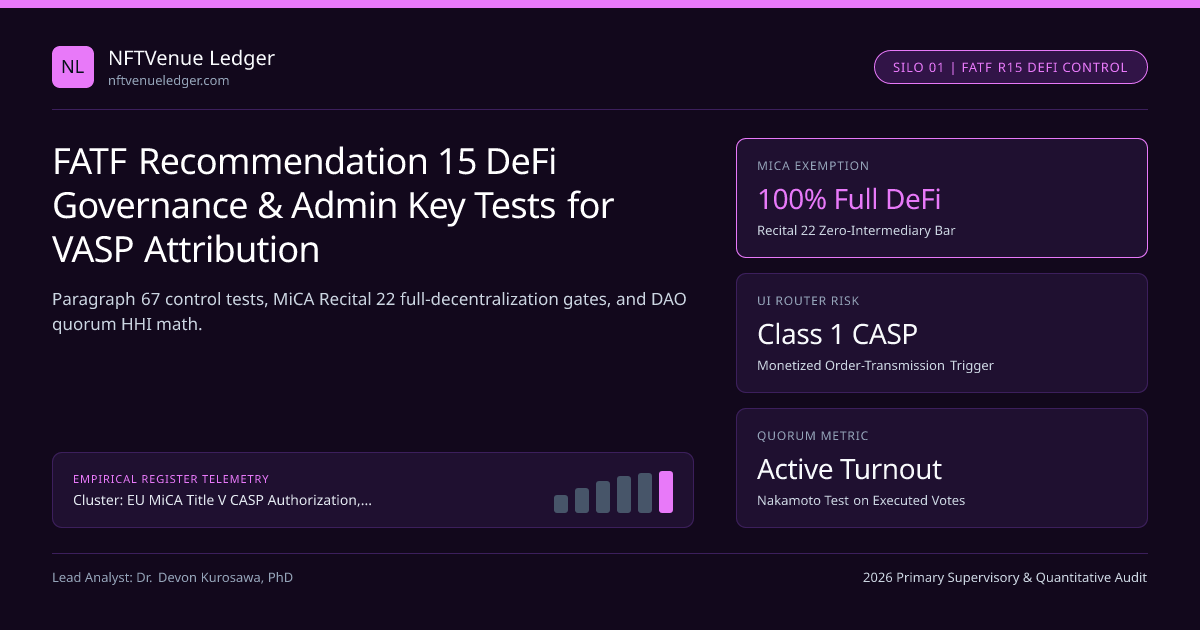
Paragraph 67 of the FATF Updated Guidance for a Risk-Based Approach to Virtual Assets and VASPs (October 2021), reinforced by IOSCO's Policy Recommendations for Decentralized Finance (FR14/2023) and Recital 22 of EU MiCA, establishes a universal regulatory axiom: a software protocol is never a VASP, but creators, owners, operators, or governance token blocs who maintain "control or sufficient influence" over a DeFi arrangement ARE VASPs under FATF Recommendation 15. Calling an automated market maker or lending market "decentralized" provides zero legal shield if a 3-of-5 founder multisig can pause swaps, swap out ERC-1967 proxy implementations without a timelock, or divert protocol LP fees to a Delaware or Cayman treasury.
Synthesized inside our EU MiCA Title V, VARA & Travel Rule master guide, protocol counsel audit five technical decentralization vectors before claiming MiCA Recital 22's "fully decentralised manner without any intermediary" safe harbor.
The Five Control Vectors Piercing "DeFi Theatre" Under FATF & IOSCO#
Supervisors at ESMA, FinCEN, and Singapore MAS evaluate end-to-end socio-technical stack control—spanning smart contracts, sequencers, oracles, governance treasuries, and hosted web frontends (across DEX ecosystems indexed in our marketplaces directory such as Astroport, Beethoven X, Auraswap, and Animeswap):
- Unilateral Proxy Upgradeability & Emergency Admin Keys: Can a narrow multisig modify settlement logic, freeze user pool balances, or whitelist hooks (compare immutable core deployments like the Uniswap v4 singleton architecture against upgradeable proxy pools)?
- Ongoing Commercial Fee Extraction: Does a foundation, Labs corporation, or concentrated DAO treasury collect taker bps, frontend interface fees (
15–25 bpsUI router skims!), or MEV orderflow auction rebates? Note: under MiCA Recital 22, even if the underlying L1 contract is immutable, a commercial company operating a hosted web frontend that charges routing fees for order reception/transmission risks Class 1 CASP classification! - Governance Token Nakamoto Coefficient & VC Voting Blocs: If founders, insiders, and affiliated venture funds hold
>= 50%of active quorum voting power in DAO proposals, IOSCO's Responsible Person test attributes operational control directly to that controlling coalition.
Comparing EU MiCA Recital 22, FATF Para. 67 & IOSCO Responsible Persons#
Crucially, ESMA emphasized in its October 2023 DeFi Market Report and subsequent Q&As that MiCA Recital 22 sets an all-or-nothing ("fully decentralised") bar: where crypto-asset services are provided in a partially decentralized manner, MiCA applies in full!
Governance & Control Attribution Matrix Across DeFi Stacks#
| Protocol Governance Archetype | Contract Upgrade & Fee Control | MiCA Recital 22 / ESMA Standing | FATF R15 / IOSCO Attribution |
|---|---|---|---|
| Immutable Singleton + IPFS Open UI | Zero admin keys; immutable swap fee; zero UI skim | Exempt ("Fully decentralised without intermediary") | Pure software tool (no VASP entity exists) |
| Immutable Core + Commercial SaaS UI | Core immutable, but Labs Inc. runs hosted router API charging 25 bps | Labs Inc. risks Class 1 Order Reception/Transmission CASP | Labs Inc. evaluated as VASP interface operator |
| 4-of-7 Multisig Upgradeable Pool | Team multisig upgrades proxy with <24h delay & takes 20% fee cut | In-Scope MiCA CASP ("Partial decentralization") | Multisig signers / Foundation designated VASP |
| Concentrated Governance Token DAO | Top 3 VC + Founder wallets control 64% of executed DAO votes | Controlling coalition / Foundation fails Recital 22 | IOSCO "Responsible Persons" under securities/VASP law |
Quantitative Governance Concentration (HHI_quorum) & Nakamoto Test#
Protocol legal architects quantify DAO voting capture before renouncing foundation keys by measuring the Effective Active-Quorum Herfindahl-Hirschman Index (HHI_quorum) across executed proposals over the trailing 180 days:
- s{i,active} = VotesCastByEntityClusteri / TotalVotesCastTrailing180d
- HHIquorum = sum{i=1}^{M} (100 * s_{i,active})^2 (Scale: 0 to 10,000)
- NakamotoQuorum = min { K : sum{i=1}^{K} s_{(i),active} > 0.50 }
- Worked Protocol Decentralization Audit:
- Although circulating token supply sits across 48,000 wallets, voter apathy leaves 11% turnout;
- Across 14 proposals: LabsTreasury = 24%, LeadVCA = 19%, LeadVC_B = 14%, 320 Delegates = 43%
- => Top 3 aligned clusters cast 24% + 19% + 14% = 57% > 50% => Nakamoto_Quorum = 3!
- => HHI_quorum = 24^2 + 19^2 + 14^2 + ... = 576 + 361 + 196 + 85 = 1,218 (Concentrated insider control!)
- => Legal Verdict: Fails MiCA Recital 22 & IOSCO Responsible Person tests unless admin powers are burned!
Embedding Permissioned KYC Hooks vs Pure Decentralization#
Explore how institutional protocols embed compliant KYC directly at the token and pool layer instead via ERC-3643 ONCHAINID venue whitelisting and FinCEN CVC MSB rules inside our MiCA, VARA & Travel Rule hub.
Frequently asked questions
Can a smart contract itself be prosecuted or licensed as a VASP under FATF Recommendation 15?
No. FATF Paragraph 67 explicitly states that a DeFi software program or smart contract is not a VASP; supervision attaches to the natural or legal persons exercising control or sufficient influence over the arrangement.
Does wrapping a DAO in a Cayman Foundation protect DeFi multisig signers from VASP rules?
While a foundation company provides corporate personality and limits general contract/tort liability for token holders, the foundation entity itself must still obtain VASP or MiCA CASP licenses if it operates regulated services.
Why do frontend swap fees create regulatory exposure when core AMM pools are immutable?
Charging a commercial bps fee on a hosted web interface that constructs, routes, and transmits user swap orders converts pure open-source publishing into commercial reception and transmission of orders (MiCA Class 1).
How can an upgradeable DeFi protocol reduce VASP attribution risk without freezing bug fixes?
Protocols minimize discretionary control by burning arbitrary drain/whitelist functions, restricting governance strictly to bounded fee/oracle parameters, dispersing active voting power, and enforcing 7-to-14-day exit timelocks.
Publication record
- Published
- November 14, 2026
- Updated
- November 14, 2026
- Author
- Dr. Devon Kurosawa, PhD
- Review
- Review not recorded
- Automated fact check
- Passed in the stored pipeline record
- Source URLs
- 3 recorded
AI assistance recorded: anthropic/claude-opus-4.6. This field does not establish human review or source verification.
Academic & Institutional Attribution
Cite This Research & Embed Live Data Card
Standard academic & institutional research paper citation format.
Dr. Devon Kurosawa, PhD. (2026, November 14). FATF Recommendation 15 DeFi Governance & Admin Key Tests for VASP Attribution. NFTVenue Ledger. https://nftvenueledger.com/protocols/fatf-recommendation-15-defi-governance-vasp-attributionRegulatory Directory Cross-Reference
Referenced Institutions & Regulatory Registries
Top Regulated Institutions in This Coverage Slice
Referenced Supervisory Authorities
Related Mica Vara VASP Marketplace Licensing & Institutional Briefings
Explore Mica Vara VASP Marketplace Licensing Hub (20) →Mica Vara VASP Marketplace Licensing
EU MiCA Title V CASP Authorization, Dubai VARA & IVMS101 Travel Rule: 2026 Venue Licensing GuideMica Vara VASP Marketplace Licensing
ERC-3643 ONCHAINID Claims Registry: Permissioned RWA Venue KYC Transfer GatesMica Vara VASP Marketplace Licensing
MiCA Article 67 CASP Prudential Safeguards: EUR 50k, 125k & 150k Own-Funds MechanicsMica Vara VASP Marketplace Licensing
ESMA MiCA Guidelines on NFT Fractionalization: Large-Series Fungibility vs Article 2(3)Mica Vara VASP Marketplace Licensing
Dubai VARA Exchange & Broker-Dealer Rulebooks: Paid-Up AED Capital & Net Liquid AssetsMica Vara VASP Marketplace Licensing
EU Transfer of Funds Regulation (TFR) Article 14: Self-Hosted Wallet >EUR 1,000 VerificationMica Vara VASP Marketplace Licensing
IVMS101.2023 Travel Rule Payload Encryption: VASP Discovery & Sunrise Issue RoutingMica Vara VASP Marketplace Licensing
MiCA Article 61 Reverse Solicitation: ESMA Third-Country Crypto Exchange Geo-FencingAmm Clob Intent Dex Settlement
Auction-Managed AMMs (am-AMM) & Bunni/Diamond Hooks: Recapturing LVR On-Chain for LPsErc721 Erc1155 Eip712 Permit Security
EIP-712 Domain Separator Engineering: Dynamic chainId Caching & Cross-Fork Replay DefenseErc721 Erc1155 Eip712 Permit Security
Uniswap Permit2 Security Audit: AllowanceTransfer vs SignatureTransfer & Witness PhishingErc721 Erc1155 Eip712 Permit Security
EIP-2612 ERC-20 Permit Audits: ecrecover Zero-Address, s-Malleability & Griefing Frontruns
NFTVenue Ledger Data, Benchmarks & Contributor Records
CC BY 4.0 Open Data
Open Institutional Datasets (CSV / JSON) →
Download desk-compiled quantitative series & schemas.
2026 Reference Matrix
2026 Institutional Benchmarks & Thresholds →
Statutory capital, clearing, margin & rate conventions.
Editorial Records
Authors & Review Records →
View named contributors where those records are available.
Complete Index
Master Research & Dossier Archive →
Browse all published briefings by topic pillar & date.