
Mica Vara VASP Marketplace Licensing
EU Transfer of Funds Regulation (TFR) Article 14: Self-Hosted Wallet >EUR 1,000 Verification
Articles 14(5) and 16(2) of EU Regulation 2023/1113 compel MiCA CASPs to collect counterparty details on all self-hosted crypto wallet transfers and prove client ownership above EUR 1,000.
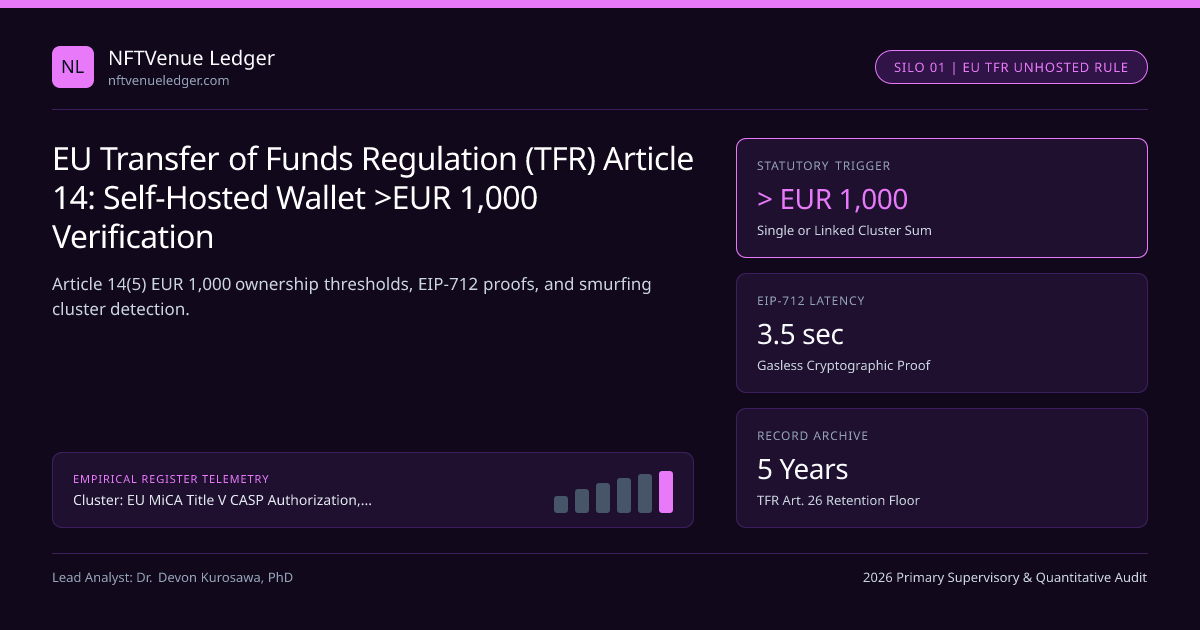
Articles 14(5) and 16(2) of Regulation (EU) 2023/1113—the recast EU Transfer of Funds Regulation (TFR)—establish a two-tier compliance gate whenever a Crypto-Asset Service Provider executes an on-chain deposit or withdrawal involving a self-hosted address (an unhosted hardware signer, browser wallet, or institutional Safe multisig not controlled by a linked CASP). For any self-hosted transfer regardless of value, the CASP must obtain and retain originator or beneficiary identity records; once a single transfer or linked batch exceeds EUR 1,000, the CASP must additionally verify whether its own customer effectively owns or controls that self-hosted address.
Integrated alongside our EU MiCA Title V, VARA & Travel Rule master guide, EBA's Travel Rule Guidelines (EBA/GL/2024/11) standardize exact technical proofs accepted by ESMA, BaFin, and AMF supervisors.
Zero-Threshold Identity Logging vs the EUR 1,000 Ownership Trigger#
Compliance teams migrating exchanges such as Binance 2807 or regional European books frequently conflate information collection with ownership verification. Under TFR:
- Transfers
<= EUR 1,000(Without Linked Smurfing Indicators): The CASP must collect the counterparty name and distributed ledger address, screen the address against EU/UN sanctions lists and blockchain risk heuristics, and store the record for five years under Article 26, without forcing an interactive cryptographic signature ceremony. - Transfers
> EUR 1,000(Single or Linked Series): Before releasing outbound funds (Article 14(5)) or crediting inbound deposits to tradeable spot balances (Article 16(2)), the CASP must assess whether the self-hosted wallet belongs to its own customer. If the customer claims ownership, the CASP must execute at least one EBA-compliant technical verification method; if the wallet belongs to a third party, enhanced risk-based AML/CFT controls apply.
EBA-Approved Technical Proof Methods: EIP-712, AOPP & Satoshi Tests#
Paragraphs 73 through 82 of EBA/GL/2024/11 prescribe specific technical mechanisms so CASPs avoid relying on easily forged wallet screenshots (which EBA explicitly rejects as standalone proof unless corroborated by secondary controls):
- Cryptographic Message Signing (EIP-712 Typed Signatures / BIP-322 / AOPP): The CASP generates a single-use session nonce, timestamp, CASP domain identifier, and customer account hash. Signing offline via Ledger, Trezor, or ERC-1271 smart wallet proves private-key possession at zero gas cost in under 4 seconds.
- Unattended Randomized Micro-Deposit ("Satoshi Test"): For UTXO chains or custodial HSM vaults unable to sign arbitrary messages, the CASP instructs the customer to broadcast an exact randomized dust amount (e.g.,
0.0001483 BTC) from the target address within a bounded 30-minute window. - Whitelisting Persistence: Once ownership of an address is cryptographically verified and continuous chain-analytics monitoring detects no ownership transfer (such as a transferable smart-account owner swap), the CASP need not re-prompt the user on subsequent
> EUR 1,000withdrawals.
Technical Proof-of-Ownership Mechanism Comparison#
| Verification Mechanism | Supported Chains & Wallets | User Gas Cost | Median Completion Latency | EBA/GL/2024/11 Supervisory Standing |
|---|---|---|---|---|
| EIP-712 / EIP-191 Typed Challenge | Ethereum, L2s, EVM EOAs & ERC-1271 Safes | EUR 0.00 | 3.5 seconds | Primary single-factor cryptographic proof |
| BIP-322 / AOPP Signed Proof | Bitcoin SegWit / Taproot Hardware Wallets | EUR 0.00 | 6.0 seconds | Primary single-factor cryptographic proof |
| Randomized Satoshi Micro-Transfer | Bitcoin, Solana, Cosmos, Legacy UTXO | EUR 0.15 - EUR 4.80 | 2 to 25 minutes | Accepted standalone proof when message signing unavailable |
| KYT Cluster + Historical KYC Link | Multi-chain institutional treasury vaults | EUR 0.00 | Automated (<500 ms) | Permitted only when combined with secondary corroboration |
Linked-Transaction ("Smurfing") Aggregation Formula#
Article 14(5) applies not only when an individual transfer exceeds EUR 1,000, but also where several transfers appear to be linked and collectively exceed EUR 1,000. EBA mandates graph-cluster aggregation across addresses sharing common-input-ownership or gas-funding roots under FATF Recommendation 15:
- S{c,T} = sum{k in Cluster(c), tk in [T - DeltaW, T]} (Amountk * EURSpot{tk})
- TriggerVerification = 1 if (SingleTxEUR > 1000) OR (S{c,T} > 1000)
- Worked Structuring Detection Scenario:
- Client withdraws 3 transfers over 18 hours to 3 fresh EVM addresses funded by the same gas faucet:
- Tx_1 = 0.14 ETH @ EUR 2,800 = EUR 392.00
- Tx_2 = 0.13 ETH @ EUR 2,820 = EUR 366.60
- Tx_3 = 0.12 ETH @ EUR 2,810 = EUR 337.20
- => S_{c,T} = 392.00 + 366.60 + 337.20 = EUR 1,095.80 > EUR 1,000.00
- => Hold Tx_3 in pre-broadcast quarantine until EIP-712 ownership proof is completed on all 3 addresses!
Inter-VASP Hand-Off & Custody Ring-Fencing#
Once wallet attribution confirms a peer VASP rather than a self-hosted wallet, the flow routes into IVMS101 Travel Rule payload encryption and cross-links with MiCA Article 75 custody segregation across the MiCA, VARA & Travel Rule hub.
Frequently asked questions
Does EU TFR ban crypto transfers to self-hosted hardware wallets like Ledger or Trezor?
No. Self-hosted wallets remain completely lawful in the EU; TFR Articles 14(5) and 16(2) simply obligate the regulated CASP to verify customer ownership on transfers above EUR 1,000 and apply risk-based AML screening.
Can a user submit a screenshot of MetaMask to satisfy the EUR 1,000 TFR ownership check?
No. EBA/GL/2024/11 explicitly rules out uncorroborated screenshots or video captures as standalone verification because DOM elements are trivially falsified; CASPs must use cryptographic signing or micro-transfers.
Do users have to re-sign an EIP-712 proof every time they withdraw over EUR 1,000?
No. Under EBA guidelines, once a CASP cryptographically verifies customer control of a specific self-hosted address, it may whitelist that address for ongoing transfers unless new risk or ownership-change indicators arise.
What happens if an inbound deposit over EUR 1,000 arrives from an unverified third-party wallet?
Under TFR Article 16 and Article 17, the beneficiary CASP holds the inbound crypto-assets in pre-credit quarantine while collecting originator details and conducting enhanced blockchain taint and sanctions screening.
Publication record
- Published
- November 14, 2026
- Updated
- November 14, 2026
- Author
- Dr. Devon Kurosawa, PhD
- Review
- Review not recorded
- Automated fact check
- Passed in the stored pipeline record
- Source URLs
- 3 recorded
AI assistance recorded: anthropic/claude-opus-4.6. This field does not establish human review or source verification.
Academic & Institutional Attribution
Cite This Research & Embed Live Data Card
Standard academic & institutional research paper citation format.
Dr. Devon Kurosawa, PhD. (2026, November 14). EU Transfer of Funds Regulation (TFR) Article 14: Self-Hosted Wallet >EUR 1,000 Verification. NFTVenue Ledger. https://nftvenueledger.com/protocols/eu-tfr-regulation-2023-1113-unhosted-wallet-verificationRegulatory Directory Cross-Reference
Referenced Institutions & Regulatory Registries
Mentioned Regulated Institutions
Related Mica Vara VASP Marketplace Licensing & Institutional Briefings
Explore Mica Vara VASP Marketplace Licensing Hub (20) →Mica Vara VASP Marketplace Licensing
EU MiCA Title V CASP Authorization, Dubai VARA & IVMS101 Travel Rule: 2026 Venue Licensing GuideMica Vara VASP Marketplace Licensing
IVMS101.2023 Travel Rule Payload Encryption: VASP Discovery & Sunrise Issue RoutingMica Vara VASP Marketplace Licensing
MiCA Article 61 Reverse Solicitation: ESMA Third-Country Crypto Exchange Geo-FencingMica Vara VASP Marketplace Licensing
MiCA Article 75 CASP Custody Segregation: Omnibus Wallets & Sub-Custodian LiabilityMica Vara VASP Marketplace Licensing
MiCA Article 76 Crypto Trading Platform Rules: Order-Book Transparency & Settlement FinalityMica Vara VASP Marketplace Licensing
Abu Dhabi ADGM FSRA Virtual Asset MTF vs DIFC DFSA Recognized Crypto Token RegimesMica Vara VASP Marketplace Licensing
Hong Kong SFC VATP Licensing: 98% Cold-Storage Custody Ratio & Insurance SizingMica Vara VASP Marketplace Licensing
Singapore MAS Payment Services Act DPT Rules: 90% Cold-Wallet Statutory Trust ControlsAmm Clob Intent Dex Settlement
UniswapX Exclusive Dutch-Decay Orders: RFQ Filler Exclusivity & Priority Gas AuctionsAmm Clob Intent Dex Settlement
MEV-Boost Proposer-Builder Separation (PBS): Relay Timing Games & Builder CentralizationAmm Clob Intent Dex Settlement
Just-In-Time (JIT) AMM Liquidity: Intra-Block Mint-Swap-Burn Fee Dilution & LP DefenseAmm Clob Intent Dex Settlement
Sandwich MEV Attacks: Closed-Form Optimal Frontrun Sizing & Slippage Tolerance Exploitation
NFTVenue Ledger Data, Benchmarks & Contributor Records
CC BY 4.0 Open Data
Open Institutional Datasets (CSV / JSON) →
Download desk-compiled quantitative series & schemas.
2026 Reference Matrix
2026 Institutional Benchmarks & Thresholds →
Statutory capital, clearing, margin & rate conventions.
Editorial Records
Authors & Review Records →
View named contributors where those records are available.
Complete Index
Master Research & Dossier Archive →
Browse all published briefings by topic pillar & date.