
Mica Vara VASP Marketplace Licensing
Japan JFSA & JVCEA Crypto Exchange Rules: 95% Cold-Wallet Segregation & Liability Reserves
Under Article 63-11 of Japan Payment Services Act, crypto-asset exchanges supervised by JFSA and JVCEA must lock >=95% of client tokens offline and match any hot-wallet slice 1:1 with own reserves.
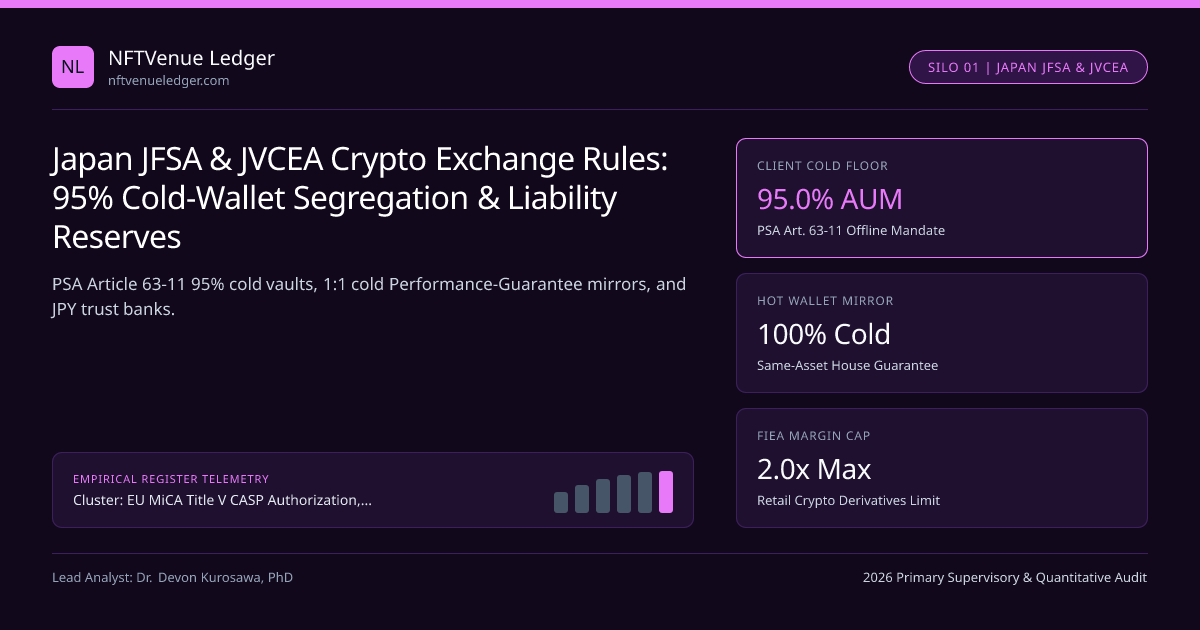
Article 63-11 of Japan's Payment Services Act (PSA), jointly enforced by the Japan Financial Services Agency (FSA) and the self-regulatory Japan Virtual and Crypto Assets Exchange Association (JVCEA), establishes the world's most mathematically bulletproof hot-wallet solvency shield—famously proven during the 2022 FTX collapse when FTX Japan returned 100% of customer fiat and crypto intact. Every registered Crypto-Asset Exchange Service Provider (CAESP) must store at least 95% of customer crypto-assets in completely offline cold wallets, and for whatever residual <=5% slice sits in online hot wallets, the exchange must hold 100% matching proprietary crypto-assets of the identical kind and quantity ("Performance-Guarantee Crypto-Assets") inside a separate cold wallet!
Integrated into our EU MiCA Title V, VARA & Travel Rule master guide, Japan's 95% Cold + 100% Cold Guarantee rule eliminates unbacked hot-wallet insolvency risk entirely.
How "Performance-Guarantee Crypto-Assets" Guarantee 100% Cold Coverage#
Consider what happens if a sophisticated attacker drains 100% of a Japanese CAESP's online hot wallets (w_hot <= 5% of client liabilities):
- Client Cold Vault (
>= 95%): Untouched because private keys reside on air-gapped hardware signers never connected to TCP/IP networks. - House Performance-Guarantee Vault (
= w_hot, also stored in Cold!): Under PSA Article 63-11-2, the exchange already holds an exact 1:1 mirror of that<= 5%hot balance in proprietary cold storage, legally encumbered with statutory priority reimbursement rights for customers ahead of all general corporate creditors. - Fiat Trust Bank Segregation: 100% of customer Japanese Yen (
JPY) balances are swept daily (withinT+2business days) into an independent licensed Japanese Trust Bank or Trust Company—never held merely in ordinary commercial bank operating accounts.
JVCEA Green List Reform & FIEA 2x Retail Margin Caps#
Historically, listing a new token in Japan required 6 to 12 months of bilateral technical screening between JVCEA and JFSA—constraining domestic order books compared to global venues in our marketplaces directory (such as Animeswap or Bcex Korea). Under JVCEA's Green List (CACL fast-track) reforms, tokens already traded across at least three Japanese member exchanges for >=6 months without incident bypass pre-screening and launch via post-facto notification.
Meanwhile, crypto derivatives (perpetuals / CFDs) are governed separately under Japan's Financial Instruments and Exchange Act (FIEA) Type I Financial Instruments Business registration, capping retail leverage at 2x (50% initial margin)—the most conservative retail derivatives cap in the G7.
Japanese PSA & FIEA Custodial Solvency Matrix#
| Japanese Regulatory Pillar | Governing Statute | Prudential / Custody Threshold | Customer Insolvency Priority |
|---|---|---|---|
Spot Crypto Custody (>= 95%) | PSA Article 63-11 | >=95% client tokens in air-gapped cold wallets | Statutory priority return right over estate |
Hot-Wallet Mirror (<= 5%) | PSA Article 63-11-2 | 100% same-asset house reserve in cold storage | Statutory priority lien matching hot exposure |
Customer Fiat (JPY) Balances | PSA Article 63-11(1) | 100% segregated in independent Japanese Trust Bank | Bankruptcy-remote trust beneficiary claim |
| Electronic Payment Instruments (Stablecoins) | Amended PSA (2023 EPI Regime) | Issued via Banks, Fund Transfer Providers, or Trust Cos | JPY/FX trust backing; JPY 1M/tx FTSP cap unless trust |
Working-Capital Encumbrance of the 1:1 Performance-Guarantee Mirror#
Because a Japanese CAESP must purchase or borrow proprietary tokens of the exact same ticker to mirror every token held in its <= 5% hot wallet, treasury quants optimize automated cold-to-hot sweep frequency to minimize w_hot balance-sheet lockup:
- VguaranteeJPY = sum{i=1}^{Ntokens} (w{hot,i} * ClientAUM_{i,JPY})
- AnnualMirrorCost = sum{i=1}^{Ntokens} Vguarantee{i,JPY} * (rborrowtokeni + CostHedgeSlippagei)
- Worked Multi-Asset Japanese Exchange Optimization (Total Client AUM = JPY 180,000,000,000):
- Naive Allocation (w_hot = 4.5% across BTC/ETH/Altcoins):
- V_guarantee = 0.045 * 180B = JPY 8,100,000,000 proprietary tokens locked in cold!
- At blended institutional token borrow rate r_borrow = 4.2%/yr => Annual Cost = JPY 340,200,000/yr
- Optimized Scheduled Batch Withdrawal Allocation (w_hot = 0.8% intraday):
- V_guarantee = 0.008 * 180B = JPY 1,440,000,000 => Annual Cost drops to JPY 60,480,000/yr (saves JPY 279.7M!)
Comparing Japanese Cold-Mirror Guarantees Against Swiss & HK Vaults#
Compare Japan's statutory cold-mirror guarantee with European DLT insolvency protections next in Swiss FINMA DLT trading facilities and Hong Kong SFC 98% cold storage inside our MiCA, VARA & Travel Rule hub.
Frequently asked questions
What are Performance-Guarantee Crypto-Assets under Japan Payment Services Act Article 63-11?
For any portion of customer crypto-assets (up to 5%) held outside cold storage in hot wallets, the exchange must hold an identical type and quantity of its own proprietary crypto-assets inside a separate cold wallet pledged first to customers.
Why did FTX Japan customers recover 100% of their assets while global FTX accounts were frozen?
Because JFSA enforced PSA Article 63-11 trust-bank fiat segregation and >=95% cold-wallet + 100% Performance-Guarantee crypto segregation onshore, keeping Japanese client balances legally and technically isolated.
How does the JVCEA Green List speed up cryptocurrency token listings in Japan?
Tokens already listed on at least three licensed Japanese member exchanges with six months of clean trading history qualify for the JVCEA Green List, bypassing lengthy pre-screening committees.
What is the maximum retail leverage allowed on crypto perpetuals or CFDs in Japan?
Under Financial Instruments and Exchange Act (FIEA) Cabinet Office Ordinances, Japanese Type I Financial Instruments Business Operators must cap retail crypto-asset margin leverage at 2x (50% margin).
Publication record
- Published
- November 14, 2026
- Updated
- November 14, 2026
- Author
- Dr. Devon Kurosawa, PhD
- Review
- Review not recorded
- Automated fact check
- Passed in the stored pipeline record
- Source URLs
- 3 recorded
AI assistance recorded: anthropic/claude-opus-4.6. This field does not establish human review or source verification.
Academic & Institutional Attribution
Cite This Research & Embed Live Data Card
Standard academic & institutional research paper citation format.
Dr. Devon Kurosawa, PhD. (2026, November 14). Japan JFSA & JVCEA Crypto Exchange Rules: 95% Cold-Wallet Segregation & Liability Reserves. NFTVenue Ledger. https://nftvenueledger.com/protocols/japan-jfsa-jvcea-crypto-asset-cold-wallet-trust-parityRegulatory Directory Cross-Reference
Referenced Institutions & Regulatory Registries
Top Regulated Institutions in This Coverage Slice
Referenced Supervisory Authorities
Related Mica Vara VASP Marketplace Licensing & Institutional Briefings
Explore Mica Vara VASP Marketplace Licensing Hub (20) →Mica Vara VASP Marketplace Licensing
EU MiCA Title V CASP Authorization, Dubai VARA & IVMS101 Travel Rule: 2026 Venue Licensing GuideMica Vara VASP Marketplace Licensing
Swiss FINMA DLT Trading Facility Licensing: Bankruptcy-Remote Custody & CHF 1,000 AMLMica Vara VASP Marketplace Licensing
German BaFin KWG Crypto Custody Transition to MiCA Article 143 GrandfatheringMica Vara VASP Marketplace Licensing
French AMF Enhanced PSAN Registration to Full EU MiCA Cross-Border PassportingMica Vara VASP Marketplace Licensing
FATF Recommendation 15 DeFi Governance & Admin Key Tests for VASP AttributionMica Vara VASP Marketplace Licensing
ERC-3643 ONCHAINID Claims Registry: Permissioned RWA Venue KYC Transfer GatesMica Vara VASP Marketplace Licensing
MiCA Article 67 CASP Prudential Safeguards: EUR 50k, 125k & 150k Own-Funds MechanicsMica Vara VASP Marketplace Licensing
ESMA MiCA Guidelines on NFT Fractionalization: Large-Series Fungibility vs Article 2(3)Amm Clob Intent Dex Settlement
NFT Automated Market Makers (SudoAMM): Discrete Linear vs Exponential Bonding Curve MathAmm Clob Intent Dex Settlement
CEX-DEX Non-Atomic Arbitrage: Inventory Risk, Block-Time Markout Curves & Builder DominanceAmm Clob Intent Dex Settlement
EIP-4844 Blob Base-Fee Spikes: Multi-Dimensional Gas Contention & L2 Liquidation LatencyAmm Clob Intent Dex Settlement
ERC-7683 Cross-Chain Intents: OriginSettler Escrows, Filler Working Capital & Optimistic Proofs
NFTVenue Ledger Data, Benchmarks & Contributor Records
CC BY 4.0 Open Data
Open Institutional Datasets (CSV / JSON) →
Download desk-compiled quantitative series & schemas.
2026 Reference Matrix
2026 Institutional Benchmarks & Thresholds →
Statutory capital, clearing, margin & rate conventions.
Editorial Records
Authors & Review Records →
View named contributors where those records are available.
Complete Index
Master Research & Dossier Archive →
Browse all published briefings by topic pillar & date.