
Mica Vara VASP Marketplace Licensing
NYSDFS 23 NYCRR Part 200 BitLicense: Greenlist Self-Certification & Custody Parity
Under 23 NYCRR Part 200 and updated Virtual Currency Guidance, NYSDFS enforces strict coin-listing/delisting governance, 1:1 same-asset custody parity, and Part 500 cybersecurity.
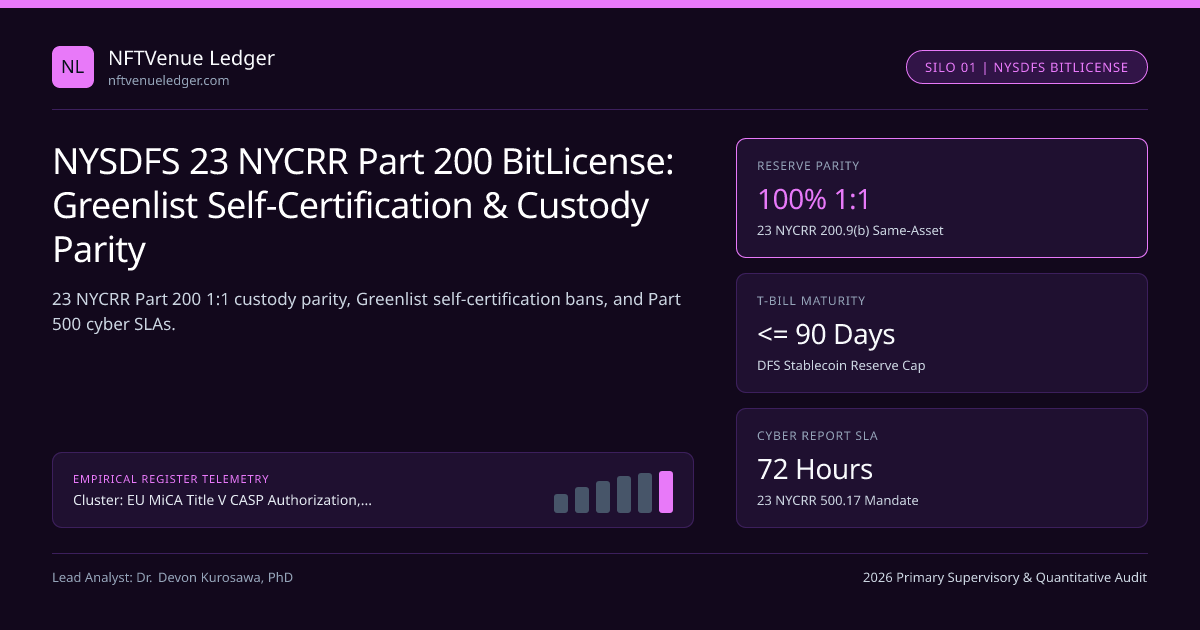
Enacted in 2015 under 23 NYCRR Part 200 and reinforced by the New York State Department of Financial Services (NYSDFS) Virtual Currency Custody (January 2023) and Coin-Listing / Coin-Delisting (November 2023) Industry Letters, New York's BitLicense and Banking Law Limited Purpose Trust Charter remain the most prescriptive state-level digital asset supervisory frameworks in the United States. Operating a crypto exchange or institutional custodian serving New York counterparties (exemplified by institutional US venues such as Bakkt Market) requires maintaining 1:1 asset-specific custodial reserves without rehypothecation, passing 23 NYCRR Part 500 cybersecurity audits, and obtaining DFS approval for a tailored Coin-Listing and Mandatory Coin-Delisting Policy.
Positioned within our EU MiCA Title V, VARA & Travel Rule master guide, NYSDFS Part 200 interacts directly with federal FinCEN CVC MSB obligations.
The Narrowed NYSDFS Greenlist & Mandatory Coin-Delisting Policies#
In its November 2023 overhaul, NYSDFS drastically contracted its public Greenlist—removing dozens of previously grandfathered tokens down to a core roster centered on Bitcoin, Ether, and DFS-regulated New York dollar-backed stablecoins—while elevating governance bars for Self-Certification of new virtual currencies:
- Board-Approved Listing & Delisting Governance: A BitLicensee cannot self-certify any token unless NYSDFS has first examined and approved both its written Coin-Listing Policy and its Coin-Delisting Policy (requiring advance written notice to NYSDFS, minimum 30-day orderly customer wind-down windows unless an emergency exploit strikes, and clear liquidation mechanics).
- Categorical Self-Certification Bans: Even firms with approved listing policies are prohibited from self-certifying: (a) stablecoins not on the NYSDFS Greenlist, (b) exchange-issued proprietary tokens, (c) bridged/wrapped assets lacking native burn-and-mint finality (contrasting wrapped lock-bridges with the Circle CCTP bridge standard), (d) tokens where a single entity controls
> 51%of validation/hashpower, or (e) obfuscated privacy coins.
23 NYCRR 200.9 Custody Parity & Limited Purpose Trust Charters#
Section 200.9(b) dictates that whenever a BitLicensee holds, stores, or maintains custody or control of virtual currency on behalf of another person, it must hold virtual currency of the identical type and amount as that owed or obligated to that other person—strictly barring fractional-reserve lending, commingling with corporate operating wallets, or pledging client coins as margin collateral.
Institutional custodians serving Registered Investment Advisers (RIAs) under SEC Custody Rule 206(4)-2 frequently pursue a New York Banking Law Limited Purpose Trust Company charter rather than a standalone BitLicense, because a chartered state trust bank exercises statutory fiduciary powers recognized nationwide as a "Qualified Custodian" while meeting Part 200 substantive virtual-currency standards.
BitLicense vs Limited Purpose Trust vs EU MiCA Matrix#
| Regulatory Attribute | NYSDFS BitLicense (23 NYCRR Part 200) | NY Limited Purpose Trust Charter | EU MiCA Class 2/3 CASP (Comparison) |
|---|---|---|---|
| Fiduciary "Qualified Custodian" Status | Money-transmitter/virtual-currency license | State-chartered fiduciary trust company | MiCA Art. 75 authorized custodian (EEA) |
| Minimum Capital & Surety Bond | Discretionary Superintendent risk-based capital + surety trust | Typically USD 2.0M - USD 10.0M+ Tier-1 liquid capital | Max(EUR 125k/150k, 25% Fixed Overheads) |
| Stablecoin Issuance Rules | Restricted; requires DFS Reserve Guidance compliance | Primary US vehicle for NY-regulated USD stablecoins | MiCA Title IV EMT (Credit Inst. or EMI only) |
| Cybersecurity Mandate | 23 NYCRR Part 500 (CISO, pen-test, MFA, 24h ransom report) | 23 NYCRR Part 500 + FFIEC bank exam | DORA Regulation (EU) 2022/2554 |
NYSDFS Supervisory Assessment & Capital Buffer Sizing#
In April 2023 (23 NYCRR Part 102), NYSDFS formalized quarterly supervisory assessments billing BitLicensees directly for DFS examination headcount alongside Section 200.8 risk-based capital:
- CapRequired2008 = OperationalRunwayMonths * MonthlyFixedOpEx + SuretyBondTrust200_9a
- AnnualDFSLevy = BaseSupervisoryFee + CustodyAndTxVolumeProRataShare
- TotalComplianceCost = AnnualDFSLevy + Part500CISOAuditCost + (CapRequired2008 * NetCapitalSpread)
- Worked NY Institutional Exchange & Custodian Model:
- MonthlyFixedOpEx = USD 550,000; DFS sets 9-month liquid cash runway = USD 4,950,000
- SuretyBondTrust2009a = USD 1,500,000 in segregated NY bank trust => Total Locked = USD 6,450,000
- AnnualDFSLevy = USD 185,000; Part 500 Penetration/SOC2/CPA = USD 340,000; Net Spread = 7.5%
- => Total Annualized Regulatory Carry = 185,000 + 340,000 + (6,450,000 * 0.075) = USD 1,008,750/yr
State-Federal Coordination: NYSDFS Part 200 vs FinCEN & EU Custody#
Compare state BitLicense obligations against federal money-transmission boundaries next in FinCEN CVC MSB non-custodial DeFi guidance and MiCA Article 75 custody segregation within our MiCA, VARA & Travel Rule hub.
Frequently asked questions
What is the difference between a New York BitLicense and a Limited Purpose Trust Charter?
A BitLicense under 23 NYCRR Part 200 authorizes virtual currency business activity, whereas a Banking Law Limited Purpose Trust Charter creates a state-chartered fiduciary bank eligible to act as an SEC Qualified Custodian.
Which cryptocurrencies are banned from self-certification under NYSDFS Coin-Listing rules?
BitLicensees cannot self-certify non-Greenlist stablecoins, exchange-native tokens, privacy coins, tokens on networks where one entity controls >51% of consensus, or improperly backed bridged assets.
How often are NYSDFS-regulated stablecoin reserves audited by independent accountants?
Under NYSDFS June 2022 Stablecoin Guidance, an independent US CPA must examine backing reserves monthly under AICPA standards, verifying parity on both the final business day and at least one random business day each month.
Does NYSDFS charge ongoing quarterly supervisory assessments to BitLicense holders?
Yes. Under 23 NYCRR Part 102 implementing New York Financial Services Law Section 206, BitLicensees pay quarterly supervisory assessments scaled to transaction volume and custodied assets.
Publication record
- Published
- November 14, 2026
- Updated
- November 14, 2026
- Author
- Dr. Devon Kurosawa, PhD
- Review
- Review not recorded
- Automated fact check
- Passed in the stored pipeline record
- Source URLs
- 3 recorded
AI assistance recorded: anthropic/claude-opus-4.6. This field does not establish human review or source verification.
Academic & Institutional Attribution
Cite This Research & Embed Live Data Card
Standard academic & institutional research paper citation format.
Dr. Devon Kurosawa, PhD. (2026, November 14). NYSDFS 23 NYCRR Part 200 BitLicense: Greenlist Self-Certification & Custody Parity. NFTVenue Ledger. https://nftvenueledger.com/protocols/nysdfs-23-nycrr-part-200-bitlicense-greenlist-custodyRegulatory Directory Cross-Reference
Referenced Institutions & Regulatory Registries
Top Regulated Institutions in This Coverage Slice
Referenced Supervisory Authorities
Related Mica Vara VASP Marketplace Licensing & Institutional Briefings
Explore Mica Vara VASP Marketplace Licensing Hub (20) →Mica Vara VASP Marketplace Licensing
EU MiCA Title V CASP Authorization, Dubai VARA & IVMS101 Travel Rule: 2026 Venue Licensing GuideMica Vara VASP Marketplace Licensing
FinCEN CVC Money Services Business Rules: Hosted Wallets vs DeFi Frontend InterfacesMica Vara VASP Marketplace Licensing
Japan JFSA & JVCEA Crypto Exchange Rules: 95% Cold-Wallet Segregation & Liability ReservesMica Vara VASP Marketplace Licensing
Swiss FINMA DLT Trading Facility Licensing: Bankruptcy-Remote Custody & CHF 1,000 AMLMica Vara VASP Marketplace Licensing
German BaFin KWG Crypto Custody Transition to MiCA Article 143 GrandfatheringMica Vara VASP Marketplace Licensing
French AMF Enhanced PSAN Registration to Full EU MiCA Cross-Border PassportingMica Vara VASP Marketplace Licensing
FATF Recommendation 15 DeFi Governance & Admin Key Tests for VASP AttributionMica Vara VASP Marketplace Licensing
ERC-3643 ONCHAINID Claims Registry: Permissioned RWA Venue KYC Transfer GatesAmm Clob Intent Dex Settlement
Balancer Weighted Math & Liquidity Bootstrapping Pools (LBPs): Dutch Weight Decay DiscoveryAmm Clob Intent Dex Settlement
Curve StableSwap Amplification Coefficient (A): Newton-Raphson Math & Depeg Convexity CliffsAmm Clob Intent Dex Settlement
NFT Automated Market Makers (SudoAMM): Discrete Linear vs Exponential Bonding Curve MathAmm Clob Intent Dex Settlement
CEX-DEX Non-Atomic Arbitrage: Inventory Risk, Block-Time Markout Curves & Builder Dominance
NFTVenue Ledger Data, Benchmarks & Contributor Records
CC BY 4.0 Open Data
Open Institutional Datasets (CSV / JSON) →
Download desk-compiled quantitative series & schemas.
2026 Reference Matrix
2026 Institutional Benchmarks & Thresholds →
Statutory capital, clearing, margin & rate conventions.
Editorial Records
Authors & Review Records →
View named contributors where those records are available.
Complete Index
Master Research & Dossier Archive →
Browse all published briefings by topic pillar & date.