Erc721 Erc1155 Eip712 Permit Security
Seaport v1.6 Protocol Architecture: Conduits, Hook Zones & Bulk Order Merkle Trees
Seaport replaces rigid buy/sell schemas with generalized Offer and Consideration item arrays, isolating user approvals inside Conduits while signing up to 2^24 orders in one EIP-712 Merkle root.
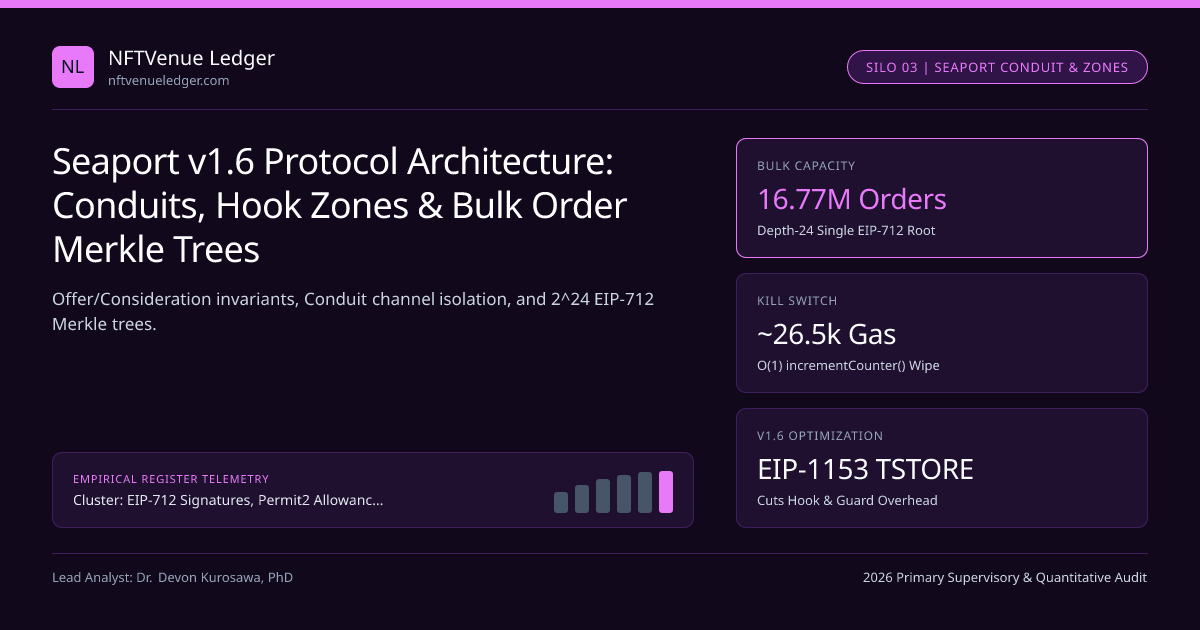
Legacy NFT marketplace contracts (Wyvern v1/v2, LooksRare v1) suffered from two painful architectural flaws: every protocol upgrade forced millions of users to pay gas re-approving setApprovalForAll across dozens of ERC-721 contracts, and listing 50 NFTs required 50 separate MetaMask signature popups! The immutable Seaport marketplace protocol (v1.1 through Cancun-optimized v1.6) eliminates both bottlenecks via three clean abstractions: Generalized OfferItem vs ConsiderationItem Barter Arrays, ConduitController Approval Isolation, and Bulk Order EIP-712 Merkle Trees capable of authorizing up to 2^24 = 16,777,216 distinct listings with a single ECDSA signature!
Contextualized within our EIP-712, Permit2 & proxy security master guide, Seaport powers settlement across curatorial and PFP collections in our marketplaces directory including Azuki, Art Blocks X Bright Moments, Admit One, and Basepaint.
Generalized Offer + Consideration Invariant & Tip Append Safety#
Instead of hardcoding "Buyer pays ERC-20, Seller sends ERC-721", every Seaport OrderParameters struct declares two arbitrary multi-asset arrays supporting NATIVE (ETH), ERC20, ERC721, ERC1155, and criteria-based Merkle trait roots (ERC721_WITH_CRITERIA):
OfferItem offer: Assets theoffererauthorizes leaving their wallet (withstartAmount->endAmountlinear Dutch interpolation).ConsiderationItem consideration: Exact(itemType, token, identifier, amount, recipient)tuples that must be delivered to each namedrecipient(e.g., item0= 95% net proceeds to Seller, item1= 2.5% ERC-2981 creator royalty, item2= 2.5% marketplace fee) or the entire transaction reverts!totalOriginalConsiderationItemsTip Mechanism: Aggregators can append frontend tips to the tail ofconsiderationat fulfillment time without invalidating the seller's signature because Seaport hashes only the firsttotalOriginalConsiderationItemssigned by the seller—meaning a tip increases what the fulfiller pays, never reducing what the seller receives!
ConduitController Channels, Seaport v1.6 Zones & Cancellation Mechanics#
How did users migrate seamlessly from Seaport v1.1 -> v1.4 -> v1.5 -> v1.6 without paying a single cent of ERC-721 re-approval gas? Because users grant setApprovalForAll to an OpenSea-controlled (or DAO-controlled) Conduit contract deployed by ConduitController.sol, which maintains a whitelist of Channels (Seaport v1.5 = true, Seaport v1.6 = true). Note the trust trade-off: the Conduit owner key can open new channels (and therefore must sit behind a multi-day TimelockController multisig or burn ownership for zero-trust conduits!).
What if an HFT NFT market maker has 4,000 live collection trait bids out on Seaport and floor prices suddenly crash -30%? Calling cancel(OrderComponents) on 4,000 individual order hashes would cost >85M gas! Instead, Seaport provides three tiered cancellation primitives:
Seaport Order Cancellation & Zone Architecture Matrix#
| Seaport Cancellation / Control Primitive | Granularity Scope | On-Chain EVM Gas Cost | Ideal Institutional Use Case |
|---|---|---|---|
cancel(OrderComponents) | Single specific orderHash(es) | ~24,800 gas per order | Delisting 1–3 individual PFP listings |
incrementCounter | 100% of signer's orders < new counter | ~26,500 gas total (O(1)!) | Emergency market-maker "Kill Switch"! |
Zone Dynamic Rejection (RESTRICTED) | Per-order off-chain/oracle rule | 0 gas to maker! (Taker reverts) | Dynamic cosigner expiry, stolen-item freeze, ERC-2981 check |
validate On-Chain Order | Pre-approves order without ECDSA sig | ~25,000 gas | DAO multisig treasuries without EIP-1271 |
EIP-712 Bulk Order Merkle Proof & Partial-Fill Fraction Overflow Math#
How does Seaport verify a depth-d Bulk Order Merkle proof while remaining 100% compliant with MetaMask's EIP-712 human-readable struct display? By defining nested fixed-size array types BulkOrder { OrderComponents[2]...[2] tree }! Simultaneously, auditors watch for Partial-Fill Fraction Rounding: for PARTIAL_OPEN ERC-1155/ERC-20 orders, Seaport requires (numerator / denominator) to divide every item's startAmount and endAmount with zero integer remainder (preventing 1-wei rounding exploits!):
- 1) Depth-d Bulk Order Signature Verification (1 <= d <= 24, max N = 2^d orders):
- Leaf0 = hashStruct(OrderComponentstarget)
- For level k = 0 to d - 1 (reading 24-bit index path from trailing signature key):
- Node{k+1} = keccak256( indexBitk == 0 ? concat(Nodek, Proof[k]) : concat(Proof[k], Nodek) )
- BulkStructHash = keccak256( concat( BULKORDERTYPEHASHd, Noded ) )
- Signature Length = 64 bytes (EIP-2098 r,vs) + 3 bytes (uint24 leafIndex) + 32 * d bytes (Merkle proof)
- 2) Exact Partial-Fill Divisibility Requirement (Blocks Rounding Drains):
- For every Offer & Consideration item j: (numerator * ItemAmount_j) mod denominator == 0
- Worked 64-NFT Market-Maker Batch Listing (d = 6 => 2^6 = 64 orders):
- Maker signs 1 EIP-712 root in 1 click (0 gas). Taker buys Order #19 (binary path 010011):
- Calldata signature payload = 64 + 3 + (32 * 6) = 259 bytes (~3,800 calldata + hashing gas -> 99% UX win!).
Creator Royalties Inside Seaport Zones vs Bytecode Validators#
Because OPEN Seaport orders allow peer-to-peer OTC or competitor frontends to construct orders with zero royalty ConsiderationItems, collections seeking mandatory royalties pair RESTRICTED Seaport Zones or token-level transfer hooks—examine this architectural tug-of-war next in ERC-2981 royalty signaling vs transfer-validator lists and setApprovalForAll blast-radius audits inside our EIP-712, Permit2 & Proxy Security hub.
Frequently asked questions
Can a malicious frontend steal seller proceeds by appending extra ConsiderationItems in Seaport?
No. Seaport verifies the seller signature against the exact first totalOriginalConsiderationItems entries; any extra tip items appended at fulfillment must be funded entirely by the buyer/fulfiller.
How does Seaport incrementCounter cancel thousands of listings in a single cheap transaction?
Every Seaport order hashes the offerer current on-chain counter value into its EIP-712 struct even though counter is omitted from OrderParameters calldata; incrementing _counters[msg.sender] by +1 instantly invalidates every prior signature.
What is the difference between FULL_OPEN and FULL_RESTRICTED order types in Seaport?
FULL_OPEN orders execute immediately if signatures and amounts match, whereas FULL_RESTRICTED orders additionally invoke the designated Zone contract (authorizeOrder / validateOrder) to enforce custom rules or cosigner expiries.
Is approving a Seaport Conduit 100% risk-free if the Conduit owner is a hot EOA?
Never approve a Conduit controlled by an untrusted hot EOA! A compromised Conduit owner could call updateChannel(maliciousContract, true) and sweep approved assets; institutional Conduits must lock ownership behind timelocked governance or burn it.
Publication record
- Published
- November 13, 2026
- Updated
- November 14, 2026
- Author
- Dr. Devon Kurosawa, PhD
- Review
- Review not recorded
- Automated fact check
- Passed in the stored pipeline record
- Source URLs
- 3 recorded
AI assistance recorded: anthropic/claude-opus-4.6. This field does not establish human review or source verification.
Academic & Institutional Attribution
Cite This Research & Embed Live Data Card
Standard academic & institutional research paper citation format.
Dr. Devon Kurosawa, PhD. (2026, November 14). Seaport v1.6 Protocol Architecture: Conduits, Hook Zones & Bulk Order Merkle Trees. NFTVenue Ledger. https://nftvenueledger.com/protocols/seaport-order-conduit-zones-bulk-merkle-cancellation-treesRegulatory Directory Cross-Reference
Referenced Institutions & Regulatory Registries
Top Regulated Institutions in This Coverage Slice
Primary Tier-1 Supervisory Registries
Related Erc721 Erc1155 Eip712 Permit Security & Institutional Briefings
Explore Erc721 Erc1155 Eip712 Permit Security Hub (20) →Erc721 Erc1155 Eip712 Permit Security
EIP-712 Typed Signatures, Permit2 Allowances, NFT Royalties & Proxy Timelocks: 2026 Security GuideErc721 Erc1155 Eip712 Permit Security
ERC-2981 NFT Royalty Signaling vs ERC-721C Programmable Transfer-Validator EnforcementErc721 Erc1155 Eip712 Permit Security
ERC-1967 Transparent vs EIP-1822 UUPS Proxies: Storage Slots & Uninitialized Logic ExploitsErc721 Erc1155 Eip712 Permit Security
EIP-2535 Diamond Multi-Facet Proxies: Selector Routing, DiamondStorage & Arbitrary DelegatecallErc721 Erc1155 Eip712 Permit Security
TimelockController & Multisig Governance Security: Delay Floors, Signer Ops & Guardian VetoesErc721 Erc1155 Eip712 Permit Security
ERC-1271 Smart-Contract Wallet Signatures: Cross-Safe & Cross-Chain Replay DefenseErc721 Erc1155 Eip712 Permit Security
ERC-4337 Account Abstraction Security: EntryPoint Storage Rules & Paymaster GriefingErc721 Erc1155 Eip712 Permit Security
EIP-7702 EOA Code Delegation Security: SetCode Tx Type 0x04, Sweeper Phishing & tx.originCross Chain Bridge Validator Exploits
Pull-Based Low-Latency Oracles (Pyth & Chainlink Data Streams): Confidence Intervals & Staleness GuardsCross Chain Bridge Validator Exploits
Read-Only Reentrancy Exploits: Curve get_virtual_price & Balancer getRate View SkewsCross Chain Bridge Validator Exploits
Checks-Effects-Interactions (CEI), Cross-Contract Locks & Cancun EIP-1153 Transient GuardsCross Chain Bridge Validator Exploits
Flash-Loan Governance Attacks: Quorum Hijacking, ERC20Votes Checkpoints & Timelock Defenses
NFTVenue Ledger Data, Benchmarks & Contributor Records
CC BY 4.0 Open Data
Open Institutional Datasets (CSV / JSON) →
Download desk-compiled quantitative series & schemas.
2026 Reference Matrix
2026 Institutional Benchmarks & Thresholds →
Statutory capital, clearing, margin & rate conventions.
Editorial Records
Authors & Review Records →
View named contributors where those records are available.
Complete Index
Master Research & Dossier Archive →
Browse all published briefings by topic pillar & date.