
Erc721 Erc1155 Eip712 Permit Security
EIP-2612 ERC-20 Permit Audits: ecrecover Zero-Address, s-Malleability & Griefing Frontruns
Flawed EIP-2612 ERC-20 permit integrations cause multi-million-dollar DeFi vault drains via ecrecover(address(0)) bypasses, WETH9 fallback phantom permits, and mempool griefing.
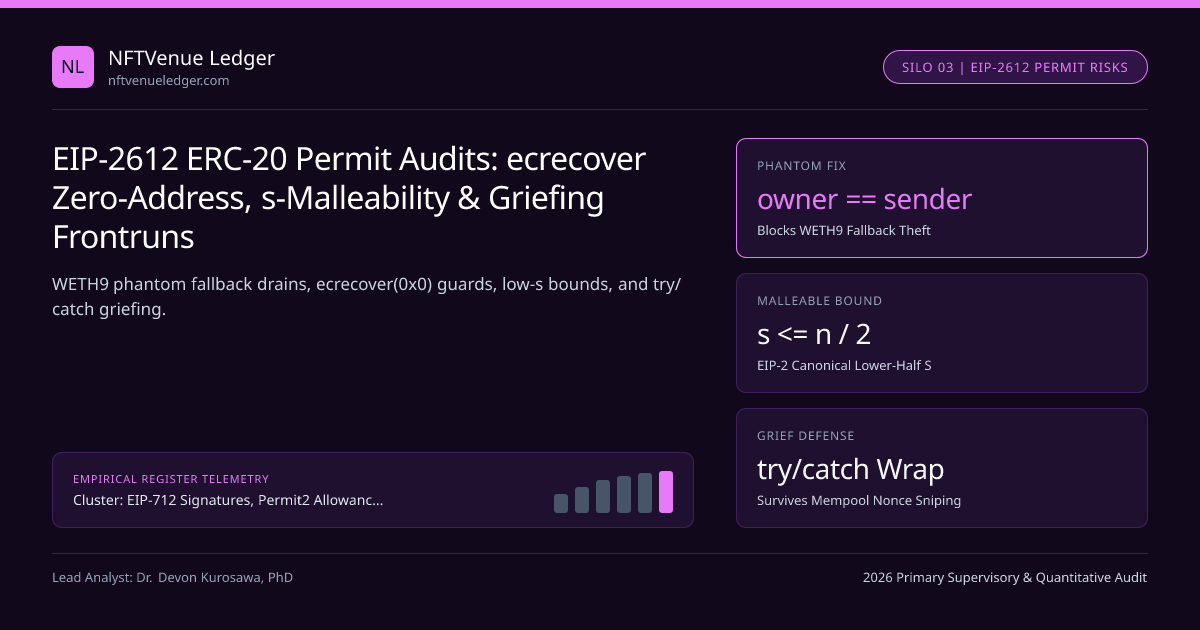
Standardized in EIP-2612, permit(address owner, address spender, uint256 value, uint256 deadline, uint8 v, bytes32 r, bytes32 s) extends ERC-20 tokens with gasless EIP-712 approvals. Yet integrating token.permit inside lending vaults, bridges, and DEX routers (across multi-token ecosystems in our marketplaces directory such as Beethoven X, Acala Swap, and Apeswap) has triggered three infamous smart-contract vulnerability classes—including the $8M+ Multichain WETH9 Phantom Permit drain and persistent Mempool Permit Griefing DoS!
Anchored inside our EIP-712, Permit2 & proxy security master guide, every auditor reviewing permit call paths verifies four non-negotiable invariants.
Vulnerability 1: The WETH9 Fallback "Phantom Permit" Exploit!#
What happens if a bridge or DEX router calls IERC20Permit(token).permit(victim, address(this), amount, deadline, 0, bytes32(0), bytes32(0)) followed by token.transferFrom(victim, attacker, amount) when token == WETH9?
WETH9(deployed in 2017) does NOT implementpermit—instead,WETH9has a silentfallback external payable { deposit; }function that accepts any unknown 4-byte function selector without reverting!- Consequently, calling
WETH9.permit(...)with garbagev=0, r=0, s=0succeeds silently without reverting (depositing 0 ETH)! Ifvictimhad previously granted a normalWETH9.approve(bridge, MAX)allowance, the subsequenttransferFrom(victim, attacker, amount)drains 100% of the victim'sWETH9balance with zero valid signature!
Vulnerability 2: ecrecover Returning address(0) & Mempool Griefing DoS#
Even on genuine EIP-2612 tokens, EVM precompile 0x01 (ecrecover) never reverts on invalid (v, r, s) inputs—it silently returns address(0)! Any custom token checking require(recoveredAddress == owner) without require(owner != address(0) && recoveredAddress != address(0)) passes whenever owner == address(0).
Equally pervasive is Permit Frontrun Griefing: suppose Vault.depositWithPermit(amount, deadline, v, r, s) calls token.permit(...) directly without try/catch. Because permit is permissionless (anyone can submit a valid user signature!), a malicious bot watching the mempool extracts (v, r, s), frontruns token.permit(...) directly on the token contract (incrementing nonces[user] from 0 -> 1!), and causes the user's Vault.depositWithPermit transaction to revert with ERC2612InvalidSigner!
Four EIP-2612 Failure Modes & Deterministic Code Fixes#
| EIP-2612 Vulnerability | Root EVM / Token Cause | Exploit Consequence | Deterministic Solidity Fix |
|---|---|---|---|
Phantom Permit (WETH9) | Silent fallback on pre-2612 tokens | Drains users who previously approved vault! | Bind owner == msg.sender (never arbitrary address from)! |
ecrecover Zero Return | Precompile 0x01 returns 0x0 on invalid v,r,s | Bypasses recovered == owner if owner == 0x0 | Use OpenZeppelin ECDSA.recover (reverts on 0x0 & high s) |
| Mempool Permit Griefing | Bot frontruns token.permit directly, bumping nonce | User's bundled depositWithPermit tx reverts! | Wrap permit in try/catch, then check allowance >= amount |
| DAI Non-Standard Selector | MakerDAO DAI uses permit(..., uint256 nonce, uint256 expiry, bool allowed) | Standard 7-arg IERC20Permit reverts on DAI | Use OpenZeppelin SafeERC20.safePermit or Permit2 |
Elliptic Curve s-Malleability Math & Safe Grief-Resistant Pattern#
For every valid secp256k1 ECDSA signature (v, r, s) over curve order n, the complementary tuple (v ^ 1, r, n - s) recovers the exact same public key via ecrecover! Although nonces[owner]++ prevents executing both signatures inside ERC20Permit, any external protocol tracking signature uniqueness via mapping(bytes32 sigHash => bool used) rather than per-signer nonces gets bypassed trivially unless uint256(s) <= n / 2 is enforced (adhering to the CEI security pattern):
- Curve Order n = 0xFFFFFFFFFFFFFFFFFFFFFFFFFFFFFFFEBAAEDCE6AF48A03BBFD25E8CD0364141
- Half-Order h = n / 2 = 0x7FFFFFFFFFFFFFFFFFFFFFFFFFFFFFFF5D576E7357A4501DDFE92F46681B20A0
- Malleability Identity:
- ecrecover(digest, v, r, s) == ecrecover(digest, (v == 27 ? 28 : 27), r, n - s)
- Mandatory Low-S Constraint (EIP-2):
- require(uint256(s) <= h && (v == 27 || v == 28) && recovered != address(0))
- Grief-Proof Vault Deposit Invariant (for caller msg.sender ONLY!):
- try IERC20Permit(token).permit(msg.sender, address(this), amount, deadline, v, r, s) {} catch {}
- // Even if bot frontran permit OR token is WETH9, ONLY msg.sender's own funds move:
- IERC20(token).safeTransferFrom(msg.sender, address(this), amount);
Why Institutional Protocols Standardize on Permit2 Over Raw EIP-2612#
Because DAI uses an 8-parameter permit, USDT lacks permit altogether, and WETH9 exposes silent fallback traps, modern institutional vaults replace direct EIP-2612 calls with Uniswap Permit2 Witness signatures—next, inspect the NFT equivalent of unlimited approvals in ERC-721/1155 setApprovalForAll operator blast radius inside our EIP-712, Permit2 & Proxy Security hub.
Frequently asked questions
How did the WETH9 Phantom Permit vulnerability drain millions from DeFi bridges?
Bridge routers accepted an arbitrary from address alongside permit(from, ...) parameters; because WETH9 has a non-reverting fallback instead of permit, attackers passed v=0,r=0,s=0 and drained victims who had previously approved the bridge.
Why does wrapping permit inside try/catch stop mempool griefing?
If an MEV bot extracts your permit signature from the mempool and calls token.permit ahead of your tx, the allowance is already set on-chain; catching the nonce-mismatch revert lets your transferFrom proceed normally.
Is try/catch around permit safe if my function accepts an arbitrary address owner parameter?
NO! Never combine try/catch permit with an arbitrary user-supplied owner parameter—only ever pass msg.sender as owner, otherwise anyone can skip signature checks against pre-approved accounts!
What is ECDSA s-value malleability in Ethereum smart contracts?
Due to secp256k1 symmetry, flipping s to (curveOrder - s) and toggling v between 27 and 28 produces a second distinct valid signature for the exact same message without knowing the private key.
Publication record
- Published
- November 13, 2026
- Updated
- November 14, 2026
- Author
- Dr. Devon Kurosawa, PhD
- Review
- Review not recorded
- Automated fact check
- Passed in the stored pipeline record
- Source URLs
- 3 recorded
AI assistance recorded: anthropic/claude-opus-4.6. This field does not establish human review or source verification.
Academic & Institutional Attribution
Cite This Research & Embed Live Data Card
Standard academic & institutional research paper citation format.
Dr. Devon Kurosawa, PhD. (2026, November 14). EIP-2612 ERC-20 Permit Audits: ecrecover Zero-Address, s-Malleability & Griefing Frontruns. NFTVenue Ledger. https://nftvenueledger.com/protocols/eip-2612-erc20-permit-deadline-malleability-ecrecover-risksRegulatory Directory Cross-Reference
Referenced Institutions & Regulatory Registries
Top Regulated Institutions in This Coverage Slice
Primary Tier-1 Supervisory Registries
Related Erc721 Erc1155 Eip712 Permit Security & Institutional Briefings
Explore Erc721 Erc1155 Eip712 Permit Security Hub (20) →Erc721 Erc1155 Eip712 Permit Security
EIP-712 Typed Signatures, Permit2 Allowances, NFT Royalties & Proxy Timelocks: 2026 Security GuideErc721 Erc1155 Eip712 Permit Security
ERC-721 & ERC-1155 setApprovalForAll Security: Operator Blast Radius & Conduit IsolationErc721 Erc1155 Eip712 Permit Security
Seaport v1.6 Protocol Architecture: Conduits, Hook Zones & Bulk Order Merkle TreesErc721 Erc1155 Eip712 Permit Security
ERC-2981 NFT Royalty Signaling vs ERC-721C Programmable Transfer-Validator EnforcementErc721 Erc1155 Eip712 Permit Security
ERC-1967 Transparent vs EIP-1822 UUPS Proxies: Storage Slots & Uninitialized Logic ExploitsErc721 Erc1155 Eip712 Permit Security
EIP-2535 Diamond Multi-Facet Proxies: Selector Routing, DiamondStorage & Arbitrary DelegatecallErc721 Erc1155 Eip712 Permit Security
TimelockController & Multisig Governance Security: Delay Floors, Signer Ops & Guardian VetoesErc721 Erc1155 Eip712 Permit Security
ERC-1271 Smart-Contract Wallet Signatures: Cross-Safe & Cross-Chain Replay DefenseCross Chain Bridge Validator Exploits
Circle CCTP Burn-and-Mint Architecture vs Lock-and-Mint Wrapped Bridge ContagionCross Chain Bridge Validator Exploits
Uniswap v3 Geometric-Mean TWAP Oracles: Tick-Accumulator Math & PoS Multi-Block Manipulation CostCross Chain Bridge Validator Exploits
Pull-Based Low-Latency Oracles (Pyth & Chainlink Data Streams): Confidence Intervals & Staleness GuardsCross Chain Bridge Validator Exploits
Read-Only Reentrancy Exploits: Curve get_virtual_price & Balancer getRate View Skews
NFTVenue Ledger Data, Benchmarks & Contributor Records
CC BY 4.0 Open Data
Open Institutional Datasets (CSV / JSON) →
Download desk-compiled quantitative series & schemas.
2026 Reference Matrix
2026 Institutional Benchmarks & Thresholds →
Statutory capital, clearing, margin & rate conventions.
Editorial Records
Authors & Review Records →
View named contributors where those records are available.
Complete Index
Master Research & Dossier Archive →
Browse all published briefings by topic pillar & date.