
Onchain Wash Trading Market Abuse
Cross-Chain Laundering Forensics: Peel Chains, Bridge-Hop Tracing & Taint-Accounting Models
Modern threat actors automate 100-hop peel chains and cross-chain bridge swaps within minutes—requiring automated bridge-envelope correlation and calibrated proportional taint accounting.
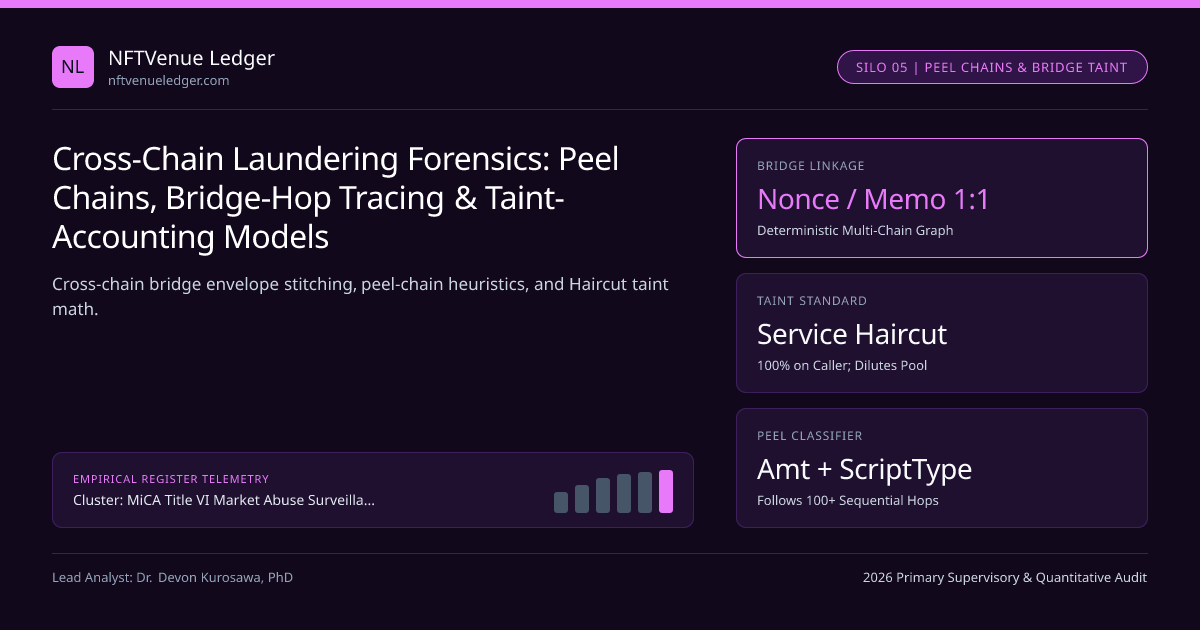
Gone are the days when exploiters or market-manipulation rings sent stolen ETH straight into a single centralized exchange deposit address! Today's automated laundering scripts ("Chain-Hopping + Automated Peel Chains") swap stolen tokens into native ETH/USDC on an AMM, peel off 1%–5% slices across 150 sequential intermediary wallets, bridge across 4 blockchains (Ethereum -> Arbitrum -> Solana -> Tron/Bitcoin via THORChain, CCTP, or intent bridges), and cash out via high-risk nested OTC brokers!
Anchored in our MiCA Title VI market abuse & wash-trading master guide and aligned with FATF Virtual Asset Red Flag Indicators and FATF Recommendation 15 enforced by FinCEN, ESMA, BaFin, and AUSTRAC, modern VASP compliance engines Stitch Cross-Chain Bridge Envelopes automatically across venues in our marketplaces directory (protecting off-ramps like Binance and Bakkt Market).
Automated Peel-Chain Change-Output Heuristics (UTXO & EVM Account Chains)#
What is a Peel Chain, and how do graph tracers follow 200 sequential hops without losing the trail?
- UTXO Peel Chain (
Bitcoin / Litecoin): Starting with a100 BTCillicit UTXO, the script creates a 2-output transaction:Output_0 = 2.14 BTC(peeled off to an OTC/CEX deposit or swapper) andOutput_1 = 97.8599 BTC(change sent to a fresh attacker address, which immediately peels off 1.89 BTC in the next block, repeating 50 times!). Investigators distinguish the Peel Output from the Change Output via four deterministic signals: (1) value ratio (change >> peel), (2) address script-type match (P2WPKH -> P2WPKHmatches input), (3) zero prior history on change address, and (4)nLockTime / RBFwallet-software fingerprinting! - EVM / Solana Cross-Bridge Stitching: When an attacker burns
500,000 USDCvia Circle CCTP on Ethereum (nonce = 88412) or deposits200 ETHinto an intent/liquidity bridge, cross-chain indexers match(sourceTx, messageNonce / amount-minus-fee, timestamp + delta_t, destinationRecipient), fusing Chain A and Chain B into one continuous multi-chain graph edge!
Poison vs Haircut (Proportional) vs Seniority (FIFO) Taint Accounting!#
Read Metric #3 carefully—choosing the wrong taint-propagation mathematics either blinds your AML team OR freezes 50% of innocent DeFi users! Compare the three classic accounting algorithms when 10 dirty ETH mixes into an address already holding 90 clean ETH, followed by two 50 ETH withdrawals:
- Poison Model (
Binary 100% Contagion — DANGEROUS FALSE POSITIVES!): Any address receiving>= 1 weiof dirty ETH becomes100%tainted forever! Why it fails: if a hacker swaps10 ETHthrough a$200MUniswapUSDC/ETHpool, Poison marks every single subsequent Uniswap user on Earth as 100% tainted! - FIFO / Seniority Model (
First-In, First-Out): Assigns exact taint chronologically to specific outgoing slices (essential for civil asset-forfeiture tracing in common-law courts, e.g., Clayton's Case, though sensitive to tx ordering). - Haircut / Proportional Exposure Model (
Institutional VASP Screening Standard): Taint dilutes proportionally to total liquidity at each hop (10 dirty / 100 total = 10.0% taint on every outgoing dollar)—stopping automatically at Known Liquid Service Boundaries (AMM Pools / Regulated VASPs) while propagating100%across pass-through EOA peel hops!
Taint Propagation Accounting Models & Legal Use-Case Matrix#
| Taint Accounting Model | Mathematical Rule on 10 Dirty + 90 Clean | Behavior Across AMM Liquidity Pools | False-Positive Rate | Primary Institutional Use Case |
|---|---|---|---|---|
Poison (All-or-Nothing) | 100% of all 100 ETH marked dirty | Breaks catastrophically (Taints entire DeFi!) | Extreme (>90%) | Only 1-hop strict OFAC SDN blocklists |
FIFO (First-In, First-Out) | First 90 ETH out = 0%; last 10 ETH = 100% | Order-dependent | Low | Civil Asset Recovery & Court Constructive Trusts |
Haircut (Proportional) | Every outgoing ETH carries 10.0% taint | Dilutes realistically ($10k / $100M = 0.01%!) | Very Low | Real-Time VASP Deposit Risk Scoring (Chainalysis/TRM) |
| Service-Boundary Haircut | 100% across EOA peel; stops/tags at VASP/DEX | Treats DEX swap output to same caller as 100%! | Minimal (<0.2%) | Gold Standard Cross-Chain AML Engine |
Service-Aware Proportional Haircut & Cross-Bridge Probabilistic Matching Math#
Notice Metric #2 (DEX Self-Swap Rule)—a vital distinction in forensic graph engineering! When Hacker H swaps 100 stolen ETH inside a $100M Uniswap pool for 300,000 USDC, H's received 300,000 USDC does NOT dilute to 0.3% taint! Because H is the atomic transaction initiator (tx.origin / swap recipient), 100.0% of H's input taint transfers directly onto H's output 300,000 USDC, while innocent subsequent swappers interacting with the $100M pool experience <= 0.3% pool dilution!
- Case A — Atomic Swap / Bridge Teleport (Initiator u -> Liquidity Pool/Bridge -> Recipient v_dest):
- TaintUSD(vdest) += TaintFraction(u) * ValueUSD(amt_out) [100% Taint Preservation Across Swap/Bridge!]
- Case B — Standard EOA-to-EOA Transfer (u -> v of amount amt):
- TaintFractionnew(v) = ( Balold(v) * TaintFractionold(v) + amt * TaintFraction(u) ) / ( Bal_old(v) + amt )
- 2) Unindexed No-KYC Swapper Cross-Chain Match Score (Ingress ein on Chain A, Egress eout on Chain B):
- Given expected service fee rate f in [0.003, 0.025] and latency window dt = tout - tin in [10s, 1800s]:
- LogLikelihoodMatch(ein, eout) = - ( (USD(eout) - USD(ein)(1 - f))^2 / (2 sigma_fee^2) ) - lambda * dt
Policing Social-Media Finfluencer Pump-and-Dumps (MiCA Article 91) Next#
Not all manipulation hides in obscure peel chains—some broadcasts live to 500,000 followers on X, YouTube, and Telegram while secretly dumping tokens from an undisclosed wallet! Examine statutory finfluencer anti-touting enforcement next in social-media finfluencer pump-and-dump rules under MiCA Article 91 inside our MiCA Title VI Market Abuse hub.
Frequently asked questions
Does swapping stolen ETH for USDC on Uniswap clean the funds?
Not at all! Graph analytics engines parse the atomic Ethereum transaction receipt: when Tainted Wallet A sends 50 ETH into a Uniswap router and receives 150,000 USDC out in the same transaction, 100% of the taint carries onto the 150,000 USDC—which Circle can also freeze on-chain!
How do investigators trace funds across THORChain if there is no EVM bridge contract?
Every THORChain cross-chain swap embeds a public plaintext memo on the input transaction specifying the exact destination chain, asset, and recipient BTC/ETH/SOL address—allowing instant deterministic 1:1 cross-chain graph linking!
What is the difference between Poison taint and Haircut taint in AML compliance?
Poison treats any wallet touched by even $1 of illicit funds as 100% tainted (creating massive false positives); Haircut tracks the exact proportional dollar percentage of illicit exposure at each balance merge.
What are FATF Red Flag Indicators for cross-chain money laundering?
Key FATF red flags include rapid "chain-hopping" across >=3 blockchains or assets within minutes with no economic rationale, automated peel-chain structuring just below Travel Rule thresholds (EUR/USD 1,000), and immediate off-ramping at nested OTC brokers.
Publication record
- Published
- November 13, 2026
- Updated
- November 14, 2026
- Author
- Dr. Devon Kurosawa, PhD
- Review
- Review not recorded
- Automated fact check
- Passed in the stored pipeline record
- Source URLs
- 3 recorded
AI assistance recorded: anthropic/claude-opus-4.6. This field does not establish human review or source verification.
Academic & Institutional Attribution
Cite This Research & Embed Live Data Card
Standard academic & institutional research paper citation format.
Dr. Devon Kurosawa, PhD. (2026, November 14). Cross-Chain Laundering Forensics: Peel Chains, Bridge-Hop Tracing & Taint-Accounting Models. NFTVenue Ledger. https://nftvenueledger.com/protocols/cross-chain-laundering-peel-chains-bridge-hop-taint-scoringRegulatory Directory Cross-Reference
Referenced Institutions & Regulatory Registries
Mentioned Regulated Institutions
Referenced Supervisory Authorities
Related Onchain Wash Trading Market Abuse & Institutional Briefings
Explore Onchain Wash Trading Market Abuse Hub (20) →Onchain Wash Trading Market Abuse
MiCA Title VI Market Abuse Surveillance, Wash-Trade Graph Forensics & STOR Guide (2026)Onchain Wash Trading Market Abuse
Social-Media Finfluencers, "Scalping" Pump-and-Dumps & MiCA Article 91(2)(d) EnforcementOnchain Wash Trading Market Abuse
Wash-Adjusted TWAP, Volume-Weighted Median & Hedonic NFT Indices Under IOSCO PrinciplesOnchain Wash Trading Market Abuse
On-Chain Sanctions Screening: OFAC SDN, EU Restrictive Measures & Dusting-Attack ImmunityOnchain Wash Trading Market Abuse
Banging the Close, Funding-Rate Gaming & Thin-Spot Perpetual Manipulation (Mango RCA)Onchain Wash Trading Market Abuse
ERC-20 Honeypot & Hidden Transfer-Tax Detection: EVM eth_call State-Override SimulationOnchain Wash Trading Market Abuse
Blockchain Entity Resolution: Common-Input Ownership, CEX Deposit Reuse & False-Positive GuardsOnchain Wash Trading Market Abuse
DeFi Governance Bribe Markets, Vote-Buying Convexity & Predatory Gauge ManipulationMarket Insights
Solana's Jupiter Expands Beyond Trading With Token Baskets, Yield Vaults and New PortfolioRegulatory Compliance
Morning Minute: Democrat Sweep Pumps Crypto as Clarity Act ResurfacesMarket Insights
Bitcoin Erases Election Rally as AI Stocks Plunge, $428 Million in Crypto Longs Get Wiped OutMarket Insights
Trump-Backed American Bitcoin Turns a Profit as Bitcoin Rise Lifts Books
NFTVenue Ledger Data, Benchmarks & Contributor Records
CC BY 4.0 Open Data
Open Institutional Datasets (CSV / JSON) →
Download desk-compiled quantitative series & schemas.
2026 Reference Matrix
2026 Institutional Benchmarks & Thresholds →
Statutory capital, clearing, margin & rate conventions.
Editorial Records
Authors & Review Records →
View named contributors where those records are available.
Complete Index
Master Research & Dossier Archive →
Browse all published briefings by topic pillar & date.