Onchain Wash Trading Market Abuse
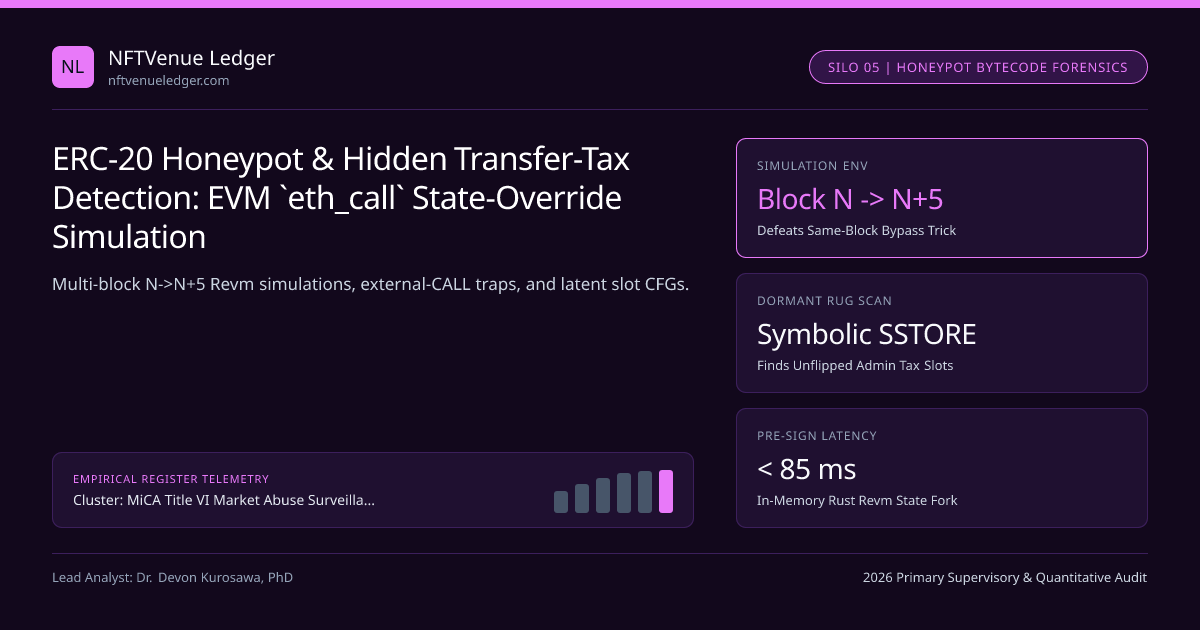
ERC-20 Honeypot & Hidden Transfer-Tax Detection: EVM eth_call State-Override Simulation
Modern scam tokens hide sell-blocking traps inside unverified external helper contracts and block-delayed triggers—defeated only by sandboxed EVM debug_traceCall buy-transfer-sell simulations plus opcode static analysis.
Over 300,000 malicious "Honeypot" ERC-20 tokens have been deployed across Ethereum, Base, BNB Chain, and Arbitrum DEXs! The classic trap looks irresistible on a price chart: a token prints 200 green candles in a row (+4,000% with zero red candles!) because retail buyers CAN buy cleanly from the Uniswap pool, whereas transfer silently reverts (or deducts a 99.9% fee!) whenever anyone other than a whitelisted insider wallet tries to SELL back into the AMM pool!
Anchored in our MiCA Title VI market abuse & wash-trading master guide, wallet security engines (Blockaid, Blowfish, GoPlus, TokenSniffer, Rabby/Phantom pre-sign simulators) and DEX aggregators across our marketplaces directory (protecting swappers on 9mm Pro, Apeswap, and Uniswap v4 routers) combine Atomic debug_traceCall Bundle Simulation with EVM Bytecode Control-Flow Decompilation!
Why Source-Code Regex Fails (Obfuscated External Call Traps & Delayed Rug Switches)!#
Early 2021 honeypot scanners simply checked Etherscan verified Solidity code for strings like require(from == owner) or _sellTax = 99. Scammers defeated regex scanners in 48 hours using four deceptive EVM tricks:
- Disguised "SafeMath / Accounting Helper" External Calls: The verified
Token.sollooks 100% clean—except inside_update(from, to, amount), it callsIAccountingOracle(0x7a12...).beforeTokenTransfer(from, to, amount), where0x7a12...is an UNVERIFIED closed-source contract that reverts wheneverto == uniswapPair && !whitelist[from]! - Same-Block Anti-Simulator Bypass (
block.number > lastBuyBlock[user]): Knowing security APIs testBuy -> Sellinside 1 single simulated transaction, scammers wrote: "Allow selling inside the SAME block as buying (so 1-block honeypot simulators pass 100%!), and revert ALL sells onceblock.number >= buyBlock + 1!" - Fake Balance Slot / Hidden
burnFromBackdoor: Even after callingrenounceOwnership(setting owner = address(0)), a hidden secondary_taxCollectoraddress retains a function encoded under a disguised 4-byte selector (e.g., multicall) that sets_balances[uniswapPair] = 1 weiand callspair.sync—draining 99.99% of ETH from the pool in 1 tx! - Uniswap v4 Malicious Pool Hooks: On singleton hook-enabled AMMs, a clean standard ERC-20 paired inside a pool attached to a malicious
beforeSwapdynamic-fee hook can hike swap fees to99.9%strictly onzeroForOnesell swaps!
Why Simulation Alone Still Needs Static Bytecode Symbolic Taint (The "Delayed Rug Switch")!#
Look closely at Step 4 above: what if a scammer sets sellTax = 0% for the first 2 hours after launch (so BOTH live buyers AND multi-block eth_call simulations succeed with 0% tax!), waits until retail deposits $400,000 into the pool, and then calls a hidden function flipping storage slot 0x09 to sellTax = 99%?!
- Pure runtime simulation at Hour 1 sees
0%tax (because the switch hasn't been flipped yet!). - Static EVM Bytecode Symbolic Analysis (
Heimdall / Gigahorse / Halmos CFG) catches the trap at Hour 0 before the switch is ever flipped! By tracing everySSTOREreachable by any non-zero caller (msg.sender == hardcodedAddr), the static analyzer proves: "Storage Slot0x09is mutable by0xDeadBeef...AND controls a conditionalREVERTor fee multiplier insidetransfer!"
Malicious Token Archetype & Detection Method Matrix#
| Malicious Token Trap | Passes Naive 1-Tx Sim? | Passes Multi-Block (N -> N+5) Sim? | Caught by Static Opcode CFG? | Wallet / Router Action |
|---|---|---|---|---|
Hard Sell Revert (Classic Honeypot) | No (Reverts immediately) | Caught (100%) | Yes | Hard Red Block (0 ETH out) |
Delayed Block Trap (block > buy + 1) | YES (Bypasses 1-tx sim!) | Caught (Reverts at N+5!) | Yes (NUMBER opcode in transfer) | Hard Red Block |
| 99% Stealth Fee-on-Transfer Tax | Succeeds (0.01 ETH returned!) | Caught (Tax = 99.0% measured!) | Yes | Hard Red Block (Tax > 25%) |
Dormant Admin Switch (0% now -> 99% later) | YES (Switch still 0!) | YES (Switch still 0!) | CAUGHT BY OPCODE CFG! (Mutable slot) | High-Risk Warning (Modifiable Tax/Pause) |
Exact Multi-Block Round-Trip Effective Tax Measurement Formula#
Notice Metric #1 (Zero External CALL): in an honest vanilla OpenZeppelin ERC20.sol, executing transfer(to, amount) performs ZERO external CALL, STATICCALL, or DELEGATECALL opcodes (only 2 SLOADs, 2 SSTOREs, and 1 LOG3). Seeing any CALL/STATICCALL to an unverified address inside transfer is an instant red flag!
- Step A [Block B0, Timestamp T0, Clean Random Funded EOA u]:
- Simulate 0.10 ETH -> Token via DEX Router: record TokensReceived = Baltoken(u) - 0
- Step B [Advance Virtual EVM Env -> Block B0 + 5, Timestamp T0 + 120s]:
- Simulate Approve + Sell 100% of TokensReceived -> ETH via DEX Router: record GrossETH_Returned
- Step C [Isolate AMM Price Impact + LP Fee from Hidden Token Tax]:
- Given pool reserves (Reth, Rtok) and standard AMM swap fee f_lp (e.g., 0.003):
- IdealZeroTaxETHOut = QuoteConstantProductRoundTrip( 0.10 ETH, Reth, Rtok, flp )
- CombinedRoundTripTaxRate = 1.0 - ( GrossETHReturned / IdealZeroTaxETHOut )
- // Verdict: Sell Reverts OR CombinedTaxRate >= 0.30 => CRITICAL HONEYPOT ALERT (Block Swap Sign)!
Unifying Pseudonymous Wallets via Entity Resolution & Deposit Reuse Next#
Every forensic capability we've built in Silo 5—Tarjan wash cycles, pre-listing insider cohorts, meme-token bonding-curve sniper bundles, and cross-chain taint—relies on one foundational graph primitive: clustering K pseudonymous blockchain addresses back to a single real-world Entity (Wallet Clustering / Entity Resolution)! Master exact clustering heuristics and false-positive pitfalls next in entity resolution, common-input & deposit-address reuse heuristics inside our MiCA Title VI Market Abuse hub.
Frequently asked questions
How can a token with "Ownership Renounced" on Etherscan still turn into a 99%-tax honeypot?
Renouncing ownership only zeroes out the standard Ownable _owner slot; scammers simply store a second private variable (e.g., address private _liquidityHelper) that retains permission to edit tax rates or wipe Uniswap pair balances!
Why do honeypot charts show straight +2,000% green candles with zero pullbacks?
Because every retail buy removes tokens from the AMM pool (pushing spot price up), while 100% of retail sell transactions revert on-chain—creating an artificial "up-only" chart until the deployer drains the ETH!
How did scammers fool first-generation honeypot detector websites?
First-generation detectors simulated buying and selling inside the same block; scammers added if (block.number == lastBuyBlock[from]) allowSell, letting the detector pass while trapping real humans who always sell in a later block!
Can a completely clean ERC-20 token still be a honeypot on Uniswap v4?
Yes! In Uniswap v4, swap hooks attach to the PoolKey rather than the ERC-20 contract; an attacker can pair a standard honest ERC-20 with a malicious Hook contract whose beforeSwap hook reverts or charges 99% fee on sells—so routers must simulate the PoolKey!
Publication record
- Published
- November 12, 2026
- Updated
- November 14, 2026
- Author
- Dr. Devon Kurosawa, PhD
- Review
- Review not recorded
- Automated fact check
- Passed in the stored pipeline record
- Source URLs
- 3 recorded
AI assistance recorded: anthropic/claude-opus-4.6. This field does not establish human review or source verification.
Academic & Institutional Attribution
Cite This Research & Embed Live Data Card
Standard academic & institutional research paper citation format.
Dr. Devon Kurosawa, PhD. (2026, November 14). ERC-20 Honeypot & Hidden Transfer-Tax Detection: EVM eth_call State-Override Simulation. NFTVenue Ledger. https://nftvenueledger.com/protocols/erc20-honeypot-transfer-tax-bytecode-static-call-detectionRelated Onchain Wash Trading Market Abuse & Institutional Briefings
Explore Onchain Wash Trading Market Abuse Hub (20) →Onchain Wash Trading Market Abuse
MiCA Title VI Market Abuse Surveillance, Wash-Trade Graph Forensics & STOR Guide (2026)Onchain Wash Trading Market Abuse
Blockchain Entity Resolution: Common-Input Ownership, CEX Deposit Reuse & False-Positive GuardsOnchain Wash Trading Market Abuse
DeFi Governance Bribe Markets, Vote-Buying Convexity & Predatory Gauge ManipulationOnchain Wash Trading Market Abuse
ESMA STOR Templates, ISO 24165 DTI Identifiers & Cross-Border CASP Supervisory Data SharingOnchain Wash Trading Market Abuse
Tarjan Strongly Connected Components (SCC) & Johnson Cycle Graphs for NFT Wash-Trade FilteringOnchain Wash Trading Market Abuse
Zero-Fee Token-Rebate Mining & Points Farming: NFT Marketplace Volume Distortion MechanicsOnchain Wash Trading Market Abuse
MiCA Article 92 PPAET Compliance: Automated Market-Abuse Surveillance & RTS 2025/885 ArchitectureOnchain Wash Trading Market Abuse
MiCA Articles 87–90 Inside Information: Token Unlocks, Exploit Disclosures & Insider ListsCybersecurity Incidents
Mercado Bitcoin Said Its Hack Was Contained, But Blockchain Data Tells a Different StoryCryptocurrency Markets
Bitcoin Fixes This? Paraguay President Resigns After Bank Lockout Hits 60% of CountryRegulatory Compliance
Former FBI Agent Pleads Guilty to Stealing $2.5M in Crypto From 35 InvestigationsMarket Insights
Morning Minute: Bitcoin Erases Election Rally as AI Stocks Crater
NFTVenue Ledger Data, Benchmarks & Contributor Records
CC BY 4.0 Open Data
Open Institutional Datasets (CSV / JSON) →
Download desk-compiled quantitative series & schemas.
2026 Reference Matrix
2026 Institutional Benchmarks & Thresholds →
Statutory capital, clearing, margin & rate conventions.
Editorial Records
Authors & Review Records →
View named contributors where those records are available.
Complete Index
Master Research & Dossier Archive →
Browse all published briefings by topic pillar & date.