
Onchain Wash Trading Market Abuse
Hybrid DEX & Appchain CLOB Surveillance: Layering, Spoofing & Order-to-Trade Ratios (OTR)
Gasless off-chain order entry on hybrid CLOB DEXs and sub-second appchains revived classic HFT layering and spoofing—demanding minimum resting speedbumps and asymmetric cancel-ratio scoring.
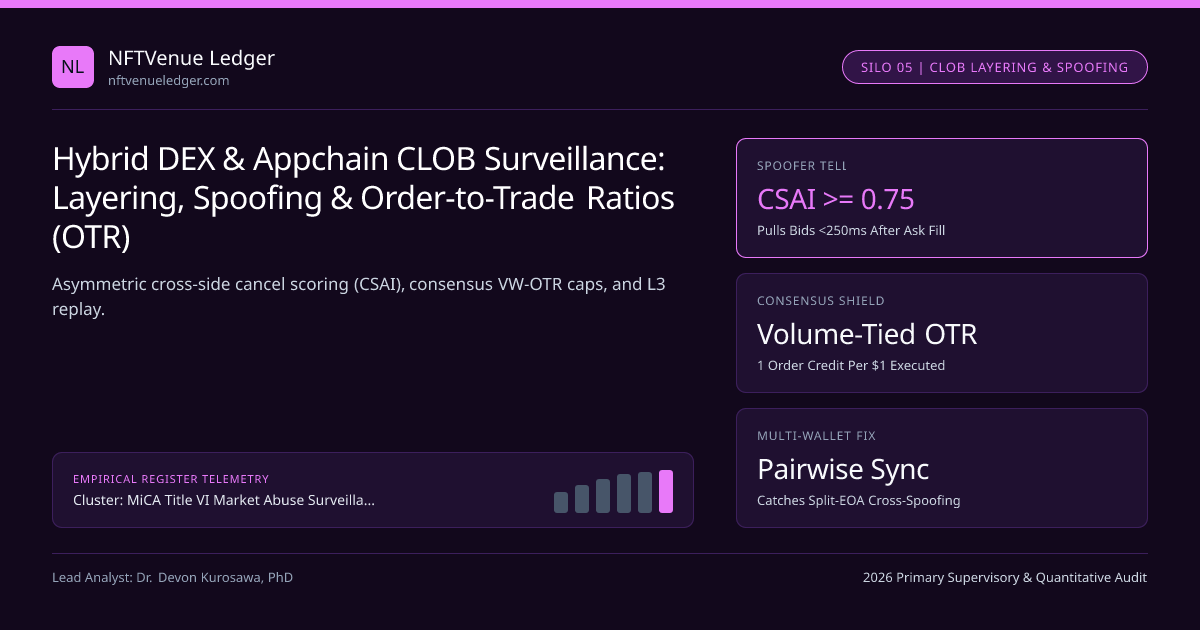
Why was classic orderbook Spoofing and Layering rare on 2020 Ethereum Layer-1 DEXs, yet rampant today on Hybrid Off-Chain CLOB / On-Chain Settlement DEXs (dYdX v4, Hyperliquid, Aevo, Vertex, Paradex, 0x/Seaport off-chain books)? Look at the Cost of Cancellation: on Ethereum L1, placing and cancelling a fake bid cost $8.00 in gas—bankrupting spoofers in 60 seconds! On modern appchain CLOB protocols and gasless EIP-712 off-chain matching engines, placing and cancelling 5,000 orders per second costs $0.00 in gas! Instantly, predatory HFT algorithms imported every equity/futures spoofing playbook straight into crypto!
Anchored in our MiCA Title VI market abuse & wash-trading master guide, policing MiCA Article 91(2)(c) False Orderbook Depth Signals across centralized and decentralized orderbooks in our marketplaces directory (from Binance and Aphelion to hybrid venues) requires Asymmetric Level-3 Telemetry that distinguishes legitimate market-maker quote refreshes from manipulative layering!
Anatomy of an Asymmetric Cross-Side Layering Cycle (< 400 Milliseconds)!#
How do you prove in court (CFTC v. Sarao / Navinder, Coscia; MiCA Art. 91(2)(c)) that a trader with a 98% cancellation rate is an illegal Spoofer rather than a legitimate Passive Market Maker (who ALSO cancels 95%–99% of quotes as Binance mid-price ticks to avoid [LVR toxicity](/tokens/loss-versus-rebalancing-lvr)!)? Compare the four-phase asymmetric behavioral signature of a Layering Cycle:
- Phase 1 — Small Hidden Genuine Target Order (
Iceberg / Top-of-Book Ask): Trader places a small5 ETHsell order (or post-only/iceberg ask) at the Best Offer$3,001.00. - Phase 2 — Large Visible Opposite-Side Wall (
Layered Spoof Bids): Milliseconds later, the same entity (or a colluding second wallet!) flashes four visible buy walls totaling450 ETH($1.35M) stacked across Bid Levels 2, 3, 4, and 5 ($3,000.60, $3,000.40, $3,000.20, $3,000.00). - Phase 3 — Induced Retail / Algo Micro-Price Lift: Competing market makers and micro-price signals (
which weight Top-5 bid/ask imbalance!) read massive90:1bid pressure, pull their own asks, and lift the spoofer's5 ETHoffer at$3,001.00! - Phase 4 — Instant Post-Fill Cancellation (
< 150ms): Within15–150msAFTER the5 ETHsell fills, the spoofer cancels 100% of the450 ETHbid walls (and immediately flips the exact trick in reverse to buy back at $2,999.00!)!
Protocol-Level Anti-Spoofing Engineering on Appchain CLOBs!#
Unlike opaque centralized exchanges, modern on-chain / appchain CLOBs (Hyperliquid, dYdX v4 Cosmos SDK) embed anti-abuse microstructure rules directly into validator consensus:
- Volume-Weighted Order-to-Trade Ratio (
OTR) Rate Budgets: Every wallet starts with a finite API/consensus action budget (e.g., 10,000 orders), replenished strictly by+1 action per $1 of actually executed volume! A genuine market maker filling$50M/dayearns50,000,000free quote updates, whereas a spoofer entering50,000fake walls that never fill exhausts its consensus quota in minutes and gets throttled to 1 tx per 10 seconds! - Cancel-Priority vs Minimum Resting Lifetime (
Maker Protection vs Anti-Flash-Quote): Notice a delicate balance! GivingCancelconsensus priority overTakerin the same block protects honest market makers from stale-quote sniping—so to stop sub-second flash-quote spoofing, surveillance penalizes orders cancelled within<500msspecifically when no external reference price moved AND an opposite-side execution occurred! - Multi-Wallet Sybil OTR Evasion Check: Spoofers try to place the
5 ETHreal ask fromWallet_Aand the450 ETHspoof bids fromWallet_B! LinkingWallet_AandWallet_Bvia entity-resolution funding & IP/Validator-RPC correlation defeats split-wallet layering!
Legitimate HFT Market Making vs Illegal Layering/Spoofing Matrix#
| Microstructure Metric | Honest Passive Market Maker | Illegal Layering / Spoofing Bot | Regulatory / Protocol Enforcement | |
|---|---|---|---|---|
| Quote Two-Sidedness | Symmetric Bid & Ask sizes (~40:60 to 60:40) | Extreme skewness (>90% size on non-executing side!) | Flag Side_Imbalance > 0.85 | |
| Why Quotes Cancel | External BTC/ETH price moved (toxic LVR defense) | Own opposite-side small order just filled! | Test `P(Cancel_SideA | Fill_SideB)` conditional spike! |
| Book Depth Placement | Tight at BBO (Level 1 & Level 2) earning spreads | Parked 2–6 ticks behind BBO to avoid accidental fill! | Weight depth-parked non-filling volume | |
Actual Fill Ratio (Vol_Fill / Vol_Posted) | 1.5% – 8.0% (consistent inventory turnover) | < 0.05% on spoofed side vs >60% on small side! | Throttle consensus OTR + file MiCA Art. 92 STOR |
Conditional Cross-Side Spoofing Asymmetry Index (CSAI) Formula#
Notice the brilliance of Bar #2 vs Bar #3 above: when an honest market maker sells 5 ETH (inventory goes -5 ETH short), basic Avellaneda-Stoikov inventory management makes them BID MORE AGGRESSIVELY to buy back inventory! When a spoofer sells 5 ETH, they PULL ALL THEIR BIDS IMMEDIATELY—the exact opposite directional reaction!
- VWOTR(E) = ( Sum{entered/modified orders i} NotionalUSD(i) ) / max( $10,000, Sum{fills f} Executed_USD(f) )
- 2) Conditional Cross-Side Spoofing Asymmetry Index (CSAI — Separates Spoofers from Honest Market Makers!):
- Over K small executions on Side S (e.g., Ask fills) preceded by resting opposite-side (-S, Bid) depth > 5 * Fill_Size:
- CancelPullFractionk = CancelledOppositeDepthWithin250ms(k) / PreFillOpposite_Depth(k)
- PriceFlatIndicatork = I( |DeltaExternalRefPrice250ms| < 0.5 * TickSize )
- CSAI(E) = (1 / K) * Sum{k=1}^{K} ( CancelPullFractionk * PriceFlatIndicator_k )
- // Honest Avellaneda-Stoikov MM: CSAI ~ 0.02 - 0.08 (retains/raises bids after selling!)
- // Predatory Layering / Spoofing: CSAI >= 0.75 across K >= 15 episodes => High-Confidence STOR Escalation!
Manipulating Illiquid Spot NFTs to Drain Lending Pools Next#
Spoofing exploits thin continuous orderbooks; what happens on illiquid discrete assets (peer-to-pool NFT lending markets like BendDAO, Blur Blend, Gondi, NFTfi, Arcade) where sweeping or washing just 4 NFTs moves the "Floor Price" by +200% or -50%? Dissect cross-market NFT lending manipulation next in NFT floor-price oracle manipulation & NFTfi/BendDAO liquidations inside our MiCA Title VI Market Abuse hub.
Frequently asked questions
Why do legitimate crypto market makers have a 95%–99% order cancellation rate?
To provide tight 1–2 bps spreads on dozens of pairs without getting picked off when BTC moves every 100ms, market makers continuously cancel and re-quote around the moving mid-price—a completely lawful risk-management behavior.
How does layering trick automated trading algorithms into buying overpriced asks?
Many execution and HFT bots compute "micro-price" weighted by visible orderbook depth across the top 5 bid and ask levels; stacking $2M of fake bids on Levels 2–5 shifts computed micro-price upward, triggering automated buy signals.
How does Hyperliquid or dYdX stop spoofers without charging $5 L1 gas per cancel?
Consensus-enforced address action limits grant every account a baseline order allowance that only grows proportionally with real executed trade volume—instantly rate-limiting accounts that spam thousands of unexecuted spoof walls.
Can a spoofer evade detection by placing fake bids on Account A and real asks on Account B?
Only against naive single-account monitors! Institutional PPAET engines run cross-account temporal correlation (flagging whenever Account A repeatedly pulls depth within 200ms of Account B filling) plus on-chain funding clustering.
Publication record
- Published
- November 13, 2026
- Updated
- November 16, 2026
- Author
- Dr. Devon Kurosawa, PhD
- Review
- Review not recorded
- Automated fact check
- Passed in the stored pipeline record
- Source URLs
- 3 recorded
AI assistance recorded: anthropic/claude-opus-4.6. This field does not establish human review or source verification.
Academic & Institutional Attribution
Cite This Research & Embed Live Data Card
Standard academic & institutional research paper citation format.
Dr. Devon Kurosawa, PhD. (2026, November 16). Hybrid DEX & Appchain CLOB Surveillance: Layering, Spoofing & Order-to-Trade Ratios (OTR). NFTVenue Ledger. https://nftvenueledger.com/protocols/hybrid-dex-offchain-orderbook-layering-spoofing-cancel-ratiosRegulatory Directory Cross-Reference
Referenced Institutions & Regulatory Registries
Mentioned Regulated Institutions
Primary Tier-1 Supervisory Registries
Related Onchain Wash Trading Market Abuse & Institutional Briefings
Explore Onchain Wash Trading Market Abuse Hub (20) →Onchain Wash Trading Market Abuse
MiCA Title VI Market Abuse Surveillance, Wash-Trade Graph Forensics & STOR Guide (2026)Onchain Wash Trading Market Abuse
NFT Floor-Price Oracle Manipulation: Peer-to-Pool Lending Drains & Liquidation CascadesOnchain Wash Trading Market Abuse
Industrial Airdrop Sybil Detection: Louvain/Leiden Modularity, Gas Trees & Action Sequence CosineOnchain Wash Trading Market Abuse
Bonding-Curve Launches, Block-0 Sniper Bundles & Coordinated Rug-Pull On-Chain TelemetryOnchain Wash Trading Market Abuse
Benford's Law, Power-Law Tails & Trade-Size Forensics on Crypto ExchangesOnchain Wash Trading Market Abuse
Cross-Chain Laundering Forensics: Peel Chains, Bridge-Hop Tracing & Taint-Accounting ModelsOnchain Wash Trading Market Abuse
Social-Media Finfluencers, "Scalping" Pump-and-Dumps & MiCA Article 91(2)(d) EnforcementOnchain Wash Trading Market Abuse
Wash-Adjusted TWAP, Volume-Weighted Median & Hedonic NFT Indices Under IOSCO PrinciplesMarket Insights
Bitcoin Miner HIVE Eyes $45 Million in Annual Revenue From AI DealCryptocurrency Crime
Prisoner Jailed for 8 Years Over $2.7M Crypto Theft Plot Run From His CellMarket Insights
Morning Minute: What Anthropic’s $1.4 Trillion IPO Means for CryptoMarket Insights
Decrypt Becomes First News Publisher to Offer Perps Trading, Powered by Solana's Phoenix
NFTVenue Ledger Data, Benchmarks & Contributor Records
CC BY 4.0 Open Data
Open Institutional Datasets (CSV / JSON) →
Download desk-compiled quantitative series & schemas.
2026 Reference Matrix
2026 Institutional Benchmarks & Thresholds →
Statutory capital, clearing, margin & rate conventions.
Editorial Records
Authors & Review Records →
View named contributors where those records are available.
Complete Index
Master Research & Dossier Archive →
Browse all published briefings by topic pillar & date.