Onchain Wash Trading Market Abuse
Zero-Fee Token-Rebate Mining & Points Farming: NFT Marketplace Volume Distortion Mechanics
Rewarding pro-rata gross trading volume on zero-royalty venues triggered $30B+ in synthetic wash loops—forcing modern protocols to shift incentives strictly toward resting bid-depth near floor.
In early 2022, a newly launched NFT marketplace briefly reported $800M+ in daily Ethereum trading volume—3x OpenSea's volume—with fewer than 4% of OpenSea's unique active buyers! How? Through Pro-Rata Gross-Volume Trade Mining: every 24 hours, the protocol minted a fixed block of governance tokens (E_day) distributed purely in proportion to each wallet's gross notional trading volume, on collections with 0% ERC-2981 creator royalties! Within hours, automated bots locked zero-royalty NFTs into $50,000 self-trades between Wallet A and Wallet B every 3 minutes—turning 2.0% protocol fees into a closed-loop token-purchasing auction that poisoned headline market metrics!
Anchored in our MiCA Title VI market abuse & wash-trading master guide, dissecting Volume-Rebate vs Resting-Liquidity Incentive Design is critical both for institutional analysts comparing venues in our marketplaces directory (from Azuki and Basepaint to DEXs like 9mm Pro and Astroport) and for legal teams evaluating MiCA Article 91(2)(a) false-volume liability under ESMA and VARA.
Nash Equilibrium of Pro-Rata Trade Mining (Why Wash Volume Converges to Emission Value / Fee!)#
Solve the exact 1-epoch game played by N wash-trading bots competing for a daily emission pool worth R_USD (say 1,000,000 tokens * $2.50 = $2,500,000/day) when the marketplace charges a f = 2.0% (0.02) platform fee on 0%-royalty collections:
- Suppose current organic daily volume is
$20,000,000(generating $400,000 in platform fees). - Look at the marginal return of $1 of self-wash volume: you pay
$0.02in platform fee (because you pay YOURSELF the $1.00 NFT price!), and you earn a slice of the$2,500,000token emission worth$0.125—an instant+525%risk-free arbitrage! - Rational bots therefore inject synthetic wash volume
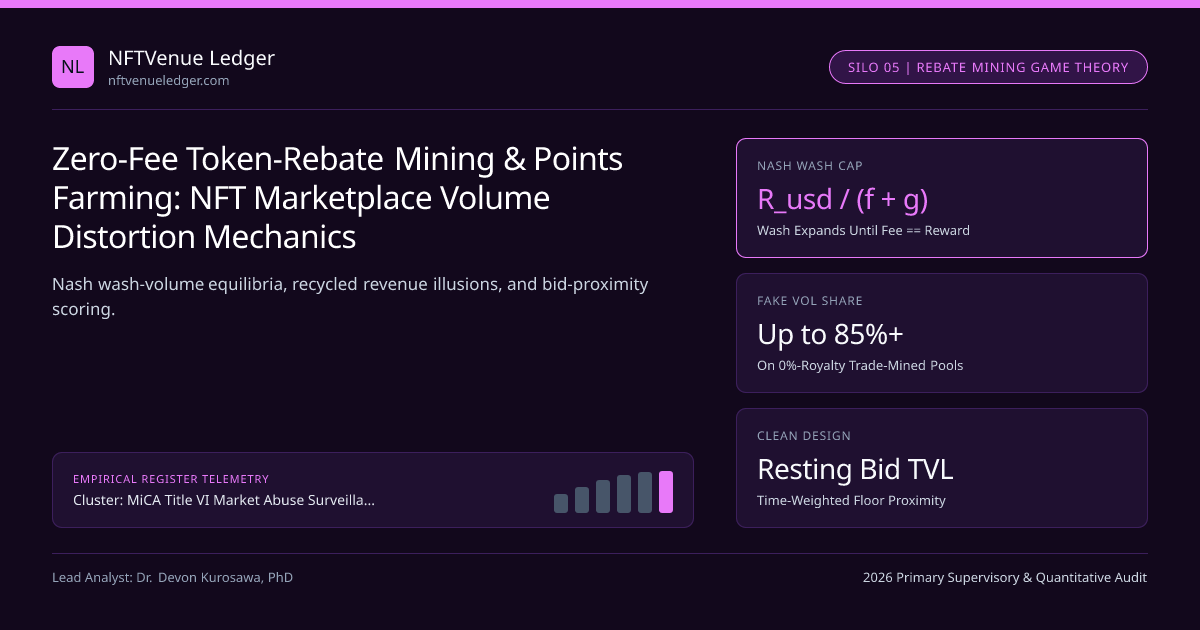
V_washrelentlessly until *total fees paid across the epoch equal the risk-discounted USD value of the daily token emission (`f (Vorganic + Vwash) + Gas = R_USD`)! AtR_USD = $2.5Mandf = 2%, Nash equilibrium synthetic volume hits$105,000,000/day(84%wash share!)*—and the instant token price drops-80%,84%of "marketplace volume" vanishes overnight!
Why "Points Farming on Resting Bids" Created a New Manipulation Vector (Collection Dumping Cascades)!#
Generation-2 NFT venues (Blur-style Bid Pool Points) smartly stopped rewarding raw self-trade volume on zero-royalty collections and instead rewarded Resting Collection-Wide Bids near the Floor Price:
- Why Bid-Depth Scoring Beat Volume Mining: If you place
100 ETHof executable collection bids0.5%below Azuki's floor, any real holder on Earth can dump their NFTs into your bid immediately! You cannot farm bid points risk-free without providing genuine instant-exit liquidity! - The Second-Order Pathology ("Points-Farmer Inventory Whiplash"): Sophisticated farmers parked
50,000+ ETHin top-of-book bids hoping not to get filled (spoofing the bid queue and cancelling when real sellers approached), OR when a whale unexpectedly dumped80 NFTsinto a farmer's bid wall, the leveraged farmer immediately listed all 80 NFTs 1 wei below floor to recycle ETH back into the bid pool—triggering violent flash-crash liquidation cascades explored in NFTfi/BendDAO floor-oracle liquidations!
Marketplace Token-Incentive Mechanism Audit Matrix#
| Incentive Mechanism | Wash-Trade Vulnerability | Real Liquidity Benefit | Adverse Second-Order Distortion | MiCA Title VI Compliance Posture |
|---|---|---|---|---|
Gross-Volume Trade Mining (0% Royalty) | Extreme (85%+ Wash) | Zero (Fake prints at 10x floor!) | Inflates FDV & misleads retail buyers | Prohibited (Encourages Art. 91 wash signals) |
Fee-Capped Rebate (Rebate <= 90% Fee) | Moderate (15%–30%) | Subsidizes genuine active takers | Bots break even via governance speculation | Requires strict STP + Tarjan SCC clawbacks |
| Time-Weighted Bid-Proximity Points | Low (Real fill risk!) | Massive (Tightens NFT/CLOB spreads) | Leveraged bid-wall dump cascades | Compliant if spoof-cancellation rules enforced |
Maker-Rebate Tiering (Regulated CLOB) | Near-Zero (With KYC STP) | Deep institutional top-of-book quotes | HFT queue-jumping competition | Standard Institutional Market-Maker Model |
Exact Game-Theoretic Nash Wash Volume & Clean Revenue Valuation Formula#
Fundamental DeFi/Web3 analysts valuing marketplace governance tokens (Price-to-Fees) MUST strip Recycled Emission Wash Fees from protocol revenue, or else pay 20x multiples for circular self-subsidies:
- Given daily token reward value Rusd, organic volume Vorg, venue fee rate f, royalty r = 0, and wash gas cost g per $1:
- Equilibrium Total Volume: Vtotal* = Rusd / (f + g)
- Equilibrium Wash Volume: Vwash* = max( 0, (Rusd / (f + g)) - V_org )
- Worked Audit Example (Rusd = $2,000,000/day, Vorg = $15,000,000, f = 0.02 [2%], g = 0.0005 [5 bps]):
- Vtotal* = $2,000,000 / 0.0205 = $97,560,976/day => Vwash* = $82,560,976/day (84.6% Wash Volume!)
- Notice "Protocol Fee Revenue" appears to be 0.02 * $97.56M = $1.95M/day,
- YET True Net Organic Economic Revenue = (f * Vorg) - Rusd * (Vorg / Vtotal*) = +$300k - $307k = -$7k/day!
- 2) Manipulation-Resistant Maker Bid-Depth Score (Time-Weighted Exponential Distance Decay):
- BidScore(order i) = Integral{topen}^{tclose} SizeETH(i) * exp( -lambda * (CleanFloor(t) - BidPrice(i)) / CleanFloor(t) ) dt
- I( Resting_Duration >= 60s ) * I( !SelfFilledInSCC )
Operationalizing Automated Surveillance Under EU MiCA Article 92 Next#
Under European and UAE law, designing or ignoring rebatewash loops is no longer merely a tokenomics debate—it triggers mandatory regulatory reporting! Examine the exact surveillance architecture required for venues and brokers next in MiCA Article 92 PPAET automated STOR surveillance systems inside our MiCA Title VI Market Abuse hub.
Frequently asked questions
Why did wash bots exclusively pick 0%-royalty NFT collections for trade mining?
Creator royalties (e.g., 5% ERC-2981) leak permanently out of the wash trader two-wallet loop to a third-party creator wallet on every trade, raising round-trip cost from 2% to 7% and making trade mining unprofitable.
How did wash traders trade a single NFT for $250,000 when the collection floor was $300?
To minimize fixed Ethereum gas costs per dollar of volume, a wash trader wrapped 150 WETH inside Wallet B and placed a private/targeted bid on a specific junk tokenId held by Wallet A—generating $500k of round-trip volume in just 2 transactions!
Why are resting bid-pool points much harder to wash-farm than trading volume points?
Volume mining lets two colluding wallets match privately in 1 millisecond with zero market risk; resting collection-wide bids sit live on the public orderbook where any external NFT holder can dump real inventory into your ETH!
What metric replaces raw trading volume when comparing NFT marketplaces or DEXs?
Institutional researchers measure Wash-Filtered Organic Volume (excluding SCC and common-funder clusters), Unique Transacting Entities, and Executable +/-2% Orderbook/AMM Liquidity Depth.
Publication record
- Published
- November 13, 2026
- Updated
- November 14, 2026
- Author
- Dr. Devon Kurosawa, PhD
- Review
- Review not recorded
- Automated fact check
- Passed in the stored pipeline record
- Source URLs
- 3 recorded
AI assistance recorded: anthropic/claude-opus-4.6. This field does not establish human review or source verification.
Academic & Institutional Attribution
Cite This Research & Embed Live Data Card
Standard academic & institutional research paper citation format.
Dr. Devon Kurosawa, PhD. (2026, November 14). Zero-Fee Token-Rebate Mining & Points Farming: NFT Marketplace Volume Distortion Mechanics. NFTVenue Ledger. https://nftvenueledger.com/protocols/zero-fee-token-rebate-mining-nft-marketplace-volume-distortionRegulatory Directory Cross-Reference
Referenced Institutions & Regulatory Registries
Top Regulated Institutions in This Coverage Slice
Related Onchain Wash Trading Market Abuse & Institutional Briefings
Explore Onchain Wash Trading Market Abuse Hub (20) →Onchain Wash Trading Market Abuse
MiCA Title VI Market Abuse Surveillance, Wash-Trade Graph Forensics & STOR Guide (2026)Onchain Wash Trading Market Abuse
MiCA Article 92 PPAET Compliance: Automated Market-Abuse Surveillance & RTS 2025/885 ArchitectureOnchain Wash Trading Market Abuse
MiCA Articles 87–90 Inside Information: Token Unlocks, Exploit Disclosures & Insider ListsOnchain Wash Trading Market Abuse
Pre-Listing Insider Wallet Forensics: Fresh-EOA Clustering Around CEX Listing AnnouncementsOnchain Wash Trading Market Abuse
Hybrid DEX & Appchain CLOB Surveillance: Layering, Spoofing & Order-to-Trade Ratios (OTR)Onchain Wash Trading Market Abuse
NFT Floor-Price Oracle Manipulation: Peer-to-Pool Lending Drains & Liquidation CascadesOnchain Wash Trading Market Abuse
Industrial Airdrop Sybil Detection: Louvain/Leiden Modularity, Gas Trees & Action Sequence CosineOnchain Wash Trading Market Abuse
Bonding-Curve Launches, Block-0 Sniper Bundles & Coordinated Rug-Pull On-Chain TelemetryMarket Insights
Morning Minute: Tokenized Stock Venues Are Launching Without Big Tech’s ApprovalMarket Insights
DTCC to Bring Tokenized Stocks and Treasuries to Solana in 2027Regulatory and Market Glossary
SoFi Brings Its Bank-Issued Stablecoin to Polygon’s Payments StackMarket Insights
Trump Media Posts $410 Million Profit. Bitcoin Gains Did the Heavy Lifting
NFTVenue Ledger Data, Benchmarks & Contributor Records
CC BY 4.0 Open Data
Open Institutional Datasets (CSV / JSON) →
Download desk-compiled quantitative series & schemas.
2026 Reference Matrix
2026 Institutional Benchmarks & Thresholds →
Statutory capital, clearing, margin & rate conventions.
Editorial Records
Authors & Review Records →
View named contributors where those records are available.
Complete Index
Master Research & Dossier Archive →
Browse all published briefings by topic pillar & date.