Cross Chain Bridge Validator Exploits
Circle CCTP Burn-and-Mint Architecture vs Lock-and-Mint Wrapped Bridge Contagion
By burning canonical USDC on the source chain and minting native USDC on the destination chain, Circle CCTP eliminates wrapped-token lockbox honeypots and liquidity fragmentation.
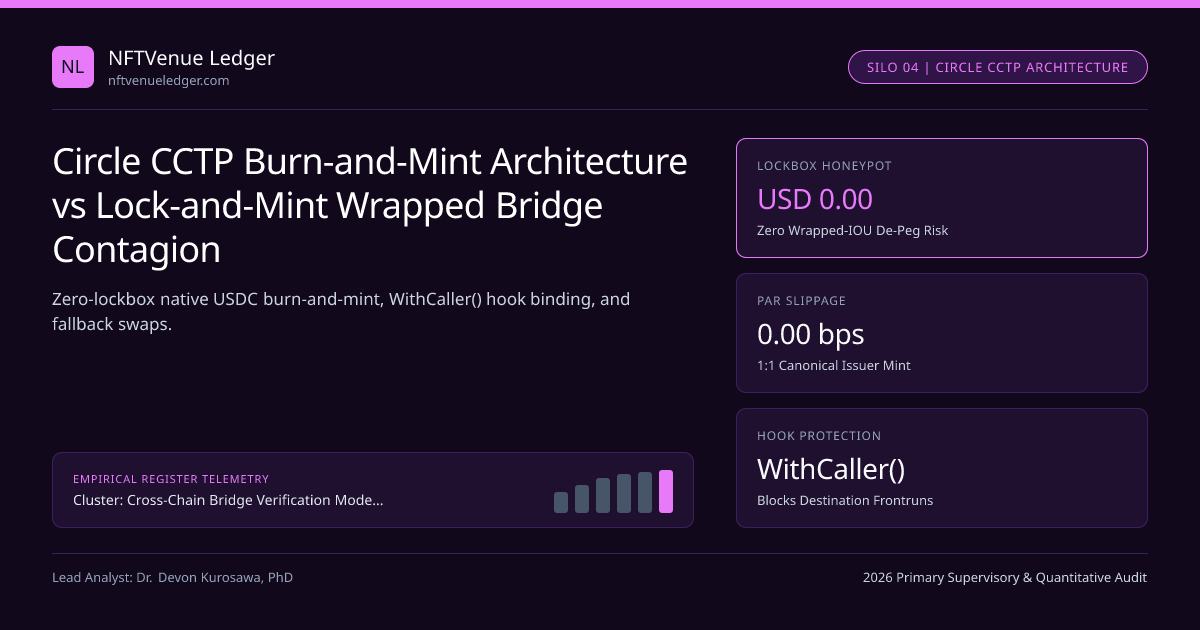
Before the Circle Cross-Chain Transfer Protocol (CCTP) standard, moving USDC from Ethereum to Arbitrum, Solana, Avalanche, or Cosmos spawned dozens of incompatible synthetic wrapped IOUs (USDC.e, madUSDC, anyUSDC, ceUSDC, whUSDC):
- Liquidity fragmented across
Nseparate DEX pools per chain. - Worse, none of those wrapped tokens were redeemable at Circle! Each wrapped ticker was backed solely by a third-party bridge's Ethereum lockbox—so when Nomad (
madUSDC), Harmony (1USDC), or Multichain (anyUSDC) was hacked, innocent LPs and lending markets on destination chains saw their "USDC" collapse to$0.02–$0.12overnight!
Anchored in our cross-chain bridge, oracle & exploit RCA master guide, Circle CCTP (and CCTP v2 Fast Transfer) replaces third-party lockboxes with Issuer-Authorized Atomic Supply Teleportation, powering institutional settlement across DEXs in our marketplaces directory (from 9mm Pro and Astroport to Beethoven X) under ESMA MiCA EMT and NYSDFS reserve rules.
Inside TokenMessenger & MessageTransmitter: Zero Lockbox TVL!#
Trace how CCTP transfers $50,000,000 of institutional USDC from Ethereum (domain = 0) to Solana (domain = 5) or Base (domain = 6) with zero AMM slippage and zero bridge TVL honeypot:
- Source-Chain Cryptographic Burn (
depositForBurn/depositForBurnWithCaller): The caller approvesTokenMessenger, which invokesFiatTokenV2.burn(amount)—permanently destroying50,000,000native USDC on Ethereum—and passes a formatted cross-domain byte payload toMessageTransmitter.sendMessage, emittingMessageSent(bytes message)with a monotonicuint64 nonce. - Circle Iris Attestation Service: Circle's off-chain attestation cluster waits for source-chain block finality (
or provides overcollateralized sub-second Fast Transfer attestations in CCTP v2!) and signskeccak256(message)using anM-of-NCircle attester quorum. - Destination-Chain Native Mint (
receiveMessage): Any relayer or solver callsMessageTransmitter.receiveMessage(message, attestation)on Base/Solana:MessageTransmittermarksusedNonces[sourceDomain_nonce] = 1, verifiesMsorted Circle attester ECDSA signatures, and instructsTokenMinterto mint50,000,000100%-fungible nativeUSDCdirectly tomintRecipient!
Security Pitfalls When Integrating CCTP Into Cross-Chain DEX Routers!#
While CCTP itself eliminates wrapped-token backing risk, *custom cross-chain swap routers built on top* of CCTP frequently introduce critical integration bugs** caught in Solidity audits:
- Bug 1 — Calling
depositForBurnWithoutdestinationCallerWhen Attaching Hooks!:
In basic depositForBurn(amount, destDomain, mintRecipient, burnToken), destinationCaller is bytes32(0)—meaning ANYONE on the destination chain can call receiveMessage(message, attestation) first! That is harmless if mintRecipient is a plain EOA, but fatal if your router calls receiveMessage(...) and assumes in the next line that your HookReceiver hasn't been frontrun or manipulated! Always use depositForBurnWithCaller(..., bytes32 destinationCaller) so MessageTransmitter reverts unless msg.sender == address(uint160(uint256(destinationCaller)))!
- Bug 2 — Non-EVM 32-Byte Address Encoding Errors (
Solana ATA vs Pubkey):
On Solana (domain 5), mintRecipient must be the 32-byte Associated Token Account (ATA) address for USDC, NOT the user's system wallet pubkey! Passing a raw wallet pubkey bricks automatic delivery until manual account creation!
- Bug 3 — Unhandled Destination Swap Slippage Reverts:
Once depositForBurn commits on Chain A, the source USDC is already burned! If your destination hook executes receiveMessage + uniswap.swap(minOut) atomically and minOut reverts due to price movement, the user's USDC remains un-minted until a fallback claim path delivers raw USDC to the user!
Cross-Chain Stablecoin Settlement Models Compared#
| Stablecoin Bridging Mechanism | Destination Asset Received | Slippage on $25M Transfer | Smart-Contract Honeypot Risk | Regulatory Classification (MiCA) |
|---|---|---|---|---|
| Lock-and-Mint Wrapped Bridge | Synthetic IOU (USDC.e) | 0 bps mint, de-peg risk | Extreme (Single L1 lockbox) | Unregulated synthetic derivative |
Cross-Chain Liquidity AMM (Stargate) | Canonical USDC (from LP pool) | 8 – 65 bps on large size | Pool TVL bounded | Liquidity pool swap |
Intent Solver (Across / Mayan) + CCTP | Canonical USDC (3s fronted) | 0.5 – 3 bps solver fee | Zero user lockup; CCTP rebalances solver! | Best-execution intent fill |
| Direct Circle CCTP v1 / v2 | Canonical Native USDC | 0.00 bps (CCTP v1) / minimal v2 | Zero Lockbox ($0 TVL) | Regulated EMT (ESMA Title IV) |
Fault-Tolerant CCTP + DEX Hook Settlement Invariant#
Note an awesome recovery feature built into Circle's TokenMessenger: if a user passes the wrong mintRecipient and the message has NOT yet been minted on the destination chain, the original sender (with a fresh Circle attestation) can call replaceDepositForBurn on the source chain to update newMintRecipient and newDestinationCaller! Meanwhile, destination swap hooks enforce a Non-Reverting Fallback Delivery Pattern:
- Step 1 (Source Chain i):
- nonce = TokenMessenger.depositForBurnWithCaller(amountIn, destDomain, bytes32(uint256(uint160(DestHookRouter))), USDC, bytes32(uint256(uint160(DestHookRouter))))
- // CRITICAL: Never confuse EVM chainId (Arbitrum = 42161) with CCTP Domain ID (Arbitrum = 3)!
- Step 2 (Destination Chain j inside DestHookRouter):
- MessageTransmitter.receiveMessage(cctpMsg, irisAttestation) // Mints exact amountIn native USDC to DestHookRouter
- try DexPool.swapExactIn(USDC, targetToken, amountIn, minOut, userRecipient) {
- emit CrossChainSwapSucceeded(nonce, userRecipient);
- } catch {
- IERC20(USDC).safeTransfer(userRecipient, amountIn); // GUARANTEES ZERO STUCK FUNDS ON SLIPPAGE!
- emit CrossChainSwapFallbackUSDC(nonce, userRecipient, amountIn);
- }
Transitioning From Bridge Settlement to On-Chain Price Oracles#
Once native USDC and bridged collateral land safely on a destination chain, how do lending markets and perpetual DEXs price collateral without getting drained by multi-block MEV or flash swaps? Turn to oracle security next in Uniswap v3 geometric-mean TWAP manipulation cost and Pyth pull-oracle confidence intervals inside our Cross-Chain Bridge & Oracle Security hub.
Frequently asked questions
Why did wrapped bridge USDC (like madUSDC and 1USDC) lose its $1 peg while native USDC stayed at $1.00?
Wrapped bridge tokens are unregulated IOUs backed solely by USDC locked in that bridge contract; when Nomad and Harmony lockboxes were drained, Circle had zero obligation or backing for the unbacked bridge IOUs.
How do intent bridges like Across and Mayan work together with Circle CCTP?
CCTP v1 waits ~13 minutes for Ethereum finality; an intent solver pays the user canonical USDC in 3 seconds on the destination chain for a tiny fee, then uses zero-slippage CCTP in the background to rebalance solver inventory.
What happens if a destination DEX swap reverts after USDC was already burned via CCTP?
Because the source USDC burn is irreversible once finalized, poorly written atomic routers leave funds un-minted until manual rescue; audited routers catch swap reverts and deliver canonical USDC directly to the user wallet.
Can a wrong recipient address in CCTP depositForBurn be corrected?
Yes, provided receiveMessage has not yet been executed on the destination chain! The original sender can invoke TokenMessenger.replaceDepositForBurn with an attestation of the original burn message to update mintRecipient.
Publication record
- Published
- November 13, 2026
- Updated
- November 14, 2026
- Author
- Dr. Devon Kurosawa, PhD
- Review
- Review not recorded
- Automated fact check
- Passed in the stored pipeline record
- Source URLs
- 3 recorded
AI assistance recorded: anthropic/claude-opus-4.6. This field does not establish human review or source verification.
Academic & Institutional Attribution
Cite This Research & Embed Live Data Card
Standard academic & institutional research paper citation format.
Dr. Devon Kurosawa, PhD. (2026, November 14). Circle CCTP Burn-and-Mint Architecture vs Lock-and-Mint Wrapped Bridge Contagion. NFTVenue Ledger. https://nftvenueledger.com/protocols/circle-cctp-burn-and-mint-attestation-vs-lock-mint-tvlRegulatory Directory Cross-Reference
Referenced Institutions & Regulatory Registries
Top Regulated Institutions in This Coverage Slice
Related Cross Chain Bridge Validator Exploits & Institutional Briefings
Explore Cross Chain Bridge Validator Exploits Hub (20) →Cross Chain Bridge Validator Exploits
Cross-Chain Bridge Verification, Oracle Manipulation & DeFi Exploit Root-Cause Guide (2026)Cross Chain Bridge Validator Exploits
Uniswap v3 Geometric-Mean TWAP Oracles: Tick-Accumulator Math & PoS Multi-Block Manipulation CostCross Chain Bridge Validator Exploits
Pull-Based Low-Latency Oracles (Pyth & Chainlink Data Streams): Confidence Intervals & Staleness GuardsCross Chain Bridge Validator Exploits
Read-Only Reentrancy Exploits: Curve get_virtual_price & Balancer getRate View SkewsCross Chain Bridge Validator Exploits
Checks-Effects-Interactions (CEI), Cross-Contract Locks & Cancun EIP-1153 Transient GuardsCross Chain Bridge Validator Exploits
Flash-Loan Governance Attacks: Quorum Hijacking, ERC20Votes Checkpoints & Timelock DefensesCross Chain Bridge Validator Exploits
ERC-4626 Tokenized Vault Security: First-Depositor Share Inflation & Virtual-Offset MathCross Chain Bridge Validator Exploits
Merkle Tree Second-Preimage Attacks, abi.encodePacked Collisions & Bridge Proof ForgeryOnchain Wash Trading Market Abuse
Pre-Listing Insider Wallet Forensics: Fresh-EOA Clustering Around CEX Listing AnnouncementsOnchain Wash Trading Market Abuse
Hybrid DEX & Appchain CLOB Surveillance: Layering, Spoofing & Order-to-Trade Ratios (OTR)Onchain Wash Trading Market Abuse
NFT Floor-Price Oracle Manipulation: Peer-to-Pool Lending Drains & Liquidation CascadesOnchain Wash Trading Market Abuse
Industrial Airdrop Sybil Detection: Louvain/Leiden Modularity, Gas Trees & Action Sequence Cosine
NFTVenue Ledger Data, Benchmarks & Contributor Records
CC BY 4.0 Open Data
Open Institutional Datasets (CSV / JSON) →
Download desk-compiled quantitative series & schemas.
2026 Reference Matrix
2026 Institutional Benchmarks & Thresholds →
Statutory capital, clearing, margin & rate conventions.
Editorial Records
Authors & Review Records →
View named contributors where those records are available.
Complete Index
Master Research & Dossier Archive →
Browse all published briefings by topic pillar & date.