Erc721 Erc1155 Eip712 Permit Security
EIP-712 Domain Separator Engineering: Dynamic chainId Caching & Cross-Fork Replay Defense
Hardcoding DOMAIN_SEPARATOR as immutable in constructor without checking runtime block.chainid exposes DEX intents and NFT listings to catastrophic cross-fork signature replay.
Before the EIP-712 typed signature standard, Ethereum applications signed raw keccak256(abi.encodePacked(...)) byte strings: not only were users blind to parameter meanings on hardware wallets, but an off-chain order signed for Contract A on Testnet or Chain X could be replayed verbatim against Contract B or a hard-forked sister chain! EIP-712 eliminates cross-context collisions by prefixing every digest with \x19\x01 || domainSeparator || hashStruct(message), binding the ECDSA signature irreversibly to five domain fields: name, version, chainId, verifyingContract, and optional salt.
Anchored in our EIP-712, Permit2 & proxy security master guide, subtle implementation mistakes in DOMAIN_SEPARATOR caching, dynamic array encoding, and proxy name upgrades remain top high-severity findings in Seaport and CoW Protocol integration audits.
The Immutable Constructor Trap During Hard Forks & L2 Clones#
To save ~2,100 gas of keccak256 hashing on every swap, early EIP-2612 and DEX contracts computed INITIAL_DOMAIN_SEPARATOR = keccak256(...) once inside constructor and stored it in an immutable bytes32 variable—never checking block.chainid again!
What happened during the September 2022 Ethereum PoW fork (chainId = 10001 splitting from Mainnet chainId = 1)? Every contract that returned INITIAL_DOMAIN_SEPARATOR unconditionally accepted Mainnet chainId = 1 signatures on ETHPoW—allowing replay bots to sweep NFTs and tokens across forked marketplaces! OpenZeppelin EIP712.sol and Uniswap Permit2 enforce the canonical Cached-With-Dynamic-Fallback Pattern:
- Cache
_CACHED_CHAIN_ID = block.chainid,_CACHED_THIS = address(this), and_CACHED_DOMAIN_SEPARATORasimmutablevalues at deployment. - On every call to
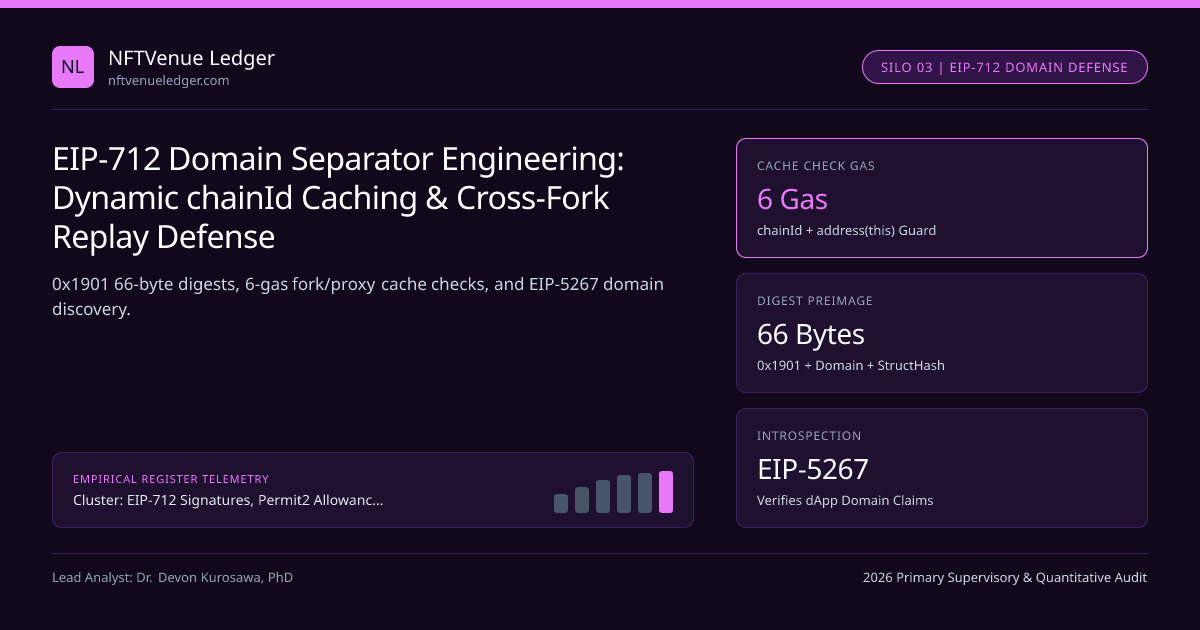
_domainSeparatorV4, compareblock.chainid == _CACHED_CHAIN_ID && address(this) == _CACHED_THIS(only6 gas!). Note whyaddress(this) == _CACHED_THISis equally critical: if Contract A is invoked viaDELEGATECALLfrom a proxy at Address P,_CACHED_THISequals the logic contract address rather than proxyP, so omitting theaddress(this)check breaks proxy EIP-712 verification!
Three Classic Solidity hashStruct Bugs That Break Signatures#
Auditing off-chain order books across venues in our marketplaces directory (from Azuki and Art Blocks X Bright Moments collectibles to hybrid DEXs like Alcor) repeatedly uncovers three fatal EIP-712 encoding deviations where Solidity on-chain verification disagrees with MetaMask/viem signTypedData:
- Bug 1 — Using
abi.encodePackedInstead ofabi.encode: EIP-712 pads every atomic field (uint8,bool,address) to full 32-byte words insideencodeData; usingabi.encodePackedtruncates widths and causes 100% signature verification failure (or worse, hash-collision shifts between adjacent dynamic fields!). - Bug 2 — Unhashed
string/bytes/uint256Fields: In EIP-712, dynamicbytesandstringvalues must be hashed individually viakeccak256(bytes(str))beforeabi.encode, and an arrayTmust encode askeccak256(abi.encodePacked(enc(arr[0]), ..., enc(arr[n-1])))! - Bug 3 — Omitting Referenced Nested Structs or Alphabetical Sorting in
TYPEHASH: WhenOrdercontains nested structTokenPermissionsandOfferItem, the root type string must append referenced sub-structs sorted strictly alphabetically by struct name (Order(...)OfferItem(...)TokenPermissions(...))!
EIP-712 Domain Field Omission Risk Matrix#
| Omitted Domain Field | Resulting Replay / Collision Attack Vector | Real-World Exploit Impact |
|---|---|---|
chainId Omitted (or Stale Cache) | Cross-chain replay across L1, Arbitrum, Base, Polygon & forks | Attacker replays L2 testnet/cheap order to drain Mainnet vault! |
verifyingContract Omitted | Cross-contract replay across v1 -> v2 protocol deployments | Cancelled v1 listing replayed on v2 router using identical struct |
address(this) == _CACHED_THIS Omitted | Proxy DELEGATECALL domain mismatch | Implementation address baked into separator breaks proxy wallets |
| Nonce / Salt / Deadline Omitted | Intra-contract infinite signature replay | Winning filler or buyer drains wallet repeatedly on every deposit |
Exact 66-Byte Inline Assembly Digest & Fork-Safe Solidity Pattern#
Production contracts compute the final 66-byte EIP-712 digest in scratch memory 0x00..0x41 without allocating a Solidity memory array, cutting memory-expansion gas:
- Domain_TypeHash = keccak256("EIP712Domain(string name,string version,uint256 chainId,address verifyingContract)")
- DomainSep(t) = keccak256(abi.encode(DomainTypeHash, keccak256(bytes(name)), keccak256(bytes(version)), block.chainid, address(this)))
- StructHash(m) = keccak256(abi.encode(MESSAGETYPEHASH, encodeField1(m.f1), ..., encodeFieldk(m.fk)))
- TypedDigest = keccak256( concat( 0x1901, DomainSep(t), Struct_Hash(m) ) ) [Exact 66-byte preimage: 2 + 32 + 32 bytes]
- Worked Cross-Chain Replay Audit (User deploys Safe/Vault at identical CREATE2 address 0x88..AA on Ethereum [1] & Base [8453]):
- Ethereum Digest: Domain_Sep(chainId = 1, addr = 0x88..AA) = 0x4f91...c208
- Base Digest: Domain_Sep(chainId = 8453, addr = 0x88..AA) = 0x9b3e...71d4 (100% Orthogonal Digest -> Replay Reverts!)
- WARNING: If protocol omitted chainId so user could "sign once for omnichain", 1 signature sweeps BOTH chains -> Use explicit Merkle chain-list instead!
EIP-5267 eip712Domain Introspection & Witness Extensions#
To eliminate off-chain wallet guesswork over whether a token uses version = "1" or version = "2", EIP-5267 adds a standardized read-only eip712Domain getter returning a bitmask fields byte plus active domain strings—see how Permit2 extends EIP-712 with dynamic runtime witness typehashes next in Uniswap Permit2 AllowanceTransfer & Witness audits and ERC-1271 Safe cross-chain replay inside our EIP-712, Permit2 & Proxy Security hub.
Frequently asked questions
Why must cached EIP-712 domain separators check address(this) in addition to block.chainid?
During deployment, immutable _CACHED_THIS captures the implementation bytecode address; when a proxy calls that implementation via DELEGATECALL, address(this) is the proxy address, requiring dynamic recomputation.
Why does EIP-712 prefix every digest with the two bytes 0x1901?
Defined by EIP-191, leading byte 0x19 guarantees the signed payload can never start with a valid RLP-encoded Ethereum transaction byte (preventing tx-replay confusion), while 0x01 designates EIP-712 structured data.
What is the most common bug when hashing nested structs or arrays in EIP-712?
Developers frequently forget to sort referenced sub-struct definitions alphabetically inside the root TYPEHASH string, or pass raw uint256 arrays without hashing abi.encodePacked(array) via keccak256 first.
How does EIP-5267 improve hardware wallet and simulation UX for EIP-712?
EIP-5267 exposes eip712Domain directly on-chain, letting wallets verify that the domain parameters supplied in a dApp eth_signTypedData_v4 RPC request actually match the target contract on-chain.
Publication record
- Published
- November 13, 2026
- Updated
- November 14, 2026
- Author
- Dr. Devon Kurosawa, PhD
- Review
- Review not recorded
- Automated fact check
- Passed in the stored pipeline record
- Source URLs
- 3 recorded
AI assistance recorded: anthropic/claude-opus-4.6. This field does not establish human review or source verification.
Academic & Institutional Attribution
Cite This Research & Embed Live Data Card
Standard academic & institutional research paper citation format.
Dr. Devon Kurosawa, PhD. (2026, November 14). EIP-712 Domain Separator Engineering: Dynamic chainId Caching & Cross-Fork Replay Defense. NFTVenue Ledger. https://nftvenueledger.com/protocols/eip-712-domain-separator-chainid-cross-fork-replay-defenseRegulatory Directory Cross-Reference
Referenced Institutions & Regulatory Registries
Top Regulated Institutions in This Coverage Slice
Primary Tier-1 Supervisory Registries
Related Erc721 Erc1155 Eip712 Permit Security & Institutional Briefings
Explore Erc721 Erc1155 Eip712 Permit Security Hub (20) →Erc721 Erc1155 Eip712 Permit Security
EIP-712 Typed Signatures, Permit2 Allowances, NFT Royalties & Proxy Timelocks: 2026 Security GuideErc721 Erc1155 Eip712 Permit Security
Uniswap Permit2 Security Audit: AllowanceTransfer vs SignatureTransfer & Witness PhishingErc721 Erc1155 Eip712 Permit Security
EIP-2612 ERC-20 Permit Audits: ecrecover Zero-Address, s-Malleability & Griefing FrontrunsErc721 Erc1155 Eip712 Permit Security
ERC-721 & ERC-1155 setApprovalForAll Security: Operator Blast Radius & Conduit IsolationErc721 Erc1155 Eip712 Permit Security
Seaport v1.6 Protocol Architecture: Conduits, Hook Zones & Bulk Order Merkle TreesErc721 Erc1155 Eip712 Permit Security
ERC-2981 NFT Royalty Signaling vs ERC-721C Programmable Transfer-Validator EnforcementErc721 Erc1155 Eip712 Permit Security
ERC-1967 Transparent vs EIP-1822 UUPS Proxies: Storage Slots & Uninitialized Logic ExploitsErc721 Erc1155 Eip712 Permit Security
EIP-2535 Diamond Multi-Facet Proxies: Selector Routing, DiamondStorage & Arbitrary DelegatecallCross Chain Bridge Validator Exploits
Optimistic Message Bridges: 1-of-N Watcher Assumptions, Dispute Windows & Nomad Zero-Root RCACross Chain Bridge Validator Exploits
ZK-SNARK Light-Client Bridges: Ethereum Sync Committee Proofs, Circuit Bugs & Multi-Prover DefenseCross Chain Bridge Validator Exploits
Circle CCTP Burn-and-Mint Architecture vs Lock-and-Mint Wrapped Bridge ContagionCross Chain Bridge Validator Exploits
Uniswap v3 Geometric-Mean TWAP Oracles: Tick-Accumulator Math & PoS Multi-Block Manipulation Cost
NFTVenue Ledger Data, Benchmarks & Contributor Records
CC BY 4.0 Open Data
Open Institutional Datasets (CSV / JSON) →
Download desk-compiled quantitative series & schemas.
2026 Reference Matrix
2026 Institutional Benchmarks & Thresholds →
Statutory capital, clearing, margin & rate conventions.
Editorial Records
Authors & Review Records →
View named contributors where those records are available.
Complete Index
Master Research & Dossier Archive →
Browse all published briefings by topic pillar & date.