Cross Chain Bridge Validator Exploits
Uniswap v3 Geometric-Mean TWAP Oracles: Tick-Accumulator Math & PoS Multi-Block Manipulation Cost
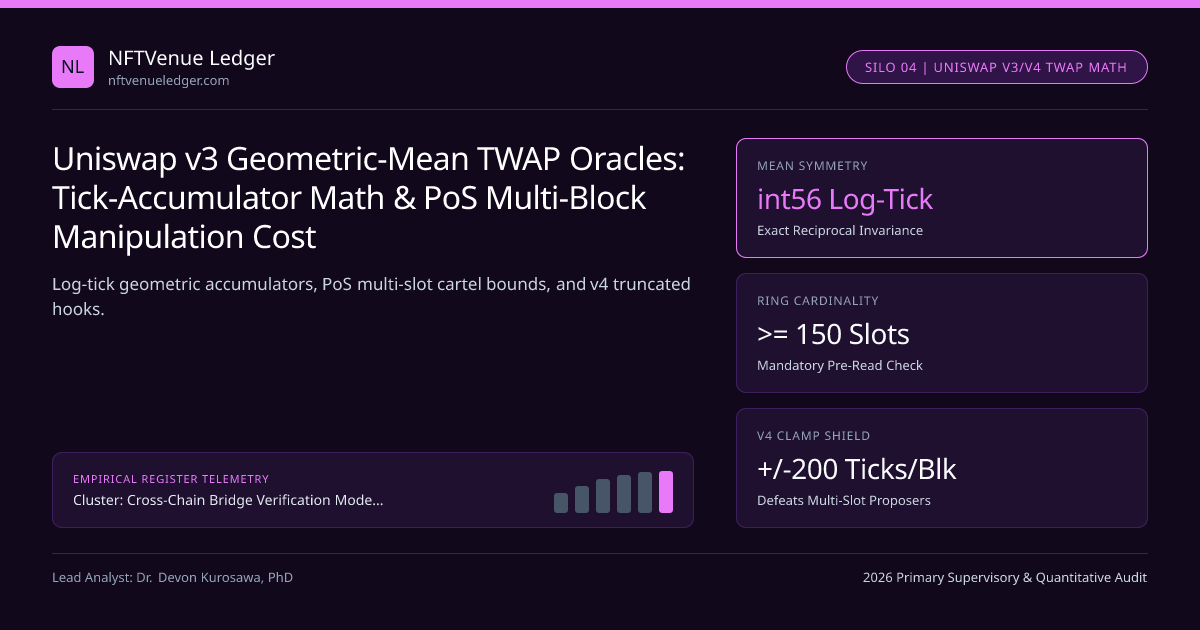
Uniswap v3 replaced v2 arithmetic price accumulators with log-1.0001 tick accumulators—making single-block flash manipulation impossible while bounding multi-block PoS attack costs.
Reading a DEX pool's current slot0.sqrtPriceX96 (or getReserves) to value lending collateral is suicide: a zero-capital flash loan moves spot price 10,000% within 1 transaction! Uniswap v2 introduced Time-Weighted Average Price (TWAP) accumulators—updating priceCumulativeLast only at the *beginning of each block using the previous* block's closing reserve, making intra-block flash loans contribute 0 seconds of weight. Yet Uniswap v2 accumulated arithmetic prices** (where P(A/B) and P(B/A) yield inconsistent reciprocals and 1 extreme outlier block skews the mean wildly!).
Anchored in our cross-chain bridge, oracle & exploit RCA master guide, the Concentrated Liquidity AMM specification (Uniswap v3 & custom v4 Oracle Hooks) switched to Geometric-Mean int56 tickCumulative Accumulators—powering manipulation-resistant on-chain reference feeds across ecosystems in our marketplaces directory (like 9mm Pro, Astroport, and Beethoven X) provided engineers enforce three subtle PoS and cardinality invariants!
Why Geometric-Mean Log-Tick TWAP Crush Arithmetic TWAP Manipulation!#
Compare pushing a 30-minute (150-block) TWAP upward by +100% (2.0x) by manipulating 1 single block under Arithmetic vs Geometric TWAP:
- Under Arithmetic Mean (
Uniswap v2): To double a 150-block arithmetic average in just 1 block, the attacker pushes spot price in Block #1 to151 * P_0(since (151*P_0 + 149*P_0) / 150 = 2.0 * P_0!)—requiring onlysqrt(151) approx 12.3xreserve capital for 1 single block! - Under Geometric Mean (
Uniswap v3 int56 tickCumulative): The pool accumulatessum(tick_i * dt_i), whereP_i = 1.0001^{tick_i}. Becausetickis logarithmic (clamped hard at MAX_TICK = 887,272), to raise a 150-block geometric mean by+100%(+6,932 ticks) in 1 single block, the attacker would have to push Block #1 by150 * 6,932 = +1,039,800 ticks—which exceedsMAX_TICK = 887,272and is mathematically IMPOSSIBLE on thin pools regardless of infinite capital!
The Post-Merge Proof-of-Stake Multi-Block Proposer Vector!#
After Ethereum's Merge to Proof-of-Stake (where validator proposers for all 32 slots in an epoch are known up to ~6.4 minutes in advance), Stanford and Uniswap researchers identified a critical shift under the MEV-Boost PBS framework:
- What if a validator pool controls 2 or 3 consecutive block proposals (
Slots s and s+1)?
- At the very last transaction of Slot
s, the attacker buys up the pool to an extreme tick—no external arbitrageur can backrun inside Slotsbecause the attacker IS the proposer of Slots! - Slot
scloses at the manipulated tick, banking12 full secondsintotickCumulative! - At the very first transaction of Slot
s+1(also proposed by the attacker!), the attacker sells back into their own liquidity, recovering nearly *100%of their capital (`paying only 2 poolFee!`) with zero arbitrage loss to external searchers**!
How Uniswap v4 Truncated Oracles & Lending Protocols Defeat Multi-Slot PoS Attacks:
- Truncated Geometric Oracle (
Uniswap v4 Hook): Clamps the maximum tick change recorded by the accumulator in any single block to+/- Delta_tick_max(e.g., +/- 200 ticks = ~2% per 12s slot)—meaning even a 3-slot proposer cartel can move a 30-minute TWAP by at most0.08%!
On-Chain AMM TWAP Design Evolution Matrix#
| Oracle Design | Reciprocal Consistency | 1-Block Flash Loan Safe? | 2-Slot PoS Proposer Safe? | Gas Cost of Read |
|---|---|---|---|---|
Spot slot0.sqrtPriceX96 | Yes | NO ($0 Flash Attack!) | NO | ~2,600 gas |
| Uniswap v2 Arithmetic TWAP | No (E[P] != 1/E[1/P]) | Yes | NO (1 outlier skews mean!) | ~5,200 gas |
| Uniswap v3 Geometric 30m TWAP | Yes (100% Symmetric) | Yes | Vulnerable ONLY on illiquid out-of-range ticks! | ~14k – 32k gas |
| v4 Truncated Geometric TWAP | Yes | Yes | YES! (+/-200 tick/slot clamp!) | ~8,500 gas |
Exact Uniswap v3 observe Tick Math & Solidity Negative-Division Trap!#
Every Solidity auditor checks OracleLibrary.consult for a classic integer-division bug: when tickCumulativesDelta < 0 and tickCumulativesDelta % secondsAgo != 0, Solidity integer division truncates toward zero instead of -infinity, biasing negative ticks upward by +1 unless explicitly decremented!
- tickCumulativesDelta = tickCumulative(t1) - tickCumulative(t0) = sum{k} (tickk * dt_k)
- arithmeticMeanTick = floor( tickCumulativesDelta / int56(uint56(W)) )
- // Solidity Adjustment: if (tickCumulativesDelta < 0 && (tickCumulativesDelta % int56(uint56(W)) != 0)) arithmeticMeanTick--;
- P_TWAP(W) = 1.0001 ^ (arithmeticMeanTick) [Computed lossless via TickMath.getSqrtRatioAtTick(arithmeticMeanTick)]
- 2) Truncated Geometric TWAP Per-Slot Manipulation Bound (Uniswap v4 Hook, Clamp = c ticks/slot):
- Even if a validator cartel proposes K consecutive blocks and pushes spot to infinity:
- MaxTWAPTickShift(K, Nwindow) <= ( c * K * (K + 1) / 2 ) / Nwindow [if starting from 0] or (c * K) / Nwindow
- Worked Example (30m window => N = 150 slots, clamp c = 200 ticks/slot, 3-slot cartel K = 3):
- Max shift <= (200 + 400 + 600) / 150 = 8 ticks = 0.08% price shift! (100% immune to PoS multi-block attacks!)
Pairing Slow TWAPs With Sub-Second Pull Oracles Next#
While a 30-minute TWAP resists manipulation, a 30-minute lag is fatal during a genuine -25% market crash (allowing traders to borrow against stale high TWAP prices or frontrun perpetual funding!). Discover how perpetual DEXs achieve sub-400ms latency safely next in Pyth pull-oracle confidence intervals and L2 sequencer downtime Chainlink grace periods inside our Cross-Chain Bridge & Oracle Security hub.
Frequently asked questions
Why is a Uniswap v3 geometric-mean TWAP much harder to manipulate than a Uniswap v2 arithmetic TWAP?
In an arithmetic mean, pushing price to 151x for 1 block doubles a 150-block average; in a geometric mean (averaging log ticks clamped at 887,272), 1 outlier block has logarithmically bounded weight, forcing attackers to sustain manipulation across many blocks against arbitrageurs.
How does the multi-block Proof-of-Stake proposer TWAP attack work?
If a staking pool is scheduled to propose two consecutive slots (N and N+1), it can manipulate the pool in the final tx of Slot N and unwind in the first tx of Slot N+1—recording a 12-second manipulated tick without losing capital to external arbitrageurs.
Why do Uniswap v3 TWAP reads revert with "OLD" on newly created pools?
To save deployment gas, Uniswap v3 initializes observation ring-buffer cardinality to 1 slot; calling observe([1800, 0]) reverts with "OLD" until someone pays one-time SSTORE gas via increaseObservationCardinalityNext and 30 minutes elapse.
Why is a 30-minute TWAP unsafe as the primary oracle for high-leverage perpetual DEXs?
Because a 30-minute TWAP lags real-time CEX moves by ~15 minutes on average, toxic takers would open leveraged longs on the lagging TWAP milliseconds after BTC spikes +3% on Binance.
Publication record
- Published
- November 13, 2026
- Updated
- November 14, 2026
- Author
- Dr. Devon Kurosawa, PhD
- Review
- Review not recorded
- Automated fact check
- Passed in the stored pipeline record
- Source URLs
- 3 recorded
AI assistance recorded: anthropic/claude-opus-4.6. This field does not establish human review or source verification.
Academic & Institutional Attribution
Cite This Research & Embed Live Data Card
Standard academic & institutional research paper citation format.
Dr. Devon Kurosawa, PhD. (2026, November 14). Uniswap v3 Geometric-Mean TWAP Oracles: Tick-Accumulator Math & PoS Multi-Block Manipulation Cost. NFTVenue Ledger. https://nftvenueledger.com/protocols/uniswap-v3-geometric-mean-twap-oracle-manipulation-costRegulatory Directory Cross-Reference
Referenced Institutions & Regulatory Registries
Top Regulated Institutions in This Coverage Slice
Primary Tier-1 Supervisory Registries
Related Cross Chain Bridge Validator Exploits & Institutional Briefings
Explore Cross Chain Bridge Validator Exploits Hub (20) →Cross Chain Bridge Validator Exploits
Cross-Chain Bridge Verification, Oracle Manipulation & DeFi Exploit Root-Cause Guide (2026)Cross Chain Bridge Validator Exploits
Pull-Based Low-Latency Oracles (Pyth & Chainlink Data Streams): Confidence Intervals & Staleness GuardsCross Chain Bridge Validator Exploits
Read-Only Reentrancy Exploits: Curve get_virtual_price & Balancer getRate View SkewsCross Chain Bridge Validator Exploits
Checks-Effects-Interactions (CEI), Cross-Contract Locks & Cancun EIP-1153 Transient GuardsCross Chain Bridge Validator Exploits
Flash-Loan Governance Attacks: Quorum Hijacking, ERC20Votes Checkpoints & Timelock DefensesCross Chain Bridge Validator Exploits
ERC-4626 Tokenized Vault Security: First-Depositor Share Inflation & Virtual-Offset MathCross Chain Bridge Validator Exploits
Merkle Tree Second-Preimage Attacks, abi.encodePacked Collisions & Bridge Proof ForgeryCross Chain Bridge Validator Exploits
ERC-7265 Smart-Contract Circuit Breakers: Rolling Outflow Rate Limiters & Delayed SettlementOnchain Wash Trading Market Abuse
Hybrid DEX & Appchain CLOB Surveillance: Layering, Spoofing & Order-to-Trade Ratios (OTR)Onchain Wash Trading Market Abuse
NFT Floor-Price Oracle Manipulation: Peer-to-Pool Lending Drains & Liquidation CascadesOnchain Wash Trading Market Abuse
Industrial Airdrop Sybil Detection: Louvain/Leiden Modularity, Gas Trees & Action Sequence CosineOnchain Wash Trading Market Abuse
Bonding-Curve Launches, Block-0 Sniper Bundles & Coordinated Rug-Pull On-Chain Telemetry
NFTVenue Ledger Data, Benchmarks & Contributor Records
CC BY 4.0 Open Data
Open Institutional Datasets (CSV / JSON) →
Download desk-compiled quantitative series & schemas.
2026 Reference Matrix
2026 Institutional Benchmarks & Thresholds →
Statutory capital, clearing, margin & rate conventions.
Editorial Records
Authors & Review Records →
View named contributors where those records are available.
Complete Index
Master Research & Dossier Archive →
Browse all published briefings by topic pillar & date.