
Cross Chain Bridge Validator Exploits
Pull-Based Low-Latency Oracles (Pyth & Chainlink Data Streams): Confidence Intervals & Staleness Guards
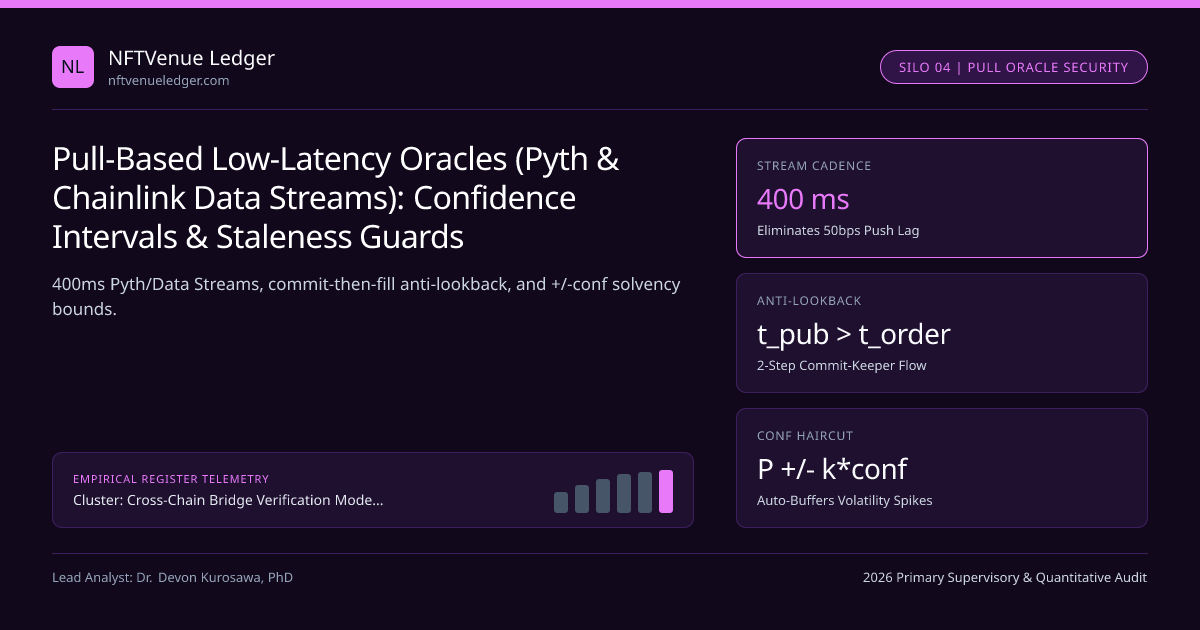
Perpetual DEXs and options vaults achieve 400ms pricing via pull-based oracles—requiring strict on-chain staleness windows, confidence-interval spread widening, and timestamp monotonicity.
Traditional Push Oracles (classic Chainlink AggregatorV3) broadcast on-chain storage updates only on a 0.5%–1.0% price deviation threshold or a 3,600-second heartbeat. While ideal for conservative 75% LTV spot lending, a 0.5% (50 bps) blind spot is fatal for 50x perpetual futures pools like the GMX multi-asset liquidity pool and high-frequency venues across our marketplaces directory (from 9mm Pro to Solana/Cosmos orderbooks like Astroport): if ETH moves +0.48% on Binance while the on-chain push oracle hasn't ticked yet, latency bots open 50x longs for a risk-free +24% ROE at passive LPs' expense!
Anchored in our cross-chain bridge, oracle & exploit RCA master guide, Pull-Based Low-Latency Oracles (Pyth Network Pythnet/Wormhole VAAs & Chainlink Data Streams) invert the dataflow: 90+ institutional market makers and exchanges stream 400ms signed quotes off-chain, and the user/keeper pulls the cryptographic price update into calldata inside the exact transaction that needs it!
Three Fatal Solidity Bugs When Calling IPyth.getPriceUnsafe!#
Dozens of DeFi forks lost millions by integrating Pyth (or Chainlink Data Streams) carelessly! Audit every pull-oracle adapter against three non-negotiable checks:
- NEVER Call
getPriceUnsafe(id)in Production!:getPriceUnsafeskips staleness validation altogether—if no keeper updated an exotic altcoin for 4 hours,getPriceUnsafecheerfully returns a 4-hour-old price! Always callpyth.getPriceNoOlderThan(priceId, maxAgeSeconds)(e.g., maxAge = 15s for perps, 60s for lending)! - NEVER Ignore
price.conf(The +/- Uncertainty Confidence Band!): During a flash crash, exchange disconnect, or L1 halt, CEX market makers widen spreads (e.g., ETH mid = $3,000, conf = +/-$90 = 3.0%!). If your protocol uses rawprice.price = $3,000whileconf = $90, attackers liquidate healthy borrowers or trade inside true market uncertainty! - Retroactive Timestamp Selection ("Oracle Lookback Cherry-Picking"): Suppose your perp DEX accepts any signed Pyth payload with
age <= 30 seconds. A trader watches Binance over the last 30 seconds: ETH dipped to$2,98522 secondsago and now trades at$3,010! If the trader submits a market-buy bundling the 22-second-old$2,985signed VAA (which still passes age <= 30s!), they buy$25below live spot! Mandatory Fix (Two-Step Commit-Execution): User commits order at blockt_commit(recording t_order = block.timestamp), and Keeper settles using a signed oracle report whosepublishTimestrictly satisfiest_order < publishTime <= t_order + maxExecWindow!
Conservative Confidence-Band Pricing: Valuing Collateral vs Debt!#
How do institutional risk engines (Solend/Save, Drift, Kamino, GMX v2 Data Streams) fold Pyth's (price P, uint64 conf C) directly into solvency and execution math so uncertainty always protects the protocol rather than the attacker?
- Valuing Collateral Asset
A(Borrowing Power): Value at the *Lower Confidence Bound `P_A - k C_A** (typically k = 1.0 to 1.96 for 95% CI`)! - Valuing Borrowed Debt Asset
D: Value at the *Upper Confidence Bound `P_D + k C_D`**! - Perpetual Taker Fills: Long entry fills at
P + C; Short entry fills atP - C(automatically widening synthetic spread when CEX books thin out!).
Push Oracles vs Pull Oracles vs Geometric TWAP Comparison#
| Oracle Paradigm | Update Latency | Who Pays On-Chain Gas? | Best Target Protocol | Critical Integration Trap |
|---|---|---|---|---|
Push Oracle (Chainlink AggregatorV3) | 50–100 bps or 1h | Oracle Operator (Subsidized) | Passive Spot Lending (Aave/Morpho) | Reading latestAnswer without updatedAt & L2 Uptime check |
Pull Oracle (Pyth / Data Streams) | 100 – 400 ms | Caller Tx (~45k gas + 1 wei fee) | Perp DEXs (GMX v2), Options, RFQs | Timestamp cherry-picking if single-tx without t_pub > t_commit! |
| Geometric TWAP | 15 – 30 min lag | Zero keeper (Swappers update) | Manipulation sanity circuit breaker | Lags real crashes; thin out-of-range tick cliffs |
| Dual Pull + Push / TWAP Anchor | 400 ms + Anchor | Caller + Passive Read | Institutional Gold Standard | Reverts cleanly into Reduce-Only if feeds diverge > 3%! |
Conservative Confidence-Adjusted Health Factor & Dynamic Exponent Scaling Formula#
Notice one more classic Solidity bug with Pyth: PythStructs.Price returns (int64 price, uint64 conf, int32 expo, uint publishTime) where expo is dynamic (usually -8 for USD pairs, but -5 or -10 on meme/FX pairs!)—hardcoding 1e8 instead of scaling dynamically by price.expo causes 100x–1,000x valuation errors!
- require(p.price > 0 && p.publishTime >= block.timestamp - MAX_STALENESS, "StaleOrNonPositivePyth!");
- scaleFactor = 10 ^ uint256(int256(18) + int256(p.expo)) [when -18 <= p.expo <= 0]
- P_wad = uint256(uint64(p.price)) * scaleFactor
- C_wad = uint256(p.conf) * scaleFactor
- require((Cwad * 10000) / Pwad <= MAXCONF_BPS, "OracleUncertaintyTooWide!");
- 2) Conservative Confidence-Penalized Lending Borrow Limit (k = 1.5 sigma):
- SafeCollateralUSD = Qtycoll * (Pcollwad - k * Ccoll_wad) / 1e18
- SafeDebtUSD = Qtydebt * (Pdebtwad + k * Cdebt_wad) / 1e18
- BorrowAllowed <=> SafeDebtUSD <= LTVmax * SafeCollateralUSD
- Worked Flash-Volatility Protection (ETH = $3,000, normal conf = $0.90 [3 bps]; CPI news spike conf = $45 [150 bps]):
- During CPI spike: Effective ETH collateral valuation drops to $3,000 - 1.5*($45) = $2,932.50 (-2.25% automatic safety buffer)!
Auditing Internal LP Token Price Adapters Next#
Even when external ETH and USDC feeds come from rock-solid Pyth or Chainlink oracles, how do protocols price yield-bearing Curve or Balancer LP tokens (wstETH/ETH, rETH/WETH)? Multiplying external ETH price by pool.getRate triggers Read-Only Reentrancy—dissected next in read-only reentrancy Balancer/Curve LP virtual-price skew inside our Cross-Chain Bridge & Oracle Security hub.
Frequently asked questions
How does oracle lookback cherry-picking exploit naive single-tx Pyth integrations?
If a perp DEX allows users to open positions in 1 transaction with any Pyth price up to 30 seconds old, bots monitor CEX prices and submit trades bundling a 25-second-old signed price whenever spot has already moved higher.
Why must DeFi protocols check Pyth price.conf in addition to price.price?
price.conf measures real-time publisher disagreement and bid-ask spread uncertainty; during exchange outages or flash crashes, conf spikes sharply—trading at raw mid-price without widening by conf bleeds LP vaults.
Should liquidations use the exact same P - k*conf conservative bound as new borrows?
Careful! Using aggressive k*conf haircuts inside liquidation triggers can liquidate solvent users purely from a 2-second news spread widening; best practice applies strict P - k*conf to NEW borrows while pausing/dampening liquidations if conf/price exceeds threshold.
Why did hardcoding 1e8 decimals break custom Pyth oracle adapters?
While major crypto pairs use expo = -8, Pyth feeds carry a per-feed signed int32 expo field (-5, -8, -10, etc.); adapters must read price.expo dynamically on every call.
Publication record
- Published
- November 13, 2026
- Updated
- November 14, 2026
- Author
- Dr. Devon Kurosawa, PhD
- Review
- Review not recorded
- Automated fact check
- Passed in the stored pipeline record
- Source URLs
- 3 recorded
AI assistance recorded: anthropic/claude-opus-4.6. This field does not establish human review or source verification.
Academic & Institutional Attribution
Cite This Research & Embed Live Data Card
Standard academic & institutional research paper citation format.
Dr. Devon Kurosawa, PhD. (2026, November 14). Pull-Based Low-Latency Oracles (Pyth & Chainlink Data Streams): Confidence Intervals & Staleness Guards. NFTVenue Ledger. https://nftvenueledger.com/protocols/pull-based-low-latency-oracles-pyth-confidence-intervalsRelated Cross Chain Bridge Validator Exploits & Institutional Briefings
Explore Cross Chain Bridge Validator Exploits Hub (20) →Cross Chain Bridge Validator Exploits
Cross-Chain Bridge Verification, Oracle Manipulation & DeFi Exploit Root-Cause Guide (2026)Cross Chain Bridge Validator Exploits
Read-Only Reentrancy Exploits: Curve get_virtual_price & Balancer getRate View SkewsCross Chain Bridge Validator Exploits
Checks-Effects-Interactions (CEI), Cross-Contract Locks & Cancun EIP-1153 Transient GuardsCross Chain Bridge Validator Exploits
Flash-Loan Governance Attacks: Quorum Hijacking, ERC20Votes Checkpoints & Timelock DefensesCross Chain Bridge Validator Exploits
ERC-4626 Tokenized Vault Security: First-Depositor Share Inflation & Virtual-Offset MathCross Chain Bridge Validator Exploits
Merkle Tree Second-Preimage Attacks, abi.encodePacked Collisions & Bridge Proof ForgeryCross Chain Bridge Validator Exploits
ERC-7265 Smart-Contract Circuit Breakers: Rolling Outflow Rate Limiters & Delayed SettlementCross Chain Bridge Validator Exploits
L2 Sequencer Downtime Oracles: Chainlink Uptime Feeds, Grace Periods & L1 Force-InclusionOnchain Wash Trading Market Abuse
NFT Floor-Price Oracle Manipulation: Peer-to-Pool Lending Drains & Liquidation CascadesOnchain Wash Trading Market Abuse
Industrial Airdrop Sybil Detection: Louvain/Leiden Modularity, Gas Trees & Action Sequence CosineOnchain Wash Trading Market Abuse
Bonding-Curve Launches, Block-0 Sniper Bundles & Coordinated Rug-Pull On-Chain TelemetryOnchain Wash Trading Market Abuse
Benford's Law, Power-Law Tails & Trade-Size Forensics on Crypto Exchanges
NFTVenue Ledger Data, Benchmarks & Contributor Records
CC BY 4.0 Open Data
Open Institutional Datasets (CSV / JSON) →
Download desk-compiled quantitative series & schemas.
2026 Reference Matrix
2026 Institutional Benchmarks & Thresholds →
Statutory capital, clearing, margin & rate conventions.
Editorial Records
Authors & Review Records →
View named contributors where those records are available.
Complete Index
Master Research & Dossier Archive →
Browse all published briefings by topic pillar & date.